|
|
|
CSE 566 Virtual Reality
Department of Computer Science
Stony Brook University
Course Syllabus,
Overview and Guidelines
Spring 2026, Mondays and
Wednesdays 3:30-4:50pm, NCS 115
Ari AT cs DOT stonybrook DOT edu
Matthew Castellana
matcastellan AT cs DOT stonybrook DOT edu
Yoonsang Kim
yoonsakim AT cs DOT stonybrook DOT edu
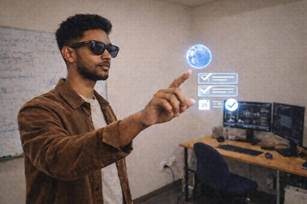
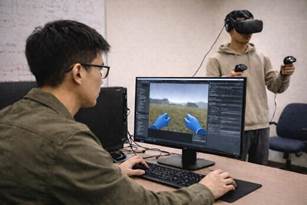
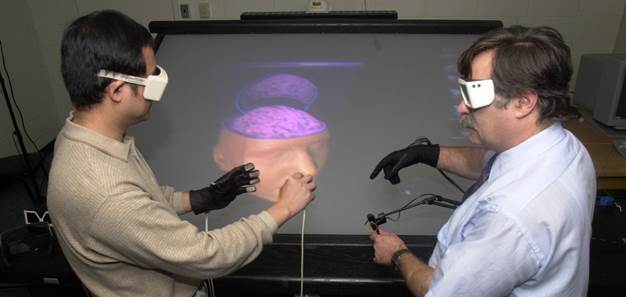
VR Course Overview
Virtual Reality (VR) is a fast moving technology and has the
potential to revolutionize our lives. VR stimulates the user’s senses, thereby
believing in an artificial version of reality.
The course will cover VR
fundamentals and technologies and related topics, including an introduction to
VR, VR systems, geometry and transformations in VR, viewing and projections,
light, optics and human vision physiology, temporal human vision and perception,
motion, vection and tracking, 3D user interfaces
(selection, manipulation, and navigation), augmented reality (AR), non-visual human
senses, and the future of the medium.
Class Time and Location
Mondays and Wednesdays from 3:30-4:50pm at
the New Computer Science Building, Room 115.
Prerequisites
● Basic Computer
Graphics and/or Visualization and/or Computer Vision is helpful, but not
required
● Coding experience
● Linear algebra
● OR: permission of course
instructor
Syllabus and Assignments Schedule
See Syllabus and Assignments Schedule.
All lecture slides will be available
for viewing by the course students on Google Drive.
Professor
Professor Arie Kaufman (Email: Ari AT cs DOT stonybrook DOT edu) is a Distinguished Professor of Computer
Science, Director of the Center for Visual Computing (CVC), a Chief Scientist of the Center of Excellence in Wireless and
Information Technology (CEWIT), and a former chair of the department
(1999-2017). He is conducting research
in virtual reality, visualization, medical imaging and related areas. His
office hours are by appointment on Zoom (send an email to schedule an
appointment).
Co-Instructors
Matthew
Castellana (matcastellan AT cs DOT stonybrook DOT edu) is a Computer Science PhD candidate in the Center for Visual
Computing. His current research interests include virtual and augmented
reality, novel VR/AR peripherals, interfaces and techniques, remote
collaboration, graphics, and related areas. He received his B.S. in Computer
Science and B.E. in Computer Systems and Engineering from Rensselaer
Polytechnic Institute in 2019. He will hold office hours on Zoom by email
appointment or through the Slack channel.
Yoonsang Kim (yoonsakim AT
cs DOT stonybrook DOT edu) is a Computer Science PhD candidate in the
Center for Visual Computing. His current research interests include augmented
reality, virtual reality, visualization, graphics, and related areas. He
received his B.S. in Computer Science at Soongsil
University in 2017 and M.S. in Computer Science from Stony Brook in 2020. He
will hold office hours on Zoom by email appointment or through the Slack
channel.
Slack Discussion Group
The course has a Slack channel on the cssbu.slack.com workspace. This channel may be used to
have discussions about the course content. The course volunteer TAs will be
active on that channel to answer your queries.
Those who have already signed into the CS SBU Slack Workspaces
have been automatically added to the course channel called
"cse566-virtualreality". If you have not yet signed up on the CS SBU
Slack workspace, please do so soon and send Matthew Castellana or Yoonsang Kim an email to add you to the course channel. If
you do not know how to sign up with the CS SBU workspace, email Matthew or Yoonsang using your CS email address to send you an invite.
Grades
The final grade in the course will be based vastly upon
assignments:
● 4 individual assignments and a
warm-up assignment:
o
Assignment 0 (Unity 3D warm-up) will constitute 1% of the
final grade,
o
Assignment 1 (Basic VR) will constitute 14% of the final
grade,
o
Assignment 2 (3D user interfaces) will constitute 20% of
the final grade,
o
Assignment 3 (Advanced VR) will constitute 20% of the
final grade,
o
Assignment 4 (Augmented reality) will constitute 20% of
the final grade,
● A midterm exam, which will constitute 25%
of the final grade.
●
Students
are expected to attend every class. Extra credit of 5% will be given to
students attending the last 5 classes of the semester.
● There will be no final exam in
this course.
Textbooks
Steven M. LaValle. Virtual Reality. Cambridge University
Press, 2017. Available for free downloading at http://lavalle.pl/vr/ [required
readings].
J. LaViola Jr., E. Kruijff, R. McMahan,
D. Bowman, and I. Poupyrev. 3D User Interfaces: Theory and Practice,
2nd Edition. Addison-Wesley, Boston, 2017, ISBN-13 978-0-13-403432-4 [recommended
for some lectures].
D. Schmalstieg and T. Höllerer. Augmented
Reality: Principles and Practice. Addison-Wesley, Boston, 2016, ISBN-13
978-0-32-188357-5 [recommended for some lectures].
Additional reading materials will be announced online and in
class, as necessary.
Hardware
Each student is required to have the following hardware to
implement the four assignments 0, 1, 2, 3, 4:
- For assignments 0, 1, 2, 3, 4,
you will require
- A programmable smart phone or tablet with cameras
(e.g., Android version 8.0 or higher or iOS version 12.0 or higher, supporting Bluetooth 3.0 or above)
- A
basic headset that will hold your smartphone (or tablet), such as Google Cardboard or do-it-yourself Google Cardboard. Additionally, in the table below, we
have listed links to VR headsets with phone inserts that are more sturdy
than a Google Cardboard.
- For assignments 2 and 3, “3D user interfaces” you will need a VR gamepad controller (suggested devices
purchasable from Amazon provided below)
Items 1(b) and 2 can be purchased
for a total less than $50. Below is a table of hardware we have tested
out and suggest for purchase. However, it is strongly suggested that you
carefully check the compatibility information (i.e., application platform and
Bluetooth version AND SUPPORTED PHONE SIZE) of the devices before
you pay for them.
|
VR Controller List Spring 2025 |
|||||||||
|
Brand |
Device |
Price pretax |
Compatibility* |
Link |
|||||
|
Only controller |
Headset + controller |
|
iOS |
Android |
|
||||
|
VR Empire |
Y |
|
$14.99 |
Partially yes |
Yes |
||||
|
Samsung Gear VR |
Y |
|
$14.95 |
- |
Full support for Samsung devices – partial for
other Android devices |
||||
|
Google Daydream VR |
|
Y |
$25.11 |
|
Daydream-compatible phones |
||||
|
ShanWan Controller |
Y |
|
$22.55 |
Yes |
Yes |
||||
|
Topmaxions |
|
Headset only |
$9.99 |
Yes |
Yes |
https://www.amazon.com/Cardboard-Topmaxions-Virtual-Reality-Compatible/dp/B01C2PA0KK |
|||
|
Most newer compatible game console controllers (e.g., PS4/5, Xbox, Switch) can also be paired with iOS/Android and used to control. |
|||||||||
|
|
|
|
|
|
|
|
|||
|
Compatibility |
Here being "compatible" doesn't
guarantee your smartphone can work with it well. Please check the supported
devices in their webpage descriptions to double-check the compatibility with
your smartphone. |
||||||||
Following
are some leading devices if you wish to buy a VR HMD**:
●
Meta Quest 3: https://www.meta.com/quest/products/quest-3/
●
Valve Index: https://store.steampowered.com/valveindex
●
HTC VIVE series: https://www.vive.com/us/product-comparison/
** Note: these are just suggestions for personal use
and are not required as part of the course. However, they’re a lot more
powerful!
Software
The software environment for all your assignments is Unity. Unity is
a cross-platform open-source game engine developed by Unity
Technologies; as of today it supports more than 19 platforms. Unity can be used to create
both three-dimensional (3D) and two-dimensional (2D) games
and virtual reality (VR) environments as well as simulations or emulations for its many
platforms, including hand-held, head-worn, stationary displays, and desktops.
Basic version of Unity is free and sufficient for all assignments.
In
Assignment 4, Augmented Reality (AR) assignment,
the surrounding real world is overlaid with the computer-generated imagery. To
support AR, Unity’s AR Foundation will be used. It is a framework for AR application development of various mobile environments. It uses computer vision technology to recognize and track
in real-time 3D simple objects and image targets, enabling the registration of the
real world and virtual objects. AR Foundation enables the development of
applications in both iOS and Android and is
easily portable to both platforms.
Assignment 0 (with 1% credit) is a basic
assignment in Unity, a mini tutorial for Unity, just to get you started. Assignment 0 is already available, you can
start working on it now. A Unity tutorial and help session of 2-3 hours is
scheduled for January 2026 during class time,
and another 2-3 hours of tutorial session for AR Foundation and a help session is
scheduled for March 2026 during class time (see syllabus).
Course Rules
The student is responsible for all the material mentioned in class
(either by the instructor or during discussions) and all the assigned readings
announced in class and/or listed online. Therefore, attendance in class is
highly recommended; and if you miss one class, please talk to those who
attended to catch up with the course material. Note that additions or changes
may be announced from time to time in class and/or on the web. All the course
material will be on the course website http://www.cs.stonybrook.edu/~cse566/ or on Google Drive as will be announced from time to
time. Class announcements will be found on Brightspace.
Assignments Submission Policy
All 5 assignments (0-4) should be
submitted electronically through Brightspace, before the deadline on the respective day at 11:59 PM
(Stony Brook Time). It is your responsibility to verify that the upload was
successful and you received a proper grade for your assignment. Late
assignments will not be accepted. No extensions will be given. Late
penalties of 10% per each late day are imposed precisely at each midnight
following the due date. Therefore, please start working on each homework
immediately after it is assigned. In addition, please upload your work as soon
as it is complete and you can then upload a refined version close to the
deadline. Each assignment will have its own specific instructions for
submission.
Student Attendance and Engagement
Students
are expected to attend every class, report for examinations and submit major
graded coursework as scheduled. If a student is unable to attend lecture(s),
report for any exam or complete major graded coursework as scheduled due to
extenuating circumstances, the student must contact the instructor by email as
soon as possible. Students may be requested to provide documentation to
support their absence and/or may be referred to the Student Support Team for
assistance. Students will be provided reasonable accommodations for missed
exams, assignments or projects due to significant illness, tragedy or other
personal emergencies. In the instance of missed lectures or labs, the student
is responsible for reviewing posted slides, seeking notes from a
classmate or identified class note taker, and other instructions given in class
from time to time. Please note, all students must follow Stony
Brook, local, state and Centers for Disease Control and Prevention (CDC)
guidelines to reduce the risk of transmission of COVID.
Student Accessibility Support Center Statement
If you have a physical, psychological, medical, or learning
disability that may impact your course work, please contact the Student
Accessibility Support Center, Stony Brook Union Suite 107, (631) 632-6748, or
at sasc@stonybrook.edu.
They will determine with you what accommodations are necessary and
appropriate. All information and documentation is confidential.
Critical Incident Management
Stony Brook University expects students to respect the rights,
privileges, and property of other people. Faculty are required to report to the
Office of University Community Standards any disruptive behavior that
interrupts their ability to teach, compromises the safety of the learning
environment, or inhibits students' ability to learn. Faculty in the HSC Schools
and the School of Medicine are required to follow their school-specific
procedures. Further information about most academic matters can be found in the
Undergraduate Bulletin, the Undergraduate Class Schedule, and the
Faculty-Employee Handbook.
Academic Integrity and Artificial Intelligence Statement
Each student must pursue her/his academic goals honestly and be personally accountable for all submitted work. Representing another person's work as your own is always wrong. Faculty is required to report any suspected instances of academic dishonesty to the Academic Judiciary. Faculty in the Health Sciences Center (School of Health Technology & Management, Nursing, Social Welfare, Dental Medicine) and School of Medicine are required to follow their school-specific procedures. For more comprehensive information on academic integrity, including categories of academic dishonesty please refer to the academic judiciary website at http://www.stonybrook.edu/commcms/academic_integrity/index.html
For students considering the use of Artificial
intelligence (AI), please refer to the Stony Brook Computer Science
department’s AI policy: https://www.cs.stonybrook.edu/students/Policies/aiusage.
We take this policy very seriously and enforce it as part of this course.
Students representing the work of AI as their own personal work is considered
and treated as academic dishonesty.
Note that plagiarism and cheating is
immoral and dishonest and will not be tolerated. Specifically, for this course
we will follow the Department of Computer
Science Policies and Procedures regarding Graduate Academic Honesty. Collaboration on any assignment
is strictly
prohibited and the student who will violate any of the
Graduate
Academic Honesty policies and procedures will fail the course and/or be
dismissed from the University. Furthermore, if you use your private or public web resources, such as
your webpages or GitHub to store course material for an
individual assignment during the semester, you must use secure, restricted
or private repositories.