Discrete Mathematics : Sets
Contents
Concepts
What is a set?
A set is a collection of related items
Examples:
- $A = \{ 1, 2, 3, 4, 5 \}$
- $P = \{ 2, 3, 5, 7, 11, 13, 17, \ldots \}$
- $S$ is a set of square numbers
- $B = \{ m \in \mathbb{Z} ~|~ m = 7n + 100 \text{ for some } n \in \mathbb{Z}\}$
Subsets
- Subset. $A \subseteq B \Leftrightarrow \forall x, \text{ if } x \in A \text{ then } x \in B$
- Not subset. $A \nsubseteq B \Leftrightarrow \exists x \text{ such that } x \in A \text{ and } x \not\in B$
- Proper subset. $A \subset B \Leftrightarrow$
- $A \subseteq B$
- $\exists x \text{ such that } x \in B \text{ and } x \not\in A$
Examples:
- Let $A = \{1\}$ and $B = \{1,\{1\}\}$.
- $(a)$ Is $A \subseteq B?$
- $(b)$ Is $A \subset B?$
- Let $A = \{m \in \mathbb{Z} ~|~ m = 6r + 12 \text{ for some } r \in \mathbb{Z} \}$ and $B = \{n \in \mathbb{Z} ~|~ n = 3s \text{ for some } s \in \mathbb{Z} \}$.
- $(a)$ Prove that $A \subseteq B$.
- $(b)$ Disprove that $B \subseteq A$.
Set equality
- Given sets $A$ and $B$, $A$ equals $B$, written $A = B$, if, and only if, every element of $A$ is in $B$ and every element of $B$ is in $A$.
- $A = B \Leftrightarrow A \subseteq B$ and $B \subseteq A$.
Examples:
- $A = \{m \in \mathbb{Z} ~|~ m = 2a \text{ for some integer } a \}$
$B = \{n \in \mathbb{Z} ~|~ n = 2b - 2 \text{ for some integer } b \}$
Is $A = B$?
Venn diagrams
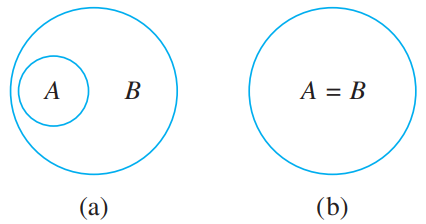
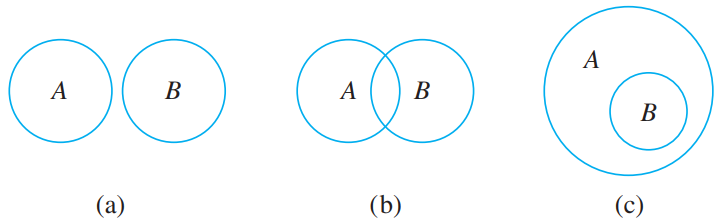
- Relationship between a small number of sets can be represented by pictures called Venn diagrams
- Venn diagram for $A \subseteq B$
- Venn diagram for $A \not\subseteq B$
Examples:
- Write a Venn diagram representing sets of numbers: $\mathbb{N}, \mathbb{W}, \mathbb{Q}, \mathbb{R}$.
Operations on sets
Let $A$ and $B$ be subsets of a universal set $U$.
- The union of $A$ and $B$, denoted $A \cup B$, is the set of all elements that are in at least one of $A$ or $B$.
$A \cup B = \{ x \in U ~|~ x \in A \text{ or } x \in B \}$ - The intersection of $A$ and $B$, denoted $A \cap B$, is the set of all elements that are common to both $A$ and $B$.
$A \cap B = \{ x \in U ~|~ x \in A \text{ and } x \in B \}$ - The difference of $B$ minus $A$ (or relative complement of $A$ in $B$), denoted $B - A$, is the set of all elements that are in $B$ and not $A$.
$B - A = \{ x \in U ~|~ x \in B \text{ and } x \not\in A \}$ - The complement of $A$, denoted $A'$, is the set of all elements in $U$ that are not in $A$.
$A' = \{ x \in U ~|~ x \not\in A \}$

Examples:
- Let the universal set $U = \{a, b, c, d, e, f, g\}$.
Let $A = \{a, c, e, g\}$ and $B = \{d, e, f, g\}$.
Find $A \cup B$, $A \cap B$, $B - A$, and $A'$.
Operations on sets
Given real numbers $a$ and $b$ with $a \le b$:
- $(a, b) = \{ x \in \mathbb{R} ~|~ a < x < b \}$
$[a, b] = \{ x \in \mathbb{R} ~|~ a \le x \le b \}$
$(a, b] = \{ x \in \mathbb{R} ~|~ a < x \le b \}$
$[a, b) = \{ x \in \mathbb{R} ~|~ a \le x < b \}$ - The symbols $\infty$ and $-\infty$ are used to indicate intervals that are unbounded either on the right or on the left:
$(a, \infty) = \{ x \in \mathbb{R} ~|~ x > a \}$
$[a, \infty) = \{ x \in \mathbb{R} ~|~ x \ge a \}$
$(-\infty, b) = \{ x \in \mathbb{R} ~|~ x < b \}$
$(-\infty, b] = \{ x \in \mathbb{R} ~|~ x \le b \}$
Examples:
- $A = (-1, 0] = \{x \in \mathbb{R} ~|~ -1 < x \le 0 \}$
$B = [0, 1) = \{x \in \mathbb{R} ~|~ 0 \le x < 1 \}$.
Find $A \cup B$, $A \cap B$, $B - A$, and $A'$.
Operations on sets
Given sets $A_0, A_1, A_2, \ldots$ that are subsets of a universal set $U$ and given a nonnegative integer $n$,
- $\cup_{i=0}^{n} A_i = \{ x \in U ~|~ x \in A_i \text{ for at least one } i = 0, 1, 2, \ldots, n \}$
- $\cup_{i=0}^{\infty} A_i = \{ x \in U ~|~ x \in A_i \text{ for at least one whole number } i \}$
- $\cap_{i=0}^{n} A_i = \{ x \in U ~|~ x \in A_i \text{ for all } i = 0, 1, 2, \ldots, n \}$
- $\cap_{i=0}^{\infty} A_i = \{ x \in U ~|~ x \in A_i \text{ for all whole numbers } i \}$
Examples:
- For each positive integer $i$, let
$A_i = \{ x \in \mathbb{R} ~|~ -\frac{1}{i} < x < \frac{1}{i} \} = \left( -\frac{1}{i}, \frac{1}{i} \right)$
Find $A_1 \cup A_2 \cup A_3$ and $A_1 \cap A_2 \cap A_3$
Find $\cup_{i=0}^{\infty} A_i$ and $\cap_{i=0}^{\infty} A_i$
Empty set
Empty set, denoted by $\phi$, is a set with no elements.
Examples:
- $\{1, 3\} \cap \{2, 4\} = \phi$
- $\{ x \in \mathbb{R} ~|~ x^2 = -1 \} = \phi$
- $\{ x \in \mathbb{R} ~|~ 3 < x < 2 \} = \phi$
Disjoint sets
- Two sets are called disjoint if, and only if, they have no elements in common.
- $A$ and $B$ are disjoint $\Leftrightarrow A \cap B = \phi$
Examples:
- Let $A = \{ 1, 3, 5 \}$ and $B = \{ 2, 4, 6 \}$. Are $A$ and $B$ disjoint?
Mutually disjoint sets
- Sets $A_1, A_2, A_3, \ldots$ are mutually disjoint (or pairwise disjoint or nonoverlapping) if, and only if, no two sets $A_i$ and $A_j$ with distinct subscripts have any elements in common.
- For all $i, j = 1, 2, 3, \ldots$
$A_i \cap A_j = \phi$ whenever $i \not= j$.
Examples:
Are the following sets mutually disjoint?
- $A_1 = \{ 3, 5 \}$, $A_2 = \{ 1, 4, 6 \}$, and $A_3 = \{ 2 \}$.
- $B_1 = \{ 2, 4, 6 \}$, $B_2 = \{ 3, 7 \}$, and $B_3 = \{ 4, 5 \}$.
Partition of a set
- A finite or infinite collection of nonempty sets $\{A_1, A_2, A_3, \ldots \}$ is a partition of a set $A$ if, and only if,
- $A$ is the union of all the $A_i$
- The sets $A_1, A_2, A_3, \ldots$ are mutually disjoint.
Examples:
- Let $A = \{ 1, 2, 3, 4, 5, 6 \}$, $A_1 = \{ 1, 2 \}$, $A_2 = \{ 3, 4 \}$, and $A_3 = \{ 5, 6 \}$. Is $\{ A_1, A_2, A_3 \}$ a partition of $A$?
- Let $\mathbb{Z}$ be the set of all integers and let
$T_0 = \{n \in \mathbb{Z} ~|~ n = 3k, \text{ for some integer } k\},$
$T_1 = \{n \in \mathbb{Z} ~|~ n = 3k + 1, \text{ for some integer } k\},$
$T_2 = \{n \in \mathbb{Z} ~|~ n = 3k + 2, \text{ for some integer } k\},$
Is $\{T_0, T_1, T_2\}$ a partition of $\mathbb{Z}$?
Power set
- Given a set $A$, the power set of $A$, denoted $P(A)$, is the set of all subsets of $A$.
Examples:
- Find the power set of the set $\{x, y\}$. That is, find $P(\{x, y\})$.
Ordered $n$-tuple
- Ordered $n$-tuple, $(x_1, x_2, \ldots, x_n)$, consists of $x_1, x_2, \ldots, x_n$ together with the ordering.
- Ordered pair = ordered 2-tuple
Ordered triple = ordered 3-tuple - Two ordered $n$-tuples $(x_1, x_2, \ldots, x_n)$ and $(y_1, y_2, \ldots, y_n)$ are equal if, and only if, $x_1 = y_1, x_2 = y_2, \ldots, x_n = y_n$.
$(x_1, x_2, \ldots, x_n) = (y_1, y_2, \ldots, y_n) \Leftrightarrow x_1 = y_1, \ldots, x_n = y_n$.
Examples:
- Is $(1, 2, 3, 4) = (1, 2, 4, 3)$?
- Is $\left( 3, (-2)^2, \frac{1}{2} \right) = \left(\sqrt{9}, 4, \frac{3}{6} \right)$?
- Is $((1, 2), 3) = (1, 2, 3)$?
Cartesian product
- Given sets $A_1, A_2, \ldots, A_n$, the Cartesian product of $A_1, A_2, \ldots, A_n$ denoted $A_1 \times A_2 \times \cdots \times A_n$, is the set of all ordered $n$-tuples $(a_1, a_2, \ldots, a_n)$ where $a_1 \in A_1, a_2 \in A_2, \ldots, a_n \in A_n$.
- $A_1 \times A_2 \times \cdots \times A_n$
$= \{ (a_1, a_2, \ldots, a_n) ~|~ a_1 \in A_1, a_2 \in A_2, \ldots, a_n \in A_n \}.$
Examples:
- Let $A_1 = \{ x, y \}$, $A_2 = \{ 1, 2, 3 \}$, and $A_3 = \{ a, b \}$. Find:
$(a)$ $A_1 \times A_2$,
$(b)$ $(A_1 \times A_2) \times A_3$, and
$(c)$ $A_1 \times A_2 \times A_3$.
Properties of sets
- Inclusion of intersection: For all sets $A$ and $B$,
$A \cap B \subseteq A$ and $A \cap B \subseteq B$. - Inclusion in union: For all sets $A$ and $B$,
$A \subseteq A \cup B$ and $B \subseteq A \cup B$. - Transitive property of subsets: For all sets $A$, $B$, and $C$,
if $A \subseteq B$ and $B \subseteq C$, then $A \subseteq C$.
Procedural versions of set definitions
Let $X$ and $Y$ be subsets of a universal set $U$ and suppose $x$ and $y$ are elements of $U$.
- $x \in X \cup Y \Leftrightarrow x \in X$ or $x \in Y$
- $x \in X \cap Y \Leftrightarrow x \in X$ and $x \in Y$
- $x \in X - Y \Leftrightarrow x \in X$ and $x \not\in Y$
- $x \in X' \Leftrightarrow x \not\in X$
- $(x, y) \in X \times Y \Leftrightarrow x \in X$ and $y \in Y$
Set identities
| Laws | Formula | Formula |
|---|---|---|
| Commutative laws | $A \cup B = B \cup A$ | $A \cap B = B \cap A$ |
| Associative laws | $(A \cup B) \cup C = A \cup (B \cup C)$ | $(A \cap B) \cap C = A \cap (B \cap C)$ |
| Distributive laws | $A \cup (B \cap C) = (A \cup B) \cap (A \cup C)$ | $A \cap (B \cup C) = (A \cap B) \cup (A \cap C)$ |
| Identity laws | $A \cup \phi = A$ | $A \cap U = A$ |
| Complement laws | $A \cup A' = U$ | $A \cap A' = \phi$ |
| Double comp. law | $(A')' = A$ | |
| Idempotent laws | $A \cup A = A$ | $A \cap A = A$ |
| Uni. bound laws | $A \cup U = U$ | $A \cap \phi = \phi$ |
| De Morgan's laws | $(A \cup B)' = A' \cap B'$ | $(A \cap B)' = A' \cup B'$ |
| Absorption laws | $A \cup (A \cap B) = A$ | $A \cap (A \cup B) = A$ |
| Complements | $U' = \phi$ | $\phi' = U$ |
| Set diff. laws | $A - B = A \cap B'$ |
Element Argument
Type 1: Prove that a set is a subset of another
- Let sets $X$ and $Y$ be given. To prove that $X \subseteq Y$,
- suppose that $x$ is a particular but arbitrarily chosen element of $X$.
- show that $x$ is an element of $Y$.
Type 2: Prove that two sets are equal
- Let sets $X$ and $Y$ be given. To prove that $X = Y$,
- Prove that $X \subseteq Y$.
- Prove that $Y \subseteq X$.
Type 3: Prove that a set equals the empty set
- To prove that a set $X$ is equal to the empty set $\phi$, prove that $X$ has no elements.
- To do this, suppose $X$ has an element and derive a contradiction.
$A \cup (B \cap C) = (A \cup B) \cap (A \cup C)$
Prove that for all sets $A$, $B$, and $C$
$A \cup (B \cap C) = (A \cup B) \cap (A \cup C)$
$A \cup (B \cap C) = (A \cup B) \cap (A \cup C)$
Proof
We need to prove:- $A \cup (B \cap C) \subseteq (A \cup B) \cap (A \cup C)$
- $(A \cup B) \cap (A \cup C) \subseteq A \cup (B \cap C)$
Suppose $x \in A \cup (B \cap C)$.
$x \in A$ or $x \in B \cap C$ $(\because \text{defn. of union})$
- Case 1. $[x \in A.]$
$x \in A \cup B$ $(\because \text{defn. of union})$
$x \in A \cup C$ $(\because \text{defn. of union})$
$x \in (A \cup B) \cap (A \cup C)$ $(\because \text{defn. of intersection})$ - Case 2. $[x \in B \cap C.]$
$x \in B$ and $x \in C$ $(\because \text{defn. of intersection})$
$x \in A \cup B$ $(\because \text{defn. of union})$
$x \in A \cup C$ $(\because \text{defn. of union})$
$x \in (A \cup B) \cap (A \cup C)$ $(\because \text{defn. of intersection})$
Suppose $x \in (A \cup B) \cap (A \cup C)$.
$x \in A \cup B$ and $x \in A \cup C$ $(\because \text{defn. of intersection})$
- Case 1. $[x \in A.]$
$x \in A \cup (B \cap C)$ $(\because \text{defn. of union})$ - Case 2. $[x \not\in A.]$
$x \in A$ or $x \in B$ $(\because \text{defn. of union})$
$x \in B$ $(\because x \not\in A)$
$x \in A$ or $x \in C$ $(\because \text{defn. of union})$
$x \in C$ $(\because x \not\in A)$
$x \in B \cap C$ $(\because \text{defn. of intersection})$
$x \in A \cup (B \cap C)$ $(\because \text{defn. of union})$
$(A \cup B)' = A' \cap B'$
Prove that for all sets $A$ and $B$, $(A \cup B)' = A' \cap B'$.
Proof
We need to prove:- $(A \cup B)' \subseteq A' \cap B'$
- $A' \cap B' \subseteq (A \cup B)'$
- Prove that $(A \cup B)' \subseteq A' \cap B'$.
Suppose $x \in (A \cup B)'$.
$x \not\in A \cup B$ $(\because \text{defn. of complement})$
It is false that ($x$ is in $A$ or $x$ is in $B$).
$x$ is not in $A$ and $x$ is not in $B$ $(\because \text{De Morgan's law of logic})$
$x \not\in A$ and $x \not\in B$
$x \in A'$ and $x \in B'$ $(\because \text{defn. of complement})$
$x \in (A' \cap B')$ $(\because \text{defn. of intersection})$
Hence, $(A \cup B)' \subseteq A' \cap B'$ $(\because \text{defn. of subset})$ - Prove that $A' \cap B' \subseteq (A \cup B)'$.
Suppose $x \in A' \cap B'$.
$x \in A'$ and $x \in B'$ $(\because \text{defn. of intersection})$
$x \not\in A$ and $x \not\in B$ $(\because \text{defn. of complement})$
$x$ is not in $A$ and $x$ is not in $B$
It is false that ($x$ is in $A$ or $x$ is in $B$) $(\because \text{De Morgan's law of logic})$
$x \not\in A \cup B$
$x \in (A \cup B)'$ $(\because \text{defn. of complement})$
Hence, $A' \cap B' \subseteq (A \cup B)'$ $(\because \text{defn. of subset})$
$A \cap B = A$ and $A \cup B = B$
For any sets $A$ and $B$, if $A \subseteq B$, then
$(a)$ $A \cap B = A$ and $(b)$ $A \cup B = B$.
$(a)$ $A \cap B = A$ and $(b)$ $A \cup B = B$.
Proof
Part $(a)$: We need to prove:- $A \cap B \subseteq A$
- $A \subseteq A \cap B$
- $A \cup B \subseteq B$
- $B \subseteq A \cup B$
- Proof that $A \cap B \subseteq A$.
$A \cap B \subseteq A$ $(\because \text{inclusion of intersection})$ - Proof that $A \subseteq A \cap B$.
Suppose $x \in A$
$x \in B$ $(\because A \subseteq B)$
$x \in A$ and $x \in B$
$x \in A \cap B$ $(\because \text{defn. of intersection})$
- Proof that $A \cup B \subseteq B$.
Suppose $x \in A \cup B$
$x \in A$ or $x \in B$ $(\because \text{defn. of union})$
If $x \in A$, then $x \in B$ $(\because A \subseteq B)$
$x \in B$ $(\because \text{Modus Ponens and division into cases})$ - Proof that $B \subseteq A \cup B$.
$B \subseteq A \cup B$ $(\because \text{inclusion in union})$
$E \subseteq A$
If $E$ is a set with no elements and $A$ is any set, then $E \subseteq A$.
Proof
Proof by contradiction.- Suppose there exists a set $E$ with no elements and a set $A$ such that $E \not\subseteq A$.
- $\exists x$ such that $x \in E$ and $x \not\in A$ $(\because \text{defn. of a subset})$
- But there can be no such element since $E$ has no elements.
- Contradiction!
- Hence, if $E$ is a set with no elements and $A$ is any set, then $E \subseteq A$.
Only one empty set
There is only one set with no elements.
Proof
- Suppose $E_1$ and $E_2$ are both sets with no elements.
- $E_1 \subseteq E_2$ $(\because \text{previous proposition})$
- $E_2 \subseteq E_1$ $(\because \text{previous proposition})$
- Thus, $E_1 = E_2$
$A \cap \phi = \phi$
Prove that for any set $A$, $A \cap \phi = \phi$
Proof
Proof by contradiction.- Suppose there is an element $x$ such that $x \in A \cap \phi$
- $x \in A$ and $x \in \phi$ $(\because \text{defn. of intersection})$
- $x \in \phi$
- Impossible because $\phi$ cannot have any elements
- Hence, the supposition is incorrect.
- So, $A \cap \phi = \phi$
If $A \subseteq B$ and $B \subseteq C'$, then $A \cap C = \phi$
For all sets $A$, $B$, and $C$, if $A \subseteq B$ and $B \subseteq C'$, then $A \cap C = \phi$.
Proof
Proof by contradiction.- Suppose there is an element $x$ such that $x \in A \cap C$
- $x \in A$ and $x \in C$ $(\because \text{defn. of intersection})$
- $x \in A$
- $x \in B$ $(\because x \in A \text{ and } A \subseteq B)$
- $x \in C'$ $(\because x \in B \text{ and } B \subseteq C')$
- $x \not\in C$ $(\because \text{defn. of complement})$
- $x \in C$ and $x \not\in C$
- Contradiction!
- Hence, the supposition is incorrect.
- So, $A \cap C = \phi$
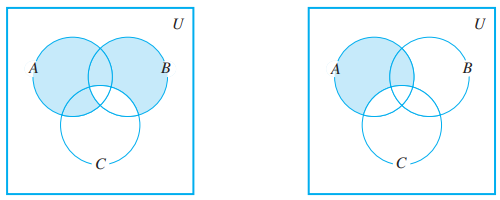
Proof by counterexample: $(A - B) \cup (B - C) = A - C$
For all sets $A$, $B$, and $C$, $(A - B) \cup (B - C) = A - C$.
Disproof
False!$(A - B) \cup (B - C) \not= A - C$
- Draw Venn diagrams
- Counterexample 1: $A = \{ 1 \}$, $B = \phi$, $C = \{ 1 \}$
- Counterexample 2: $A = \phi$, $B = \{ 1 \}$, $C = \phi$
Proof by induction: $|\text{PowerSet}(X)| = 2^n$
For all integers $n \ge 0$, if a set $X$ has $n$ elements, then $\text{PowerSet}(X)$ has $2^n$ elements.
Proof
Let $P(n)$ denote "Any set with $n$ elements has $2^n$ subsets."- Basis step. $P(0)$ is true.
The only set with zero elements is the empty set. The only subset of the empty set is itself. Hence, $2^0 = 1$. - Induction step. Suppose that $P(k)$ is true for any $k \ge 0$.
i.e., "Any set with $k$ elements has $2^k$ subsets."
Now, we want to show that $P(k+1)$ is true.
i.e., "Any set with $k+1$ elements has $2^{k+1}$ subsets."
Suppose set $X$ has $k+1$ elements including element $a$.
#subsets of $X$
$=$ #subsets of $X$ without $a$ + #subsets of $X$ with $a$
$=$ #subsets of $(X - \{ a \})$ + #subsets of $X$ with $a$
$=$ #subsets of $(X - \{ a \})$ + #subsets of $(X - \{ a \})$
$(\because$ 1:1 correspondence$)$
$= 2 \cdot$ #subsets of $(X - \{ a \})$
$= 2 \cdot 2^k$
$= 2^{k+1}$
Hence, $P(k+1)$ is true.
1:1 correspondence: Any subset $A$ of $X - \{a\}$ can be matched up with a subset $B$, equal to $A \cup \{a\}$, of $X$ that contains $a$.
Algebraic proof: $(A \cup B) - C = (A - C) \cup (B - C)$
Construct an algebraic proof that for all sets $A$, $B$, and $C$,
$(A \cup B) - C = (A - C) \cup (B - C)$
$(A \cup B) - C = (A - C) \cup (B - C)$
Proof
- $(A \cup B) - C$
$= (A \cup B) \cap C'$ $(\because \text{set difference law})$
$= C' \cap (A \cup B)$ $(\because \text{commutative law})$
$= (C' \cap A) \cup (C' \cap B)$ $(\because \text{distributive law})$
$= (A \cap C') \cup (B \cap C')$ $(\because \text{commutative law})$
$= (A - C) \cup (B - C)$ $(\because \text{set difference law})$
Algebraic proof: $A - (A \cap B) = A - B$
Construct an algebraic proof that for all sets $A$ and $B$,
$A - (A \cap B) = A - B$
$A - (A \cap B) = A - B$
Proof
- $A - (A \cap B)$
$= A \cap (A \cap B)'$ $(\because \text{set difference law})$
$= A \cap (A' \cup B')$ $(\because \text{De Morgan's law})$
$= (A \cap A') \cup (A \cap B')$ $(\because \text{distributive law})$
$= \phi \cup (A \cap B')$ $(\because \text{complement law})$
$= (A \cap B') \cup \phi$ $(\because \text{commutative law})$
$= A \cap B'$ $(\because \text{identity law})$
$= A - B$ $(\because \text{set difference law})$