Discrete Mathematics : Sequences
Contents
- Sequences
- Ordinary Mathematical Induction
- Strong Mathematical Induction
- Recursion
- More Induction Problems
Sequences
Types of sequences
- Finite sequence: $a_m, a_{m + 1}, a_{m+2}, \ldots, a_n$
e.g.: $1^1, 2^2, 3^2, \ldots, 100^2$ - Infinite sequence: $a_m, a_{m + 1}, a_{m+2}, \ldots$
e.g.: $\frac{1}{1}, \frac{1}{2}, \frac{1}{3}, \ldots$
Recursive and non-recursive definitions
- Closed-form formula: $a_k = f(k)$
e.g.: $a_k = \frac{k}{k + 1}$ - Recursive formula: $a_k = g(k, a_{k-1}, \ldots, a_{k - c})$
e.g.: $a_k = a_{k-1} + (k-1) a_{k-2}$
Growth of sequences
- Increasing sequence
e.g.: $2, 3, 5, 7, 11, 13, 17, \ldots$ - Decreasing sequence
e.g.: $\frac{1}{1}, \frac{1}{2}, \frac{1}{3}, \ldots$ - Oscillating sequence
e.g.: $1, -1, 1, -1, \ldots$
Term and sequence
- Compute $a_k$ given $a_1, a_2, a_3, \ldots$
e.g.: Compute $a_k$ given $\frac{1}{n}, \frac{2}{n+1}, \frac{3}{n+2}, \ldots$ - Compute $a_1, a_2, a_3, \ldots$ given $a_k$
e.g.: Compute $a_1, a_2, a_3, \ldots$ given $a_k = \frac{k}{k + 1}$
Sum and product definition
- Summation form: \begin{align*} \sum_{k = m}^{n} a_k = a_{m} + a_{m + 1} + a_{m + 2} + \cdots + a_{n} \end{align*} where, $k = $ index, $m = $ lower limit, $n = $ upper limit
- Product form: \begin{align*} \prod_{k = m}^{n} a_k = a_{m} \cdot a_{m + 1} \cdot a_{m + 2} \cdot \cdots \cdot a_{n} \end{align*} where, $k = $ index, $m = $ lower limit, $n = $ upper limit
e.g.: $\sum_{k = m}^{n} \frac{(-1)^k}{k + 1}$
e.g.: $\prod_{k = m}^{n} \frac{k}{k + 1}$
Sum and product properties
- Suppose $a_m, a_{m + 1}, a_{m + 2}, \ldots$ and $b_m, b_{m + 1}, b_{m + 2}, \ldots$ are sequences of real numbers and $c$ is any real number
- Sum properties
- $\sum_{k = m}^{n} a_k = \sum_{k = m}^{i} a_k + \sum_{k = i + 1}^{n} a_k$ for $m \le i
< n$
where, $i$ is between $m$ and $n - 1$ (inclusive) - $c \cdot \sum_{k = m}^{n} a_k = \sum_{k = m}^{n} (c \cdot a_k)$
- $\sum_{k = m}^{n} a_k + \sum_{k = m}^{n} b_k = \sum_{k = m}^{n} (a_k + b_k)$
- $\sum_{k = m}^{n} a_k = \sum_{k = m}^{i} a_k + \sum_{k = i + 1}^{n} a_k$ for $m \le i
< n$
-
Product properties
- $\left( \prod_{k = m}^{n} a_k \right) \cdot \left( \prod_{k = m}^{n} b_k \right) = \prod_{k = m}^{n} (a_k \cdot b_k)$
Factorial function
- The factorial of a whole number $n$, denoted by $n!$, is defined as follows: \begin{align*} n! &= \left. \begin{cases} 1 & \text{if } n = 0,\\ n \cdot (n - 1) \cdot \cdots \cdot 3 \cdot 2 \cdot 1 & \text{if } n > 0. \end{cases} \right\}\\ n! &= \left. \begin{cases} 1 & \text{if } n = 0,\\ n \cdot (n - 1)! & \text{if } n > 0. \end{cases} \right\} \end{align*}
Ordinary Mathematical Induction
- Mathematical induction is aesthetically beautiful and insanely powerful proof technique
- Mathematical induction is probably the greatest of all proof techniques and probably the simplest
Core idea
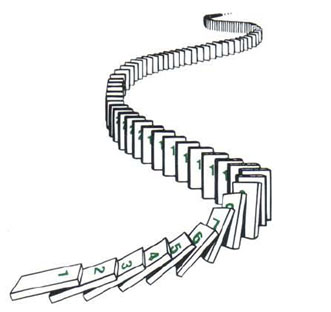
- A starting domino falls.
- From the starting domino, every successive domino falls.
- Then, every domino from the starting domino falls.
Template
Proposition: For all integers $n \ge a$, a property $P(n)$ is true.
Proof
- Basis step.
Show that $P(a)$ is true. - Induction step.
Assume $P(k)$ is true for some integer $k \ge a$.
(This supposition is called the inductive hypothesis.)
Now, prove that $P(k + 1)$ is true.
Why does the template work?
Proposition: For all integers $n \ge a$, a property $P(n)$ is true.
Proof
- Basis step.
$P(a)$ - Induction step.
$\forall k \ge a, P(k) \rightarrow P(k+1)$.
Why does the proof work?
- $P(a)$ (base case)
$P(a) \rightarrow P(a + 1)$ (inductive hypothesis)
$\therefore P(a + 1)$ - $P(a + 1)$ (conclusion from argument 1)
$P(a+1) \rightarrow P(a + 2)$ (inductive hypothesis)
$\therefore P(a + 2)$ - $P(a + 2)$ (conclusion from argument 2)
$P(a+2) \rightarrow P(a + 3)$ (inductive hypothesis)
$\therefore P(a + 3)$ - so on... $P(a+4), P(a+5), \ldots$
$1 + 2 + 3 + \cdots + n = \frac{n(n+1)}{2}$
Pattern
- $1 = \frac{1 \cdot 2}{2}$
- $1 + 2 = \frac{2 \cdot 3}{2}$
- $1 + 2 + 3 = \frac{3 \cdot 4}{2}$
- $1 + 2 + 3 + 4 = \frac{4 \cdot 5}{2}$
- $1 + 2 + 3 + 4 + 5 = \frac{5 \cdot 6}{2}$
- $1 + 2 + 3 + 4 + 5 + 6 = \frac{6 \cdot 7}{2}$
- $1 + 2 + 3 + 4 + 5 + 6 + 7 = \frac{7 \cdot 8}{2}$
- $1 + 2 + 3 + 4 + 5 + 6 + 7 + 8 = \frac{8 \cdot 9}{2}$
- $1 + 2 + 3 + 4 + 5 + 6 + 7 + 8 + 9 = \frac{9 \cdot 10}{2}$
- $1 + 2 + 3 + 4 + 5 + 6 + 7 + 8 + 9 + 10 = \frac{10 \cdot 11}{2}$
- $1 + 2 + 3 + 4 + 5 + 6 + 7 + 8 + 9 + 10 + 11 = \frac{11 \cdot 12}{2}$
Proposition: $1 + 2 + 3 + \cdots + n = \frac{n(n+1)}{2}$ for all integers $n \ge 1$.
Proof
Let $P(n)$ denote $1 + 2 + \cdots + n = \frac{n(n+1)}{2}$.- Basis step. $P(1)$ is true because $1 = 1(1+1)/2$.
- Induction step. Suppose that $P(k)$ is true for some $k \ge 1$.
Now, we want to show that $P(k + 1)$ is true. That is,
Assume $P(k)$: $1+2+\cdots+k = \frac{k(k+1)}{2}$ for some $k \ge 1$
Prove $P(k+1)$: $1+2+\cdots+(k+1) = \frac{(k+1)(k+2)}{2}$ \begin{align*} & \text{LHS of } P(k+1) \\ &= (1 + 2 + \cdots + k) + (k + 1) \\ &= \frac{k(k + 1)}{2} + (k + 1) && (\because P(k) \text{ is true}) \\ &= \frac{(k+1)(k+2)}{2} && (\because \text{distributive law}) \\ &= \text{RHS of } P(k + 1) \end{align*}
$\left( 1 - \frac{1}{2} \right) \left( 1 - \frac{1}{3} \right) \cdots \left( 1 - \frac{1}{n} \right) = \frac{1}{n}$
Proposition: $\left( 1 - \frac{1}{2} \right) \left( 1 - \frac{1}{3} \right) \cdots \left( 1 - \frac{1}{n} \right) =
\frac{1}{n}$ for all integers $n \ge 2$.
Proof
Let $P(n)$ denote $\left( 1 - \frac{1}{2} \right) \left( 1 - \frac{1}{3} \right) \cdots \left( 1 - \frac{1}{n} \right) = \frac{1}{n}$.- Basis step. $P(2)$ is true. (How?)
- Induction step.
Assume $P(k)$: $\left( 1 - \frac{1}{2} \right) \left( 1 - \frac{1}{3} \right) \cdots \left( 1 - \frac{1}{k} \right) = \frac{1}{k}$ for some $k \ge 2$.
Prove $P(k+1)$: $\left( 1 - \frac{1}{2} \right) \left( 1 - \frac{1}{3} \right) \cdots \left( 1 - \frac{1}{k+1} \right) = \frac{1}{k+1}$ \begin{align*} & \text{LHS of } P(k+1) \\ &= \left[ \left( 1 - \frac{1}{2} \right) \left( 1 - \frac{1}{3} \right) \cdots \left( 1 - \frac{1}{k} \right) \right] \left( 1 - \frac{1}{k + 1} \right) \\ &= \frac{1}{k} \left( 1 - \frac{1}{k + 1} \right) && (\because P(k) \text{ is true}) \\ &= \frac{1}{k} \cdot \frac{k}{k + 1} && (\because \text{common denominator}) \\ &= \frac{1}{k+1} && (\because \text{remove common factor}) \\ &= \text{RHS of } P(k+1) \end{align*}
$\frac{1}{1 \cdot 2} + \frac{1}{2 \cdot 3} + \cdots + \frac{1}{n \cdot (n+1)} = \frac{n}{n+1}$
Proposition: $\frac{1}{1 \cdot 2} + \frac{1}{2 \cdot 3} + \cdots + \frac{1}{n \cdot (n+1)} = \frac{n}{n+1}$ for all
integers $n \ge 1$.
Proof
Let $P(n)$ denote $\frac{1}{1 \cdot 2} + \frac{1}{2 \cdot 3} + \cdots + \frac{1}{n \cdot (n+1)} = \frac{n}{n+1}$.- Basis step. $P(1)$ is true. (How?)
- Induction step.
Assume $P(k)$: $\frac{1}{1 \cdot 2} + \frac{1}{2 \cdot 3} + \cdots + \frac{1}{k \cdot (k+1)} = \frac{k}{k+1}$ for some $k \ge 1$
Prove $P(k + 1)$: $\frac{1}{1 \cdot 2} + \frac{1}{2 \cdot 3} + \cdots + \frac{1}{(k+1) \cdot (k+2)} = \frac{k+1}{k+2}$ \begin{align*} & \text{LHS of } P(k+1) \\ &= \left( \frac{1}{1 \cdot 2} + \frac{1}{2 \cdot 3} + \cdots + \frac{1}{k \cdot (k+1)} \right) + \frac{1}{(k+1) \cdot (k+2)} \\ &= \frac{k}{k + 1} + \frac{1}{(k+1) \cdot (k+2)} && (\because P(k) \text{ is true}) \\ &= \frac{k^2 + 2k + 1}{(k+1) \cdot (k+2)} && (\because \text{common denominator}) \\ &= \frac{(k+1)^2}{(k+1) \cdot (k+2)} && (\because \text{simplify}) \\ &= \frac{k+1}{k+2} && (\because \text{remove common factor}) \\ &= \text{RHS of } P(k+1) \end{align*}
Problems for practice
For all integers $n \ge 1$:- $1 + 3 + \cdots + (2n-1) = n^2$
- $2 + 4 + \cdots + 2n = n(n+1)$
- $1^2 + 2^2 + \cdots + n^2 = \frac{n(n+1)(2n+1)}{6}$
- $1^3 + 2^3 + \cdots + n^3 = \left( \frac{n(n+1)}{2} \right)^2$
- $1 \cdot 2 + 2 \cdot 3 + \cdots + n (n + 1) = \frac{n(n+1)(n+2)}{3}$
- $2^2 + 5^2 + 8^2 + \cdots + (3n-1)^2 = \frac{n(6n^2 + 3n - 1)}{2}$
- $\sum_{i = 1}^{n} \frac{1}{(2i-1)(2i+1)} = \frac{n}{2n+1}$
- $\sum_{i = 1}^{n} i(i+1)(i+2) = \frac{n(n+1)(n+2)(n+3)}{4}$
- $\underbrace{111\ldots1}_{\text{$n$ times}} = \frac{10^n - 1}{9}$
$F(0)^2 + F(1)^2 + \cdots + F(n)^2 = F(n)F(n+1)$
Proposition: Fibonacci sequence is: $F(0) = 1$, $F(1) = 1$, and
$F(n) = F(n - 1) + F(n - 2)$ for $n \ge 2$. Prove that:
$F(0)^2 + F(1)^2 + \cdots + F(n)^2 = F(n)F(n+1)$ for all $n \ge 0$.
$F(n) = F(n - 1) + F(n - 2)$ for $n \ge 2$. Prove that:
$F(0)^2 + F(1)^2 + \cdots + F(n)^2 = F(n)F(n+1)$ for all $n \ge 0$.
Proof
Let $P(n)$ denote $F(0)^2 + F(1)^2 + \cdots + F(n)^2 = F(n)F(n+1)$.- Basis step. $P(0)$ is true. (How?)
- Induction step. Suppose that $P(k)$ is true for some $k \ge 0$.
Now, we want to show that $P(k + 1)$ is true. \begin{align*} & \text{LHS of } P(k+1) \\ &= ( F(0)^2 + F(1)^2 + \cdots + F(k)^2 ) + F(k + 1)^2 \\ &= F(k) F(k + 1) + F(k + 1)^2 && (\because P(k) \text{ is true}) \\ &= F(k + 1) (F(k) + F(k + 1)) && (\because \text{distributive law}) \\ &= F(k + 1) F(k + 2) && (\because \text{recursive definition}) \\ &= \text{RHS of } P(k+1) \end{align*}
$1 + r + r^2 + \cdots + r^n = \frac{r^{n+1}-1}{r - 1}$
Proposition: $1 + r + r^2 + \cdots + r^n = \frac{r^{n+1}-1}{r - 1}$ for $r \ne 1$ and for all integers $n \ge 1$.
Proof
Let $P(n)$ denote $1 + r + r^2 + \cdots + r^n = \frac{r^{n+1}-1}{r - 1}$.- Basis step. $P(1)$ is true. (How?)
- Induction step. Suppose that $P(k)$ is true for some $k \ge 1$.
Now, we want to show that $P(k + 1)$ is true. \begin{align*} & \text{LHS of } P(k+1) \\ &= (1 + r + r^2 + \cdots + r^k) + r^{k + 1} \\ &= \left( \frac{r^{k+1}-1}{r - 1} \right) + r^{k + 1} && (\because P(k) \text{ is true}) \\ &= \frac{(r^{k+1}-1) + r^{k + 1} (r-1)}{r - 1} && (\because \text{common denominator}) \\ &= \frac{r^{(k+1)+1}-1}{r - 1} && (\because \text{simplify}) \\ &= \text{RHS of } P(k+1) \end{align*}
$2^{2n} - 1$ is divisible by $3$
Proposition: $2^{2n} - 1$ is divisible by $3$, for all integers $n \ge 0$.
Proof
Let $P(n)$ denote $2^{2n} - 1$ is divisible by $3$.- Basis step. $P(0)$ is true. (How?)
- Induction step. Suppose that $P(k)$ is true for some $k \ge 0$.
Now, we want to show that $P(k + 1)$ is true. \begin{align*} & \text{LHS of } P(k+1) \\ &= 2^{2(k+1)} - 1 \\ &= 2^2 \cdot 2^{2k} - 1 && (\because a^{b+c} = a^b \cdot a^c) \\ &= (3 + 1) \cdot 2^{2k} - 1 && (\because \text{rewrite}) \\ &= 3 \cdot 2^{2k} + (2^{2k} - 1) && (\because \text{distributive law}) \\ &= 3 \cdot 2^{2k} + 3r && (\because P(k) \text{ is true}) \\ &= 3 \cdot (2^{2k} + r) && (\because \text{distributive law}) \\ &= 3 \cdot \text{integer} && (\because \text{addition is closed on integers}) \\ &= \text{RHS of } P(k+1) \end{align*}
Problems for practice
For all integers $n \ge 0$:- $5^{n} - 1$ is divisible by 4
- $7^{n} - 1$ is divisible by 6
- $9^{n} + 3$ is divisible by 4
- $3^{2n} - 1$ is divisible by 8
- $7^{n} - 2^{n}$ is divisible by 5
- $7^{n+2} + 8^{2n+1}$ is divisible by 57
- $n^3 + 2n$ is divisible by 3
- $n^{3} - 7n + 3$ is divisible by 3
- $17n^3 + 103n$ is divisible by 6
$x^{n} - y^{n}$ is divisible by $x - y$
Proposition: $x^{n} - y^{n}$ is divisible by $x - y$, for all integers $x, y$ such that $x \ne y$, for all integers $n \ge
0$.
Proof
Let $P(n)$ denote $x^{n} - y^{n}$ is divisible by $x - y$, s.t. $x \ne y$.- Basis step. $P(0)$ is true. (How?)
- Induction step. Suppose that $P(k)$ is true for some $k \ge 0$.
Now, we want to show that $P(k + 1)$ is true. \begin{align*} & \text{LHS of } P(k+1) \\ &= x^{k + 1} - y^{k + 1} \\ &= x^{k + 1} - x \cdot y^k + x \cdot y^k- y^{k + 1} && (\because \text{subtract and add}) \\ &= x \cdot (x^k - y^k) + y^k (x - y) && (\because \text{distributive law}) \\ &= x \cdot (x - y) r + y^k (x - y) && (\because P(k) \text{ is true}) \\ &= (x-y) (xr + y^k) && (\because \text{distributive law}) \\ &= (x-y) \cdot \text{integer} && (\because +,\times, \text{expo are closed on integers}) \\ &= \text{RHS of } P(k+1) \end{align*}
$2^{n} < n!$
Proposition: $2^{n} < n!$, for all integers $n \ge 4$.
Proof
Let $P(n)$ denote $2^{n} < n!$.- Basis step. $P(4)$ is true. (How?)
- Induction step. Suppose that $P(k)$ is true for some $k \ge 4$.
Now, we want to show that $P(k + 1)$ is true. \begin{align*} & \text{LHS of } P(k+1) \\ &= 2^{k+1} \\ &= 2^k \cdot 2 && (\because a^{b+c} = a^b \cdot a^c) \\ &< k! \cdot 2 && (\because P(k) \text{ is true}) \\ &< k! \cdot (k +1) && (\because 2 < (k + 1) \text{ for } k \ge 4) \\ &= (k+1)! && (\because \text{factorial recursive definition}) \\ &= \text{RHS of } P(k+1) \end{align*}
$n^2 < 2^n$
Proposition: $n^2 < 2^n$, for all integers $n \ge 5$.
Proof
Let $P(n)$ denote $n^2 < 2^n$.- Basis step. $P(5)$ is true. (How?)
- Induction step. Suppose that $P(k)$ is true for some $k \ge 5$.
Now, we want to show that $P(k + 1)$ is true. \begin{align*} & \text{LHS of } P(k+1) \\ &= (k+1)^2 = k^2 + 2k + 1 && (\because \text{expand}) \\ &< k^2 + 2k + k && (\because 1 < k) \\=& \; k^2 + 3k && (\because \text{simplify}) \\ &< k^2 + k^2 && (\because 3 < k) \\=& \; 2k^2 && (\because \text{simplify}) \\ &< 2 \cdot 2^k && (\because P(k) \text{ is true}) \\=& \; 2^{k + 1} && (\because a^b \cdot a^c=a^{b + c}) \\=& \; \text{RHS of } P(k+1) \end{align*}
Tiling board with L-shaped trominoes
Proposition: If one square is removed from a $2^n \times 2^n$ board, the remaining squares can be completely covered by
L-shaped trominoes, for all integers $n \ge 1$.
Example
- L-shaped tromino:

- L-shaped trominoes cover $2^3 \times 2^3$ board with a missing square:
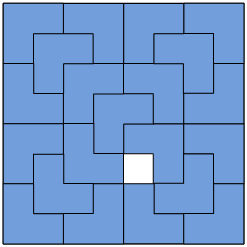
Proposition: If one square is removed from a $2^n \times 2^n$ board, the remaining squares can be completely covered by
L-shaped trominoes, for all integers $n \ge 1$.
Proof
Let $P(n)$ denote ''A $2^n \times 2^n$ board with a square removed can be completely covered by L-shaped trominoes.''- Basis step. $P(1)$ is true. (How?)
- Induction step. Suppose that $P(k)$ is true for some $k \ge 1$.
Now, we want to show that $P(k + 1)$ is true.
Consider $2^{k+1} \times 2^{k+1}$ board with a square removed.
Divide it into four equal quadrants.
Consider the quadrant with the missing square. We can tile this quadrant with trominoes because $P(k)$ is true.
Remaining three quadrants meet at the center. Place a tromino on the three central squares of the three quadrants.
The three quadrants can now be tiled using trominoes because $P(k)$ is true. As all four quadrants can be covered with trominoes, $P(k + 1)$ is true.

Bogus proofs
Proposition: All dogs in the world have the same color.
Proof
Let $P(n)$ denote ''In any collection of $n$ dogs, all of them have the same color.''- Basis step. $P(1)$ is true. (How?)
- Induction step. Suppose that $P(k)$ is true for some $k \ge 1$.
Now, we want to show that $P(k + 1)$ is true.
Consider a set of $k + 1$ dogs, say, $\{ d_1, d_2, \ldots, d_k, d_{k+1} \}$.
$\{ d_1, d_2, \ldots, d_k \}$ dogs have the same color. \hfill ($\because P(k)$ is true)
$\{ d_2, d_3, \ldots, d_{k + 1} \}$ dogs have the same color. \hfill ($\because P(k)$ is true)
So, all $k+1$ dogs have the same color.
That is, $P(k + 1)$ is true.
- What's wrong?
Proposition: All sand in the world cannot make a heap.
Proof
Let $P(n)$ denote ''$n$ grains of sand is not a heap.''- Basis step. $P(1)$ is true. (How?)
- Induction step. Suppose that $P(k)$ is true for some $k \ge 1$.
Now, we want to show that $P(k + 1)$ is true.
If $n$ grains of sand is not a heap of sand, then $n + 1$ grains of sand is not a heap of sand either.
Therefore, $P(k + 1)$ is true.
- What's wrong?
Proposition: We are nonliving things.
Proof
Let $P(n)$ denote ''$n$ atoms of matter is nonliving.''- Basis step. $P(1)$ is true. (How?)
- Induction step. Suppose that $P(k)$ is true for some $k \ge 1$.
Now, we want to show that $P(k + 1)$ is true.
Consider $n$ atoms of matter that is not living. Add one more atom to this collection. Adding one more atom cannot suddenly bring life to the nonliving. So, $n + 1$ atoms of matter is not living.
Therefore, $P(k + 1)$ is true.
- What's wrong?
Strong Mathematical Induction
Equivalence
Equivalence: Ordinary and strong mathematical induction techniques are equivalent to each other. In other words, Any statement that can be proved with ordinary mathematical induction can be proved
with strong mathematical induction and vice versa.
Why strong induction?
There are many propositions for which strong mathematical induction seems both simpler and more natural way of provingTemplate
Proposition: For all integers $n \ge a$, a property $P(n)$ is true.
Proof
- Basis step.
Show that $P(a), P(a+1), P(a + 2), \ldots, P(b)$ are true. - Induction step.
Assume $\{ P(a), P(a + 1), \ldots, P(k) \}$ are true for some $k \ge b$.
(This supposition is called the inductive hypothesis.)
Now, prove that $P(k + 1)$ is true.
$a_n = 5^n - 1$
Proposition: Consider the sequence: $a_0 = 0$, $a_1 = 4$, and
$a_k = 6 a_{k - 1} - 5 a_{k - 2}$ for all integers $k \ge 2$.
Prove that $a_n = 5^n - 1$ for all integers $n \ge 0$.
$a_k = 6 a_{k - 1} - 5 a_{k - 2}$ for all integers $k \ge 2$.
Prove that $a_n = 5^n - 1$ for all integers $n \ge 0$.
Proof
Let $P(n)$ denote ''$a_n = 5^n - 1$.''- Basis step. $P(0)$ and $P(1)$ are true. (How?)
- Induction step. Suppose that $P(i)$ is true for some $k \ge 1$ and any $i \in [0, k]$. We want to show that $P(k + 1)$ is true. \begin{align*} & \text{LHS of } P(k+1) \\ &= a_{k + 1} \\ &= 6 a_{k} - 5 a_{k - 1} && (\because \text{recursive definition}) \\ &= 6 (5^k - 1) - 5 (5^{k - 1} - 1) && (\because P(k), P(k-1) \text{ are true}) \\ &= 5^{k + 1} - 1 && (\because \text{simplify}) \\ &= \text{RHS of } P(k+1) \end{align*}
Problems for practice
- Consider the sequence: $a_0 = 12$, $a_1 = 29$, and
$a_k = 5 a_{k - 1} - 6 a_{k - 2}$ for all integers $k \ge 2$.
Prove that $a_n = 5 \cdot 3^n + 7 \cdot 2^n$ for all integers $n \ge 0$. - Consider the sequence: $a_1 = 3$, $a_2 = 5$, and
$a_k = 3 a_{k - 1} - 2 a_{k - 2}$ for all integers $k \ge 3$.
Prove that $a_n = 2^n + 1$ for all integers $n \ge 1$. - Consider the sequence: $a_0 = 1$, $a_1 = 2$, $a_2 = 3$, and
$a_k = a_{k - 1} + a_{k - 2} + a_{k - 3}$ for all integers $k \ge 3$.
Prove that $a_n \le 3^n$ for all integers $n \ge 0$. - Consider the sequence: $a_0 = 1$, $a_1 = 3$, and
$a_k = 2 a_{k - 1} - a_{k - 2}$ for all integers $k \ge 2$.
Prove that $a_n = 2n+1$ for all integers $n \ge 0$. - Consider the sequence: $a_0 = 0$, $a_1 = 1$, and
$a_k = 5 a_{k - 1} - 6 a_{k - 2}$ for all integers $k \ge 2$.
Prove that $a_n = 3^n - 2^n$ for all integers $n \ge 0$. - Consider the sequence: $a_1 = 1$, $a_2 = 8$, and
$a_k = a_{k - 1} + 2 a_{k - 2}$ for all integers $k \ge 3$.
Prove that $a_n = 3 \cdot 2^{n-1} + 2(-1)^n$ for all integers $n \ge 1$.
$n > 1$ is divisible by prime
Proposition: Any integer greater than 1 is divisible by a prime number.
Proof
Let $P(n)$ denote ''$n$ is divisible by a prime number.''- Basis step. $P(2)$ is true. (How?)
- Induction step. Suppose that $P(i)$ is true for some $k \ge 2$ and any $i \in [2,
k]$. We want to show that $P(k + 1)$ is true.
Consider two cases:- Case 1: [$k + 1$ is prime.] $P(k + 1)$ is true. (How?)
- Case 2: [$k + 1$ is not prime.] We can write $k + 1 = ab$ such that both $a,b \in [2, k]$ using the definition of a composite. This means, $k+1$ is divisible by $a$. We see that $a$ is divisible by a prime due to the inductive hypothesis. As $k + 1$ is divisible by $a$ and $a$ is divisible by a prime, $k + 1$ is divisible by a prime, due to the transitivity of divisibility. Hence, $P(k + 1)$ is true.
3-cent and 5-cent coins
Proposition: $n$ cents can be obtained using a combination of 3- and 5-cent coins, for all integers $n \ge 8$.
(Assume you have an infinite supply of 3- and 5-cent coins.)
(Assume you have an infinite supply of 3- and 5-cent coins.)
Proof
Let $P(n)$ denote ''$n$ cents can be obtained using a combination of 3- and 5-cent coins.''- Basis step. $P(8),P(9), P(10), P(11), P(12)$ are true. (How?)
- Induction step. Suppose that $P(i)$ is true for some $k \ge 12$ and any $i \in [8,
k]$. We want to show that $P(k + 1)$ is true.
$k + 1 = \underbrace{(k - 4)}_{\text{Part 1}} + \underbrace{5}_{\text{Part 2}}$
Part 1 can be obtained by a collection of 3- and 5-cent coins because $P(k - 4)$ is true and $(k - 4) \ge 8$.
Part 2 requires a 5-cent coin.
Hence, $P(k + 1)$ is true.
Proof (improved)
Let $P(n)$ denote ''$n$ cents can be obtained using a combination of 3- and 5-cent coins.''- Basis step. $P(8)$, $P(9)$, and $P(10)$ are true. (How?)
- Induction step. Suppose that $P(i)$ is true for some $k \ge 10$ and any $i \in [8,
k]$. We want to show that $P(k + 1)$ is true.
$k + 1 = \underbrace{(k - 2)}_{\text{Part 1}} + \underbrace{3}_{\text{Part 2}}$
Part 1 can be obtained by a collection of 3- and 5-cent coins because $P(k - 2)$ is true and $(k - 2) \ge 8$.
Part 2 requires a 3-cent coin.
Hence, $P(k + 1)$ is true.
3-cent and 5-cent coins (Ordinary induction)
Solve the previous problem using ordinary induction.
Proof (invalid)
Let $P(n)$ denote ''$n$ cents can be obtained using a combination of 3- and 5-cent coins.''- Basis step. $P(8)$ is true. (How?)
- Induction step. Suppose that $P(k)$ is true for some $k \ge 8$. We want to show that $P(k + 1)$ is true. $k + 1 = \underbrace{k}_{\text{Part 1}} + \underbrace{(3 + 3 - 5)}_{\text{Part 2}}$
Part 1: $P(k)$ is true as $k \ge 8$.
Part 2: Add two 3-cent coins and subtract one 5-cent coin.
Hence, $P(k + 1)$ is true.
Incorrect! What's wrong?
Proof (invalid)
Let $P(n)$ denote ''$n$ cents can be obtained using a combination of 3- and 5-cent coins.''- Basis step. $P(8)$ is true. (How?)
- Induction step. Suppose that $P(k)$ is true for some $k \ge 8$. We want to show
that
$P(k + 1)$ is true.
$k + 1 = \underbrace{k}_{\text{Part 1}} + \underbrace{(5 + 5 - 3 - 3 - 3)}_{\text{Part 2}}$
Part 1: $P(k)$ is true as $k \ge 8$.
Part 2: Add two 5-cent coins and subtract three 3-cent coins.
Hence, $P(k + 1)$ is true.
Incorrect! What's wrong?
Proof
Let $P(n)$ denote ''$n$ cents can be obtained using a combination of 3- and 5-cent coins.''- Basis step. $P(8)$ is true. (How?)
- Induction step. Suppose that $P(k)$ is true for some $k \ge 8$. We want to show
that
$P(k + 1)$ is true.
Consider two cases:- [Case 1: There is a 5-cent coin in the set of $k$ cents.]
$k + 1 = \underbrace{k}_{\text{Part 1}} + \underbrace{(3 + 3 - 5)}_{\text{Part 2}}$
Part 1: $P(k)$ is true as $k \ge 8$.
Part 2: Add two 3-cent coins and subtract one 5-cent coin. - [Case 2: There is no 5-cent coin in the set of $k$ cents.]
$k + 1 = \underbrace{k}_{\text{Part 1}} + \underbrace{(5 + 5 - 3 - 3 - 3)}_{\text{Part 2}}$
Part 1: $P(k)$ is true as $k \ge 8$.
Part 2: Add two 5-cent coins and subtract three 3-cent coins.
- [Case 1: There is a 5-cent coin in the set of $k$ cents.]
Problems for practice
- Any collection of $n$ people can be divided into teams of size
- 5 and 6, for all integers $n \ge 35$
- 4 and 7, for all integers $n \ge 18$
- Every amount of postage of $12$ cents or more can be formed using just $4$-cent and $5$-cent stamps.
- Fibonacci sequence is: $f_0 = 1$, $f_1 = 1$, and
$f_n = f_{n - 1} + f_{n - 2}$ for $n \ge 2$. Prove that:
- $f_n \le (7/4)^n$ for all $n \ge 0$.
- $f_n \ge (3/2)^{n - 1}$ for all $n \ge 1$.
- $f_n \ge 2^{(n - 1)/2}$ for all $n \ge 3$.
- $f_n = (p^n - q^n) / \sqrt{5}$ for all $n \ge 1$,
where $p = (1 + \sqrt{5}) / 2$ and $q = (1 - \sqrt{5}) / 2$.
Hint: Note that $p$ and $q$ are the roots of $x^2 - x - 1 = 0$. So, $p^2 = p + 1$ and $q^2 = q + 1$.
Recursion
Some recursive functions
- Suppose $f(n) = n!$, where $n \in \mathbb{W}$. Then, \begin{align*} f(n) &= \begin{cases} 1 & \text{if } n = 0,\\ n \cdot f(n - 1) & \text{if } n \ge 1. \end{cases} \end{align*} Closed-form formula: $f(n) = n \cdot (n-1) \cdot \cdots \cdot 1$
- Suppose $F(n) = n$th Fibonacci number. Then, \begin{align*} F(n) &= \begin{cases} 1 & \text{if } n = 0 \text{ or } 1,\\ F(n - 1) + F(n - 2) & \text{if } n \ge 2. \end{cases} \end{align*} Closed-form formula: $F(n) =$ ?
- Suppose $C(n) = n$th Catalan number. Then, \begin{align*} C(n) &= \begin{cases} 1 & \text{if } n = 1,\\ \frac{4n-2}{n+1} \cdot C(n - 1) & \text{if } n \ge 2. \end{cases} \end{align*} Closed-form formula: $C(n) = \frac{1}{n + 1} \cdot \binom{2n}{n}$
- Suppose $M(m, n) = $ product of $m, n \in \mathbb{N}$. Then, \begin{align*} M(m, n) &= \begin{cases} m & \text{if } n = 1,\\ M(m, n - 1) + m & \text{if } n \ge 2. \end{cases} \end{align*} Closed-form formula: $M(m, n) = m \times n$
- Suppose $E(a, n) = a^n$, where $n \in \mathbb{W}$. Then, \begin{align*} E(a, n) &= \begin{cases} 1 & \text{if } n = 0,\\ E(a, n - 1) \times a & \text{if } n \ge 1. \end{cases} \end{align*} Closed-form formula: $E(a, n) = a^n$
- Suppose $O(n) = n$th odd number $\in \mathbb{N}$. Then, \begin{align*} O(n) &= \begin{cases} 1 & \text{if } n = 1,\\ O(n - 1) + 2 & \text{if } n \ge 2. \end{cases} \end{align*} Closed-form formula: $O(n) = 2n - 1$
- Recursive function for primes?
Relationship between induction and recursion
| Recursion | Ordinary induction | Strong induction |
|---|---|---|
| Base case | Basis: $f(a)$ | Basis: $f(a), f(a + 1), \ldots, f(b)$ |
| Recursive case | Induction: Prove $f(n)$ from $f(n-1)$ | Induction: Prove $f(n)$ from $f(n - 1), f(n - 2), \ldots, f(a)$ |
Arithmetic sequence
Definitions
- Arithmetic sequence:
$\langle a_0, a_1, a_2, \ldots, a_n\rangle = \langle a, a + d, a + 2d, \ldots, a + nd \rangle$ - $n$th term
- Recursive definition:
$a_n = a_{n - 1} + d$ for all integers $n \ge 1$ - Nonrecursive definition:
$a_n = a + nd$ for all integers $n \ge 0$ - Summation
$\sum_{i = 0}^{n} a_i = a_0 + a_1 + \cdots + a_n = (n + 1) a + d n (n + 1) / 2$
Example
Problem: A skydiver's speed upon leaving an airplane is approx. 9.8 m/sec one second after departure, 9.8 + 9.8 =
19.6
m/sec two seconds after departure, and so forth. How fast would the skydiver be falling 60 seconds after
leaving
the airplane?
Solution:
- Let $s_n = $ skydiver speed (m/sec) $n$ sec. after exiting the plane
- $s_n = s_0 + 9.8 n$ for each integer $n \ge 0$
- $s_{60} = 0 + (9.8)(60) = 588$ m/sec.
Geometric sequence
Definition
- Geometric sequence:
$\langle a_0, a_1, a_2, \ldots, a_n\rangle = \langle a, a r, a r^2, \ldots, a r^n \rangle$ - $n$th term
- Recursive definition:
$a_n = r a_{n - 1}$ for all integers $n \ge 1$ - Nonrecursive definition:
$a_n = a r^n$ for all integers $n \ge 0$
- Recursive definition:
- Summation
$\sum_{i = 0}^{n} a_i = a_0 + a_1 + \cdots + a_n = a \left( \frac{r^{n + 1} - 1}{r - 1} \right)$
Example
Problem: Suppose you deposit 100,000 dollars in your bank account for your newborn baby. Suppose you earn 3% interest
compounded annually.
How much will be the amount when your kid hits 21 years of age?
How much will be the amount when your kid hits 21 years of age?
Solution:
- Suppose $A_k = $ Amount in your account after $k$ years. Then, \begin{align*} A_k &= \begin{cases} 100,000 & \text{if } k = 0,\\ (1 + 3\%) \times A_{k - 1} & \text{if } k \ge 1. \end{cases} \end{align*}
- Solving the recurrence by the method of iteration, we get
$\fbox{$A_{k} = ((1.03)^k \cdot 100,000)$ dollars}$ How? - Homework: Prove the formula using induction
- When your kid hits 21 years, $k = 21$, therefore
$A_{21} = ((1.03)^{21} \cdot 100,000) \approx 186,029.46$ dollars
Problem: Suppose you deposit 100,000 dollars in your bank account for your newborn baby. Suppose you earn 3% interest
compounded quarterly.
How much will be the amount after 84 quarters (or periods)?
How much will be the amount after 84 quarters (or periods)?
Solution:
- Suppose $A_k = $ Amount in your account after $k$ quarters. Then, \begin{align*} A_k &= \begin{cases} 100,000 & \text{if } k = 0,\\ (1 + \frac{3}{4} \%) \times A_{k - 1} & \text{if } k \ge 1. \end{cases} \end{align*}
- Solving the recurrence by the method of iteration, we get
$\fbox{$A_{k} = ((1.0075)^k \cdot 100,000)$ dollars}$ - Homework: Prove the formula using induction
- After 84 quarters or pay periods (21 years), $k = 84$,
$A_{84} = ((1.0075)^{84} \cdot 100,000) \approx 187,320.2$ dollars
Towers of Hanoi
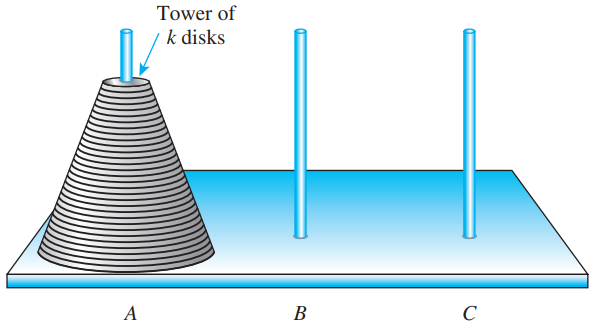
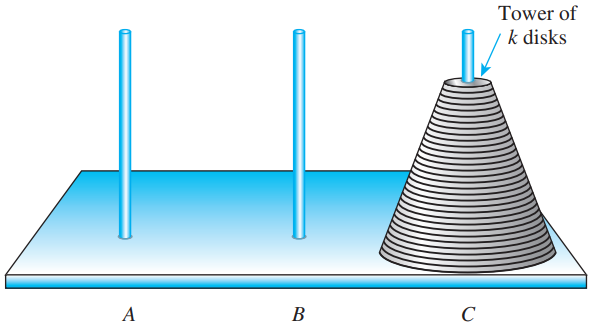
Problem: There are $k$ disks on peg 1. Your aim is to move all $k$ disks from peg 1 to peg 3 with the minimum number
of
moves. You can use peg 2 as an auxiliary peg. The constraint of the puzzle is that at any time, you cannot
place
a larger disk on a smaller disk.
What is the minimum number of moves required to transfer all $k$ disks from peg 1 to peg 3?
What is the minimum number of moves required to transfer all $k$ disks from peg 1 to peg 3?
Workout
Suppose $k = 1$. Then, the 1-step solution is:- Move disk 1 from peg $A$ to peg $C$.
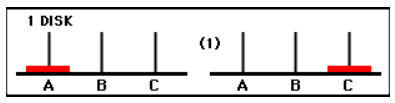
Source: http://mathforum.org/dr.math/faq/faq.tower.hanoi.html
Suppose $k = 2$. Then, the 3-step solution is:
- Move disk 1 from peg $A$ to peg $B$.
- Move disk 2 from peg $A$ to peg $C$.
- Move disk 1 from peg $B$ to peg $C$.
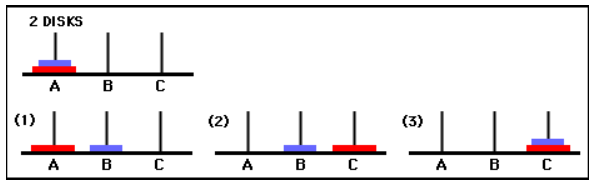
Source: http://mathforum.org/dr.math/faq/faq.tower.hanoi.html
Suppose $k = 3$. Then, the 7-step solution is:
- Move disk 1 from peg $A$ to peg $C$.
- Move disk 2 from peg $A$ to peg $B$.
- Move disk 1 from peg $C$ to peg $B$.
- Move disk 3 from peg $A$ to peg $C$.
- Move disk 1 from peg $B$ to peg $A$.
- Move disk 2 from peg $B$ to peg $C$.
- Move disk 1 from peg $A$ to peg $C$.
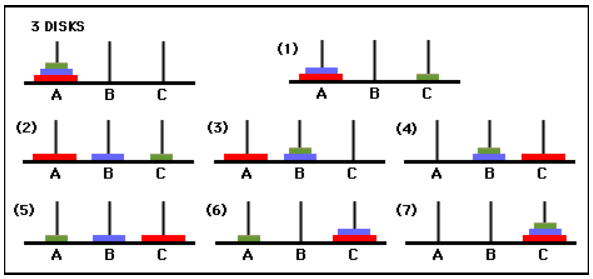
Suppose $k = 4$. Then, the 15-step solution is:
- Move disk 1 from peg $A$ to peg $B$.
- Move disk 2 from peg $A$ to peg $C$.
- Move disk 1 from peg $B$ to peg $C$.
- Move disk 3 from peg $A$ to peg $B$.
- Move disk 1 from peg $C$ to peg $A$.
- Move disk 2 from peg $C$ to peg $B$.
- Move disk 1 from peg $A$ to peg $B$.
- Move disk 4 from peg $A$ to peg $C$.
- Move disk 1 from peg $B$ to peg $C$.
- Move disk 2 from peg $B$ to peg $A$.
- Move disk 1 from peg $C$ to peg $A$.
- Move disk 3 from peg $B$ to peg $C$.
- Move disk 1 from peg $A$ to peg $B$.
- Move disk 2 from peg $A$ to peg $C$.
- Move disk 1 from peg $B$ to peg $C$.
Solution
For any $k \ge 2$, the recursive solution is:- Transfer the top $k - 1$ disks from peg $A$ to peg $B$.
- Move the bottom disk from peg $A$ to peg $C$.
- Transfer the top $k - 1$ disks from peg $B$ to peg $C$.
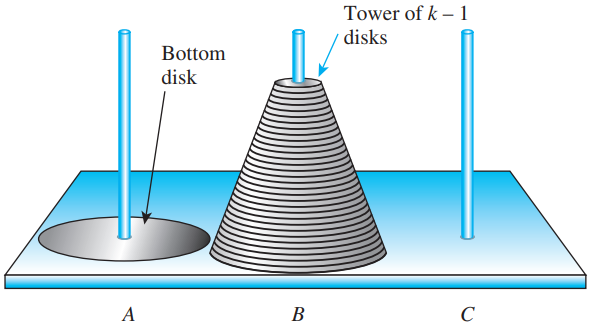
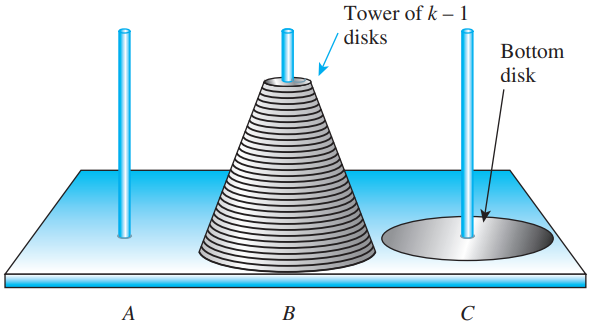
Algorithm
\begin{algorithm}
\begin{algorithmic}
\FUNCTION{Towers-of-Hanoi}{$k, A, C, B$}
  \IF{$k = 1$}
    \STATE Move disk $k$ from $A$ to $C$
  \ELSIF{$k \ge 2$}
    \STATE \CALL{Towers-of-Hanoi}{$k - 1, A, B, C$}
    \STATE Move disk $k$ from $A$ to $C$
    \STATE \CALL{Towers-of-Hanoi}{$k - 1, B, C, A$}
  \ENDIF
\ENDFUNCTION
\end{algorithmic}
\end{algorithm}
- Let $M(k)$ denote the minimum number of moves required to move $k$ disks from one peg to another peg. Then \begin{align*} M(k) &= \left. \begin{cases} 1 & \text{if } k = 1,\\ 2 \cdot M(k - 1) + 1 & \text{if } k > 1. \end{cases} \right\} \end{align*}
- Solving the recurrence by the method of iteration, we get
$\fbox{$M(k) = 2^k - 1$}$ - Homework: Prove the formula using induction
Greatest common divisor (GCD)
Problem: Compute the greatest common divisor (GCD) of two integers efficiently.
Definition
- The greatest common divisor (GCD) of two integers $a$ and $b$ is the largest integer that divides both $a$ and $b$.
- A simple way to compute GCD:
- Find the divisors of the two numbers
- Find the common divisors
- Find the greatest of the common divisors
- Examples:
- $\text{GCD}(2, 100) = 2$
- $\text{GCD}(3, 99) = 3$
- $\text{GCD}(3, 4) = 1$
- $\text{GCD}(12, 30) = 6$
- $\text{GCD}(1071, 462) = 21$
Solution
- Recurrence relation: Suppose $a > b$. \begin{align*} \text{GCD}(a, b) &= \left. \begin{cases} a & \text{if } b = 0,\\ \text{GCD}(b, a \bmod b) & \text{if } b \ge 1. \end{cases} \right\} \end{align*}
- Example: \begin{align*} & \text{GCD}(1071, 462) \\ &= \text{GCD}(462, 1071 \bmod 462) \\ &= \text{GCD}(462, 147) && (\because 1071 = 2 \cdot 462 + 147) \\ &= \text{GCD}(147, 462 \bmod 147) \\ &= \text{GCD}(147, 21) && (\because 462 = 3 \cdot 147 + 21) \\ &= \text{GCD}(21, 147 \bmod 21) \\ &= \text{GCD}(21, 0) && (\because 147 = 7 \cdot 21 + 0) \\ &= 21 \end{align*}
- Intuition

Algorithm
\begin{algorithm}
\begin{algorithmic}
\FUNCTION{GCD}{$a, b$}
  \IF{$b = 0$} \RETURN $a$
  \ELSE \RETURN \CALL{GCD}{$b, a \bmod b$}
  \ENDIF
\ENDFUNCTION
\end{algorithmic}
\end{algorithm}
More Induction Problems
McCarthy's 91 function
Problem: Let $M : \mathbb{Z} \to \mathbb{Z}$ be the following function.
\begin{align*}
M(n) &= \begin{cases}
n - 10 & \text{if } n \ge 101, \\
M(M(n + 11)) & \text{if } n \le 100.
\end{cases}
\end{align*}
Prove that $M(n) = 91$ for all integers $n \le 100$.
Solution
- Basis step. $M(n) = 91$ for $n \in [90, 100]$. (How?) \begin{align*} M(n) &= M(M(n + 11)) && (\because \text{By definition}) \\ &= M((n + 11) - 10) && (\because (n + 11) \ge 101) \\ &= M(n + 1) \end{align*} So, $M(n) = M(101) = 91$ for $n \in [90, 100]$.
- Induction step. Suppose that $M(i) = 91$ for some $k \le 90$ and any $i \in [k, 100]$. We want to show that $M(k - 1) = 91$. \begin{align*} M(k - 1) &= M(M(k - 1 + 11)) && (\because \text{By definition}) \\ &= M(M(k + 10)) && (\because \text{Simplify}) \\ &= M(91) && (\because \text{Inductive hypothesis, because } k < (k + 10) \le 100) \\ &=91 && (\because \text{Base case}) \end{align*}
Staircase problem
Problem: You need to ascend a staircase consisting of $n$ steps. The number of steps you can climb at a time is at
most
$b$. What is the number of ways of ascending the staircase?
Solution
- Suppose $S_k = $ #ways of ascending a staircase with $k$ steps. Then, \begin{align*} S_k &= \begin{cases} \fbox{?} & \text{if } k \in [1, b],\\ \fbox{?} & \text{if } k \in [b + 1, n]. \end{cases} \end{align*}
| Steps | Ways | #Ways |
|---|---|---|
| $1$ | $1$ | $1$ |
| $2$ | $1+1$, $2$ | $2$ |
| $3$ | $1+1+1$, $1+2$, $2+1$, $3$ | $4$ |
| $4$ | $1+1+1+1$, $1+1+2$, $1+2+1$, $2+1+1$, $2+2$, $1+3$, $3+1$, $4$ | $8$ |
- Base case.
Is $S_k = 2^{k-1}$? for $k \in [1, b]$. \begin{align*} S_k &= \begin{cases} 1 & \text{if } k = 1,\\ S_{k-1} + \cdots + S_1 + 1 & \text{if } k \in [2, b]. \end{cases} \end{align*} Solving the recurrence, we get $S_k = 2^{k-1}$ for $k \in [1, b]$. - Recursion case.
$S_k = S_{k - 1} + S_{k - 2} + \cdots + S_{k - b}$ for $k \in [b+1, n]$.
Continued fractions
Problem: Prove that every rational number can be written as a continued fraction.
Basics
- A continued fraction an expression of the form:
$a_1 + \frac{1}{a_2 + \frac{1}{a_3 + \frac{1}{\cdots + \frac{1}{a_n}}}}$ - Formally, a continued fraction is:
$(i)$ integer, or
$(ii)$ integer + 1/(continued fraction) - Example: Golden ratio $= \frac{1+\sqrt{5}}{2} = 1 + \frac{1}{1 + \frac{1}{1 + \frac{1}{1 + \cdots}}}$
- Given an integer $n$ and a natural number $d$,
we can write $n = qd + r$ such that $r \in [0, d - 1]$. - Observe that the rational number $n/d$ can be written as:
$\frac{n}{d} = q + \frac{r}{d} = q + \frac{1}{\frac{d}{r}}$ - Every rational can be written with a positive denominator.
Proof
Let $P(d)$ denote ''Any rational with denominator $d$ has a continued fraction''.- Basis step. $P(1)$ is true. (How?)
- Induction step. Suppose that $P(i)$ is true for all $i \in [1, d]$, for some $d \ge 1$. We need to prove that $P(d + 1)$ is true. Consider the rational $\frac{n}{d+1}$ for some integer $n$.
- [Case $r = 0$.] Then, $\frac{n}{d + 1} = q = $ integer.
An integer is a continued fraction. - [Case $r \ne 0$.] Then, $\frac{n}{d + 1} = q + \frac{r}{d+1} = q +
\frac{1}{\frac{d+1}{r}}$.
$\frac{d+1}{r}$ is a continued fraction due to inductive hypothesis because $P(r)$ is true. $\qquad (\because r \in [1, d])$
Integer + 1/(continued fraction) is a continued fraction.
Using the division theorem, we have $n = q (d+1) + r$,
where $r \in [0, d]$.
We consider two cases: