Discrete Mathematics : Relations
Contents
- Functions vs. relations
- Binary relation
- Inverse of a relation
- Relation on a set
- Equivalence relation and equivalence class
- Modular arithmetic
Functions vs. relations
Are these functions?
Are these functions?
$-$ rational $p =$ rational $q$
$-$ $m < n$
$-$ $d$ does not divide $n$
$-$ $n$ leaves a remainder of 5 when divided by $d$
$-$ line $\ell_1$ is parallel to line $\ell_2$
$-$ person $a$ is a parent of person $b$
$-$ triangle $t_1$ is congruent to triangle $t_2$
$-$ edge $e_1$ is adjacent to edge $e_2$
$-$ matrix $A$ is orthogonal to matrix $B$
No! (Because an input is mapped to more than one output.)
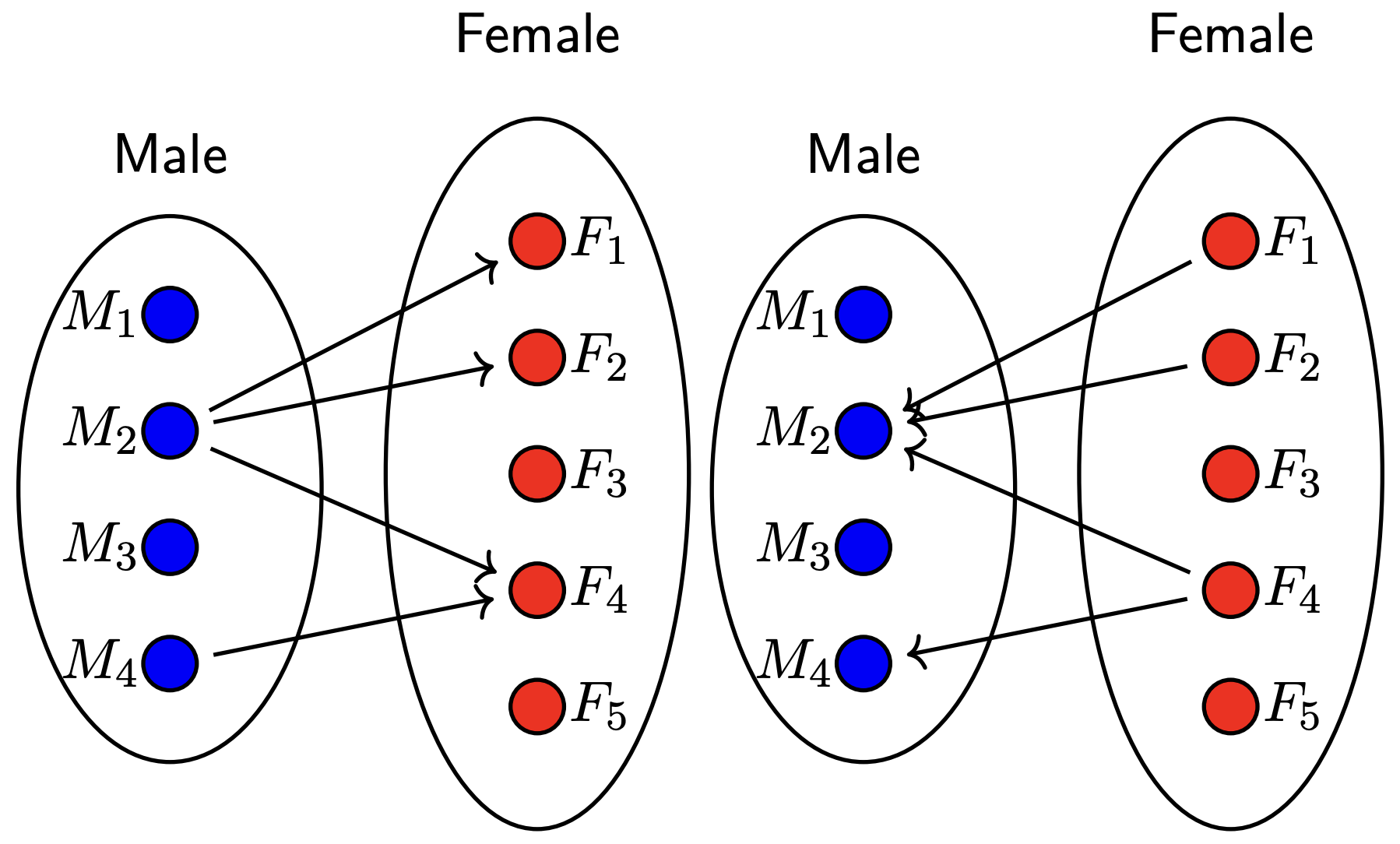
What are these mappings called? Relations!
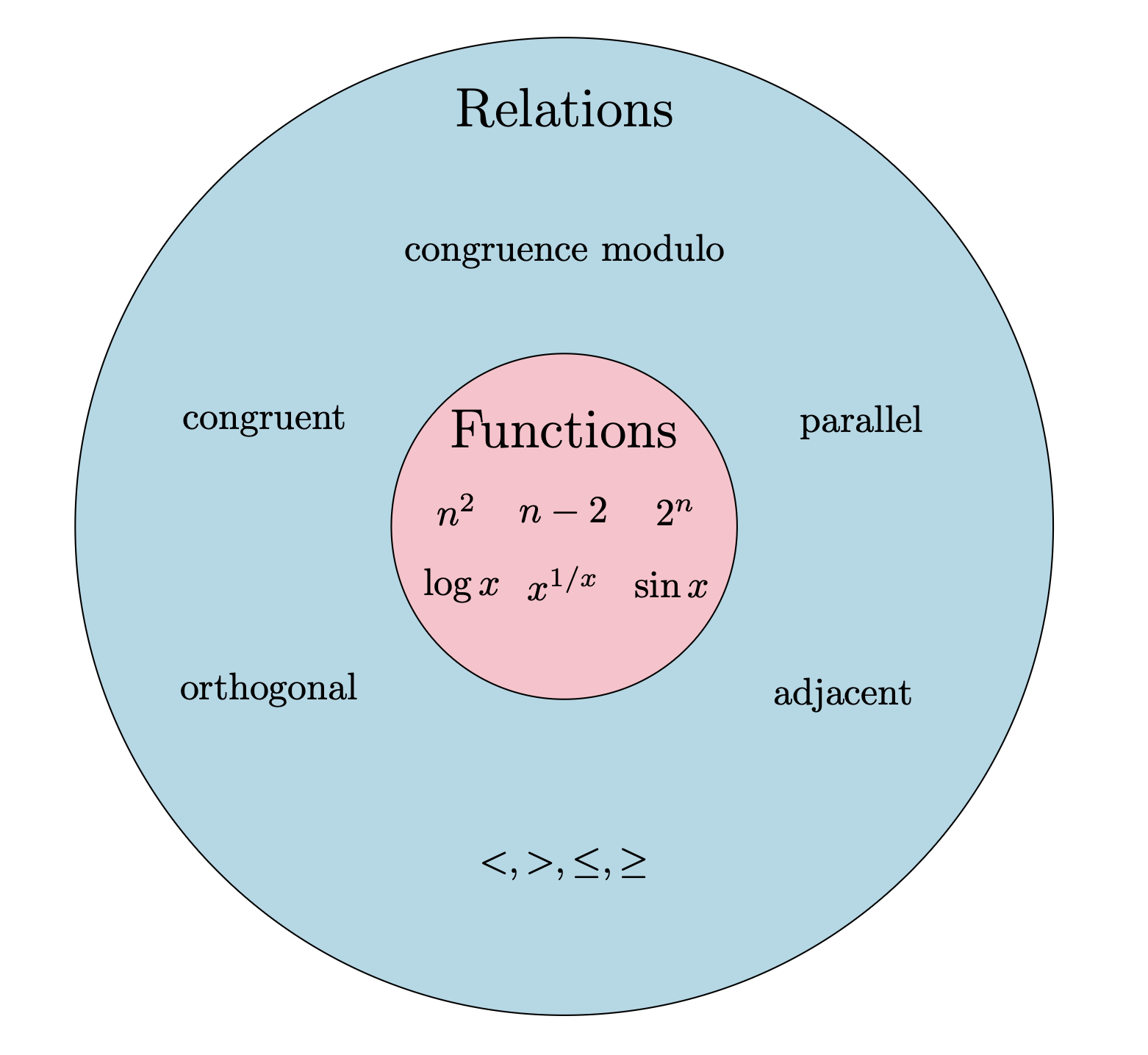
Venn diagram
Examples
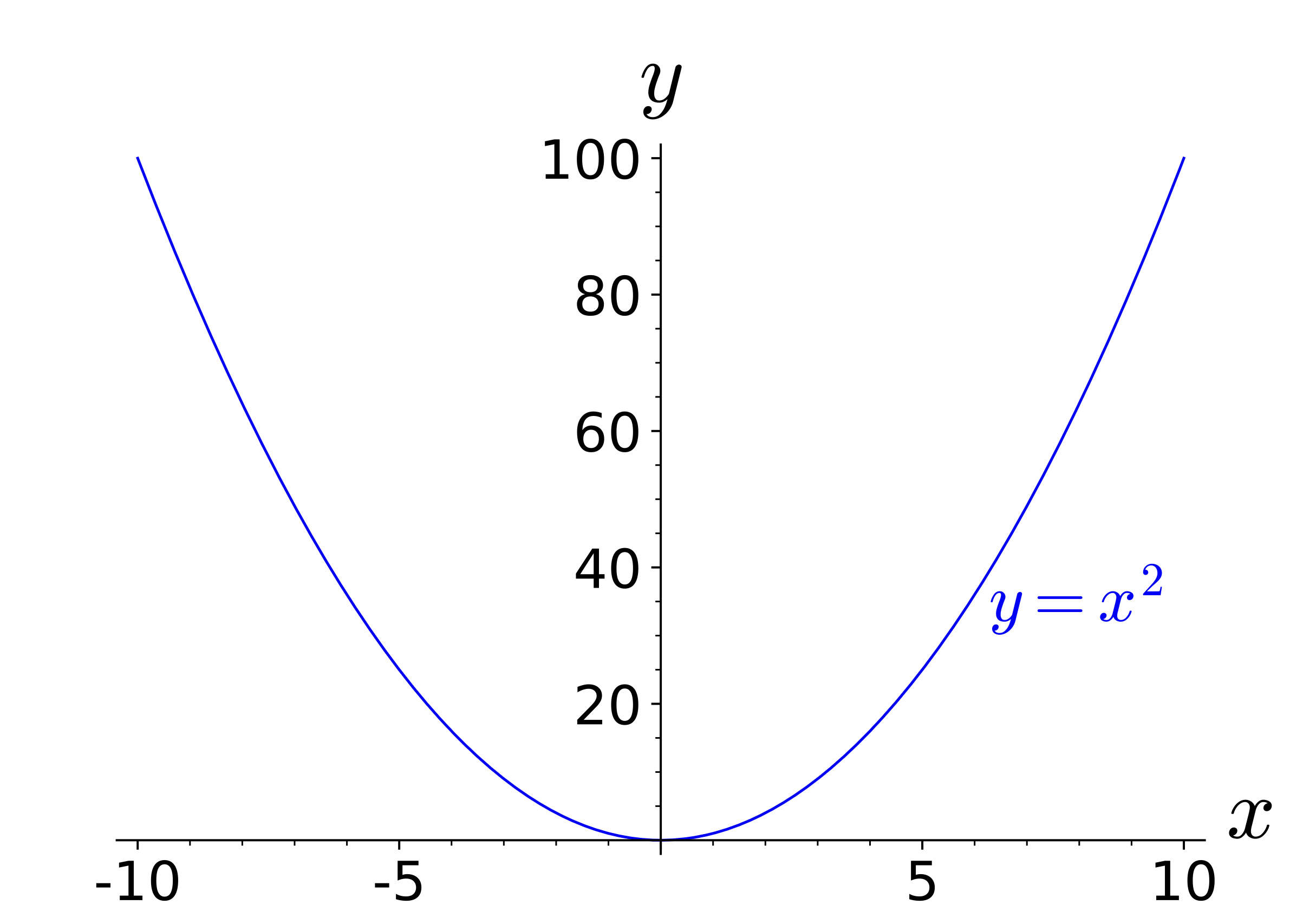
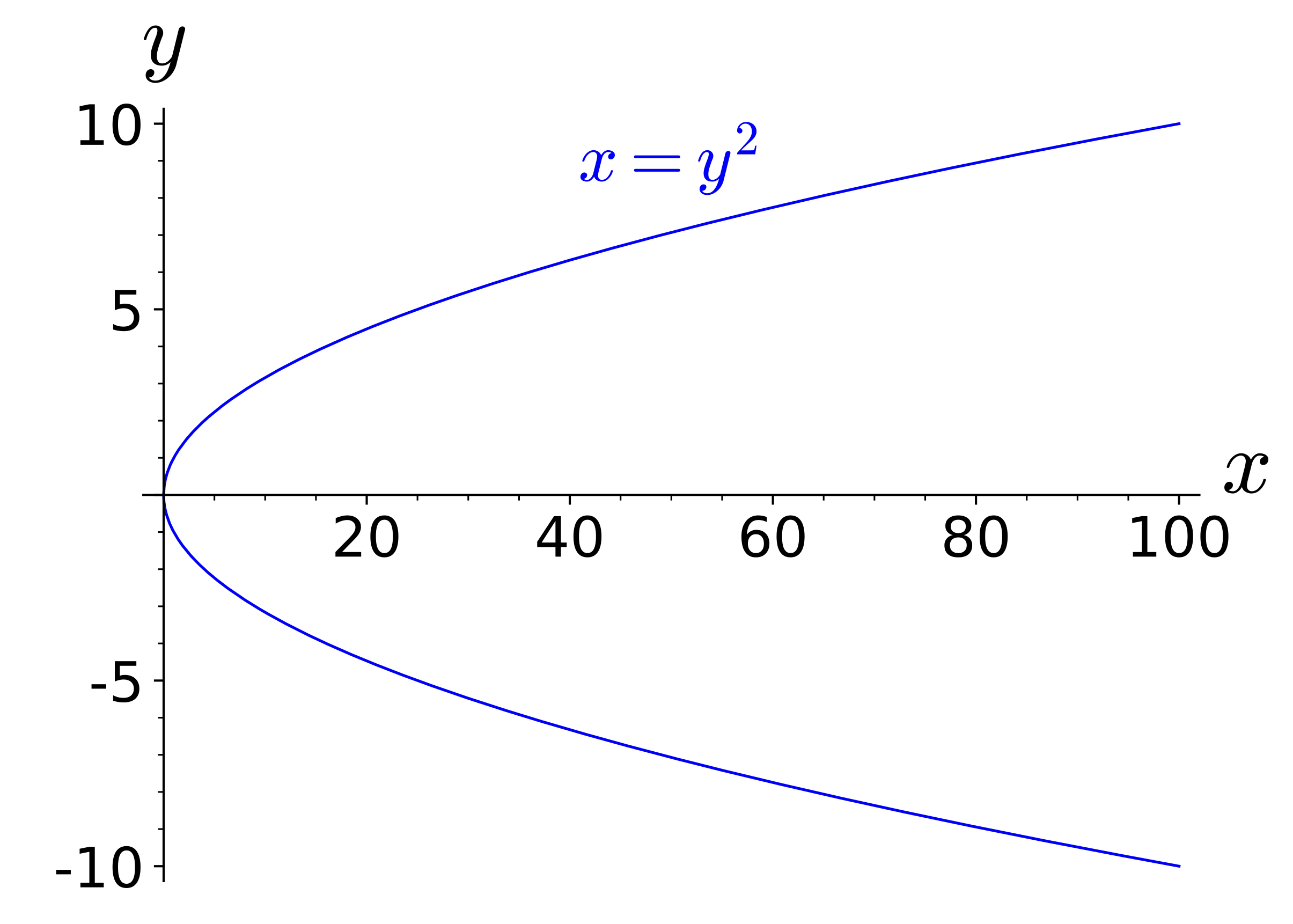
| $y = x^2$ | $y = \pm\sqrt{x}$ | |
|---|---|---|
| Function? | ✓ | ✗ |
| Relation? | ✓ | ✓ |
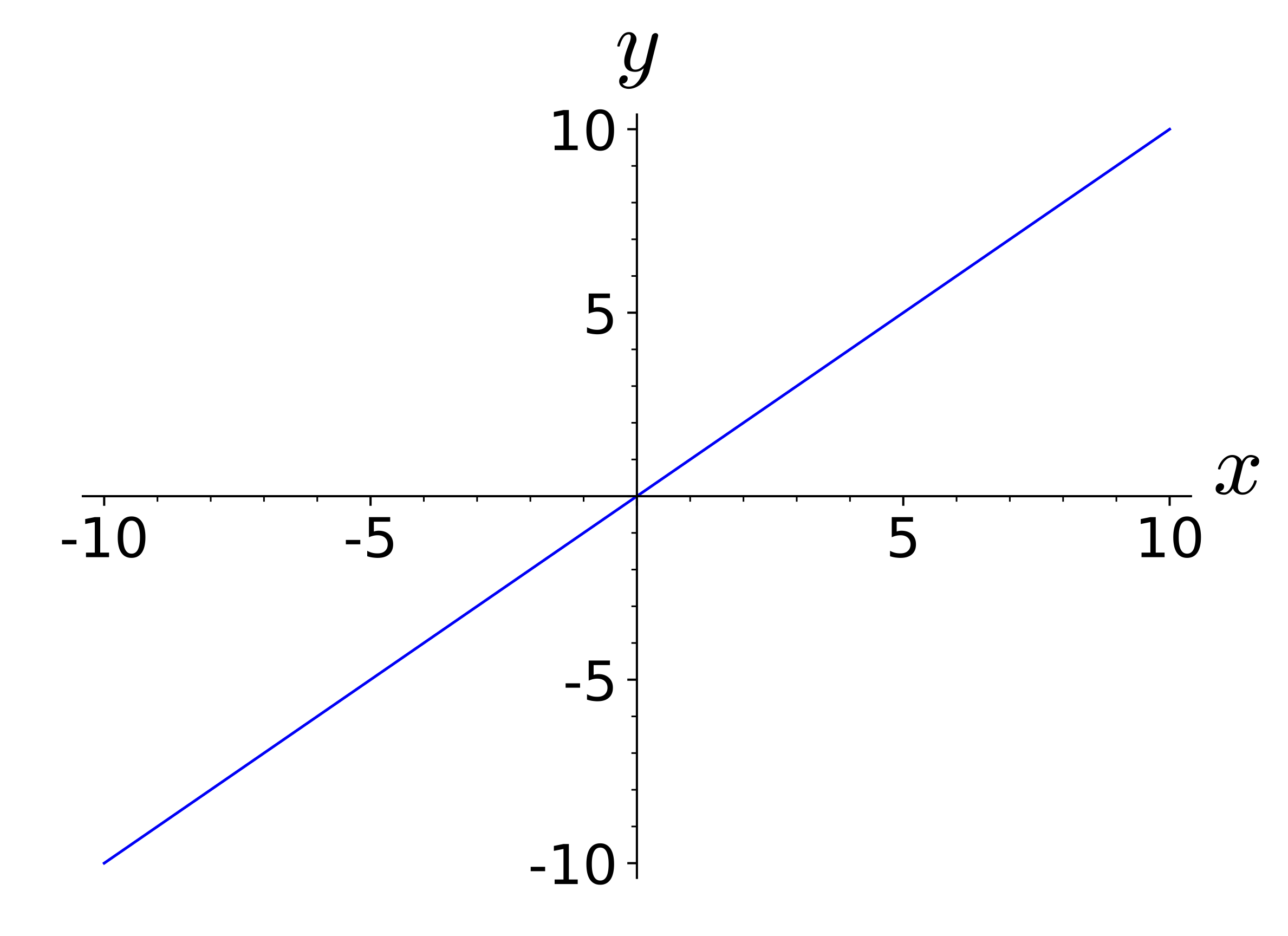
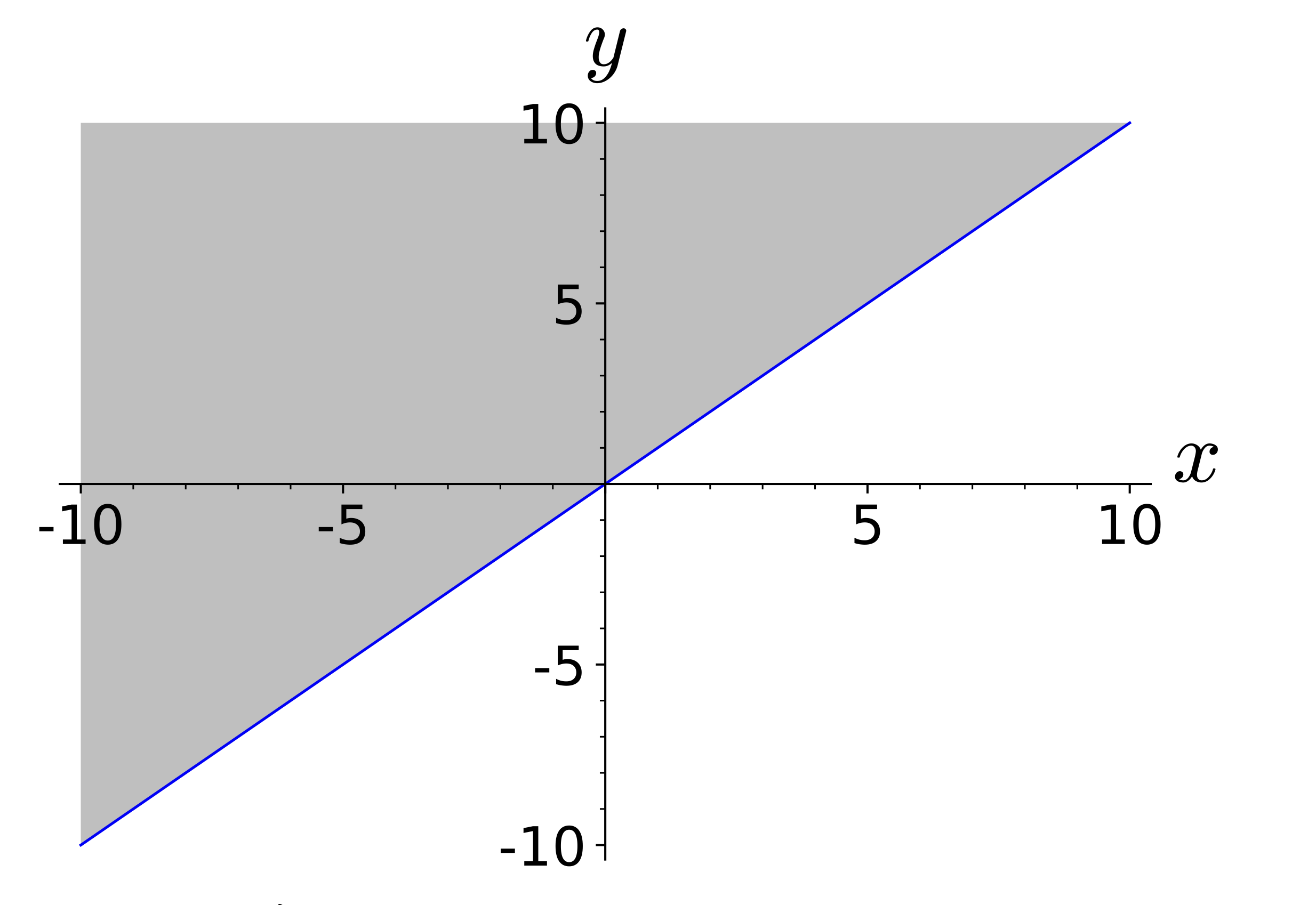
| $y = x$ | $y \ge x$ | |
|---|---|---|
| Function? | ✓ | ✗ |
| Relation? | ✓ | ✓ |
What is a binary relation?
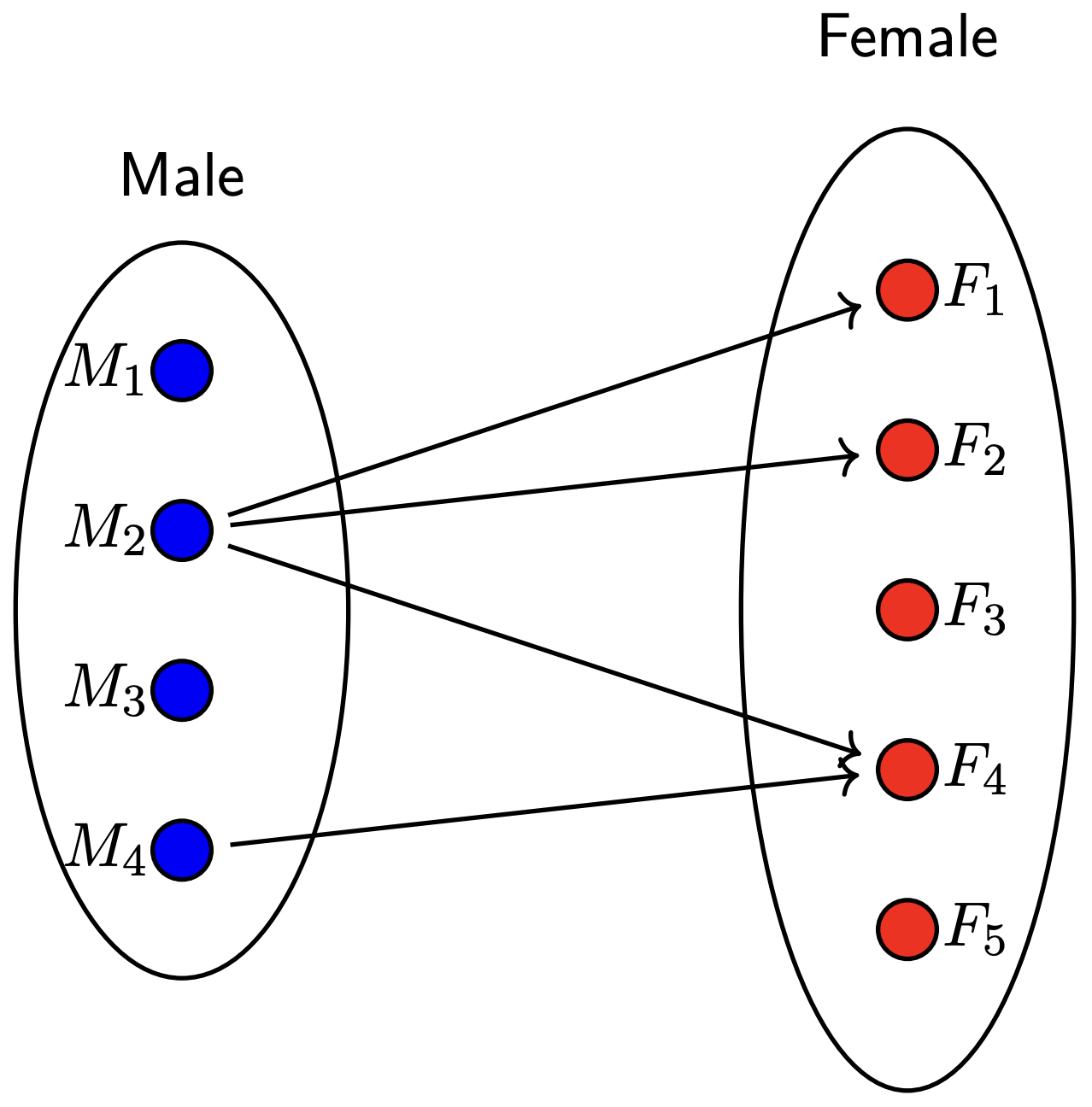
- If $A$ and $B$ are sets, then a binary relation $R$ from $A$ to $B$ is a subset of $A \times B$.
- We say that $x$ is related to $y$ by $R$, written $x \mathrel{R} y$, if, and only if, $(x, y) \in R$. Formally, $\fbox{$x \mathrel{R} y \Leftrightarrow (x, y) \in R$}$.
Set of all functions is a proper subset of the set of all relations.
Example 1: Marriage relation
Example 2: Less than relation
A relation $L: \mathbb{R} \rightarrow \mathbb{R}$ as follows.
For all real numbers $x$ and $y$, $(x, y) \in L \Leftrightarrow x \mathrel{L} y \Leftrightarrow x < y$.
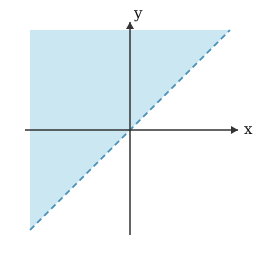
Draw the graph of $L$ as a subset of the Cartesian plane $\mathbb{R} \times \mathbb{R}$.
For all real numbers $x$ and $y$, $(x, y) \in L \Leftrightarrow x \mathrel{L} y \Leftrightarrow x < y$.
Draw the graph of $L$ as a subset of the Cartesian plane $\mathbb{R} \times \mathbb{R}$.
Solution
- $L = \{ (x, y) \mid x \in \mathbb{R}, y \in \mathbb{R}, x < y \}$
- $L = \{ (-10.678, 30.23),\ (17.13, 45.98),\ (100/9, 200),\ \ldots \}$
- Graph:
Example 3: Congruence modulo 2 relation
Define a relation $C: \mathbb{Z} \rightarrow \mathbb{Z}$ as follows.
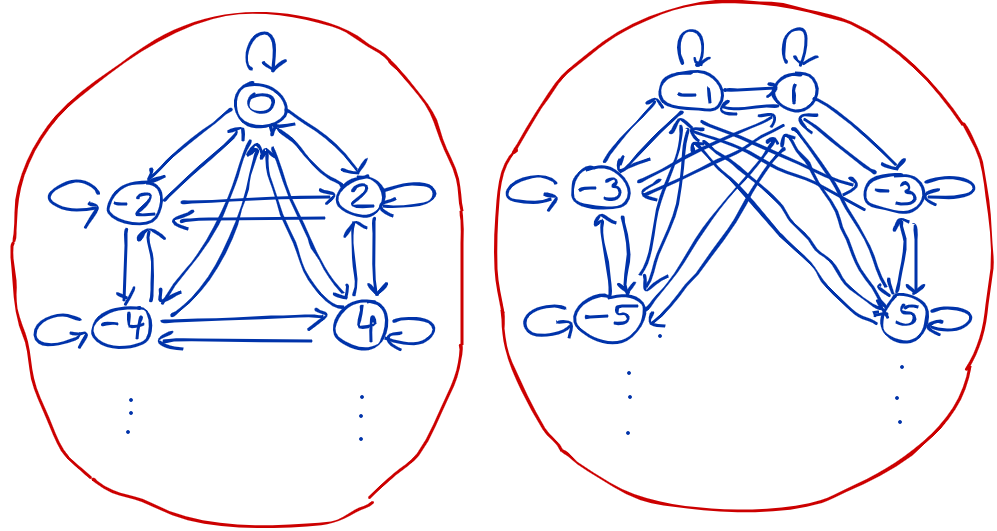
For all $(m, n) \in \mathbb{Z} \times \mathbb{Z}$, $m \mathrel{C} n \Leftrightarrow m - n$ is even.
Prove that if $n$ is any odd integer, then $n \mathrel{C} 1$.
For all $(m, n) \in \mathbb{Z} \times \mathbb{Z}$, $m \mathrel{C} n \Leftrightarrow m - n$ is even.
Prove that if $n$ is any odd integer, then $n \mathrel{C} 1$.
Solution
- $A = \{ (x, y) \mid x \text{ is even},\ y \text{ is even} \}$
$B = \{ (x, y) \mid x \text{ is odd},\ y \text{ is odd} \}$
$C = A \cup B$ - Proof.
Suppose $n$ is odd i.e., $n = 2k + 1$ for some integer $k$.
This implies that $n - 1 = 2k = $ even.
In other words, $n \mathrel{C} 1$ using the congruence modulo 2 definition.
Inverse of a relation
Definition
- Let $R$ be a relation from $A$ to $B$.
Then the inverse relation $R^{-1}$ from $B$ to $A$ is:
$\fbox{$R^{-1} = \{(y, x) \in B \times A ~|~(x, y) \in R\}$}$. - For all $x \in A$ and $y \in B$,
$\fbox{$(x, y) \in R \Leftrightarrow (y, x) \in R^{-1}$}$.
Example: Inverse of a finite relation
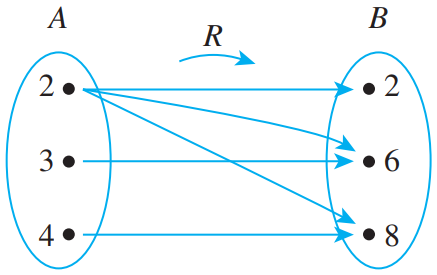
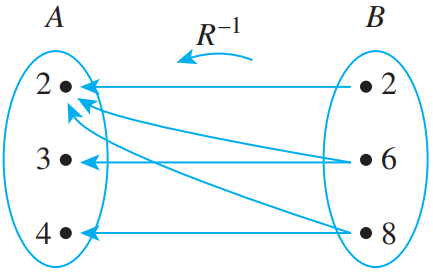
- Let $A = \{2, 3, 4\}$ and $B = \{2, 6, 8\}$.
Let $R: A$ to $B$. For all $(a, b) \in A \times B$, $a \mathrel{R} b \Leftrightarrow a ~|~ b$. - Determine $R$ and $R^{-1}$. Draw arrow diagrams for both.
Describe $R^{-1}$ in words.
Solution
- $R = \{(2, 2),\ (2, 6),\ (2, 8),\ (3, 6),\ (4, 8)\}$
$R^{-1} = \{(2, 2),\ (6, 2),\ (8, 2),\ (6, 3),\ (8, 4)\}$ - For all $(b, a) \in B \times A$,
$(b, a) \in R^{-1} \Leftrightarrow b$ is a multiple of $a$.
Example: Inverse of an infinite relation
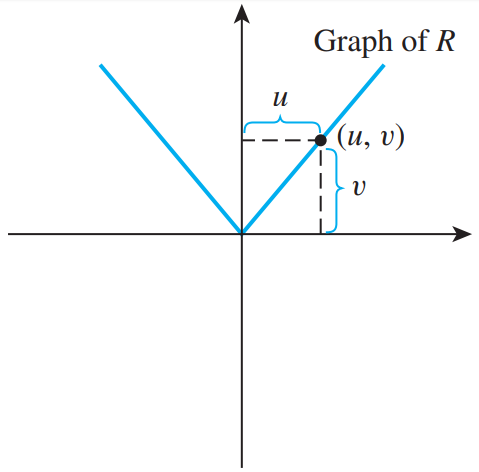
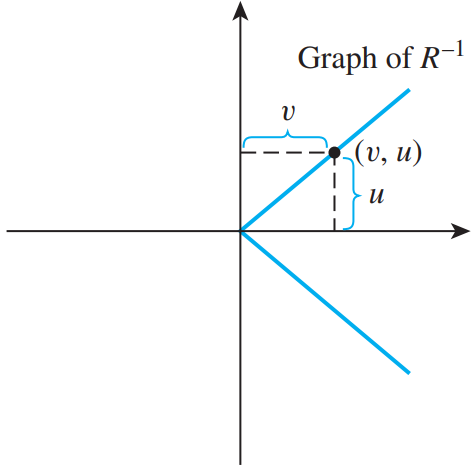
- Define a relation $R$ from $\mathbb{R}$ to $\mathbb{R}$ as follows:
For all $(u, v) \in \mathbb{R} \times \mathbb{R}$, $u \mathrel{R} v \Leftrightarrow v = 2|u|$. - Draw the graphs of $R$ and $R^{-1}$ in the Cartesian plane.
Is $R^{-1}$ a function?
Solution
- $R^{-1}$ is not a function. Why?
Relation on a set
- A relation on a set $A$ is a relation from $A$ to $A$.
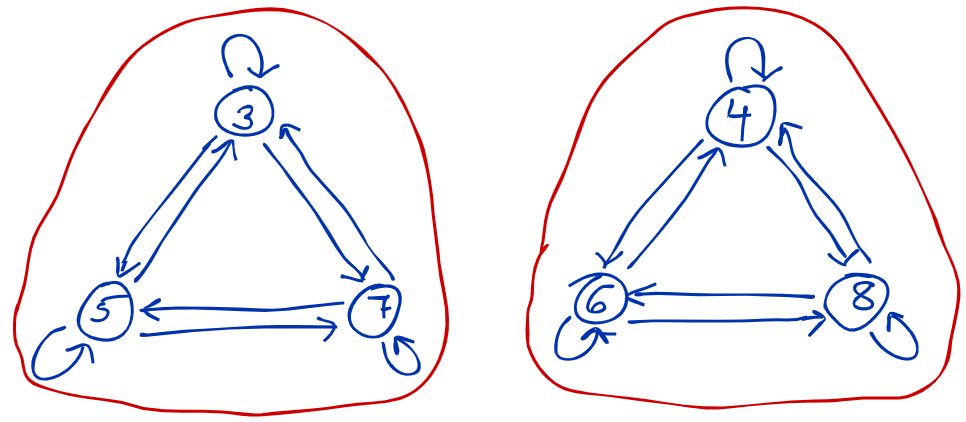
- The resulting arrow diagram is a directed graph possibly containing loops.
Example
- Let $A = \{3, 4, 5, 6, 7, 8\}$. Define relation $R$ on $A$ as follows.
For all $x, y \in A$, $x \mathrel{R} y \Leftrightarrow 2 \mid (x - y)$. Draw the graph of $R$.
Solution
Reflexivity, symmetry, and transitivity
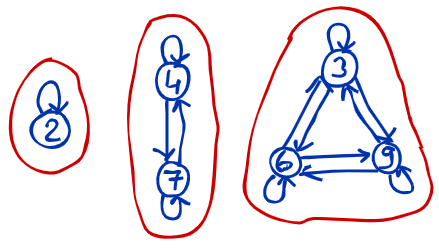
- Set $A = \{ 2, 3, 4, 6, 7, 9 \}$
Relation $R$ on set $A$ is: $\forall x,y \in A$, $x \mathrel{R} y \Leftrightarrow 3 ~|~ (x - y)$.
- Reflexivity. $\forall x \in A,\ (x,x) \in R$.
- Symmetry. $\forall x, y \in A$, if $(x,y) \in R$, then $(y,x) \in R$.
- Transitivity.
$\forall x, y, z \in A$, if $(x,y) \in R$ and $(y,z) \in R$, then $(x,z) \in R$.
Example 1
- $A = \{ 0, 1, 2, 3 \}$.
$R = \{ (0,0),\ (0,1),\ (0,3),\ (1,0),\ (1,1),\ (2,2),\ (3,0),\ (3,3) \}$.
Is $R$ reflexive, symmetric, and transitive?
Solution
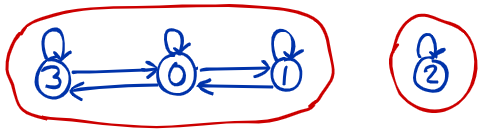
- Reflexive. $\forall x \in A,\ (x,x) \in R$.
- Symmetric. $\forall x, y \in A$, if $(x,y) \in R$, then $(y,x) \in R$.
- Not transitive. e.g.: $(1,0),(0,3) \in R$ but $(1,3) \notin R$.
$\exists x, y, z \in A$, $(x,y) \in R$ and $(y,z) \in R$ but $(x,z) \notin R$.
Example 2
- $A = \{ 0, 1, 2, 3 \}$. $R = \{ (0,0),\ (0,2),\ (0,3),\ (2,3) \}$.
Is $R$ reflexive, symmetric, and transitive?
Solution
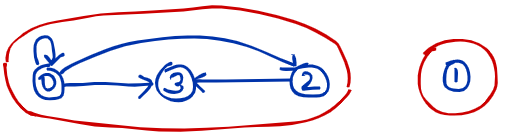
- Not reflexive. e.g.: $(1,1) \notin R$. $\exists x \in A,\ (x,x) \notin R$.
- Not symmetric. e.g.: $(0,3) \in R$ but $(3,0) \notin R$.
$\exists x, y \in A$, $(x,y) \in R$ but $(y,x) \notin R$. - Transitive.
$\forall x, y, z \in A$, if $(x,y) \in R$ and $(y,z) \in R$, then $(x,z) \in R$.
Example 3
- $A = \{ 0, 1, 2, 3 \}$. $R = \{ (0,1),\ (2,3) \}$.
Is $R$ reflexive, symmetric, and transitive?
Solution

- Not reflexive. e.g.: $(0,0) \notin R$. $\exists x \in A,\ (x,x) \notin R$.
- Not symmetric. e.g.: $(0,1) \in R$ but $(1,0) \notin R$.
$\exists x, y \in A$, $(x,y) \in R$ but $(y,x) \notin R$. - Transitive. Why?
$\forall x, y, z \in A$, if $(x,y) \in R$ and $(y,z) \in R$, then $(x,z) \in R$.
Equivalence relation and equivalence class
- Relation $R$ on set $A$ is an equivalence relation iff
$R$ is reflexive, symmetric, and transitive. - Equivalence class of element $a$, denoted by $[a]$, for an equivalence relation is defined as:
$\fbox{$[a] = \{ x \in A ~|~ (x, a) \in R \}$}$
Example: Less than
- Suppose $R$ is a relation on $\mathbb{R}$ such that $x \mathrel{R} y \Leftrightarrow x < y$.
Is $R$ an equivalence relation? If yes, what are the equivalence classes?
Solution
- Not reflexive. e.g.: $0 \not< 0$. $\exists x \in \mathbb{R},\ x \not< x$.
- Not symmetric. e.g.: $0 < 1$ but $1 \not< 0$.
$\exists x, y \in \mathbb{R}$, if $x < y$, then $y \not< x$. - Transitive. $\forall x, y, z \in \mathbb{R}$, if $x < y$ and $y < z$, then $x < z$.
Example: Equality (or Identity relation)
- Suppose $R$ is a relation on $\mathbb{R}$ such that $x \mathrel{R} y \Leftrightarrow x = y$.
Is $R$ an equivalence relation?
Solution
- Reflexive. $\forall x \in \mathbb{R},\ x = x$.
- Symmetric. $\forall x, y \in \mathbb{R}$, if $x = y$, then $y = x$.
- Transitive. $\forall x, y, z \in \mathbb{R}$, if $x = y$ and $y = z$, then $x = z$.
Equivalence classes: $[a] = \{ a \}$.
Example: Partition
- Suppose $R$ is a partition relation on $A$ such that
$\forall x, y \in A$, $x \mathrel{R} y \Leftrightarrow x, y \in A_i$ for some subset $A_i$. - $A = \{ 0, 1, 2, 3, 4 \}$. Partition of $A$ is $\{ \{ 0, 3, 4 \},\ \{ 1 \},\ \{ 2 \} \}$.
Is $R$ an equivalence relation?
Solution
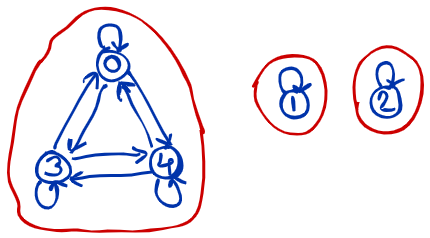
- $R$ is reflexive, symmetric, and transitive.
- So, $R$ is an equivalence relation.
- Equivalence classes: $[0] = \{ 0, 3, 4 \},\ [1] = \{ 1 \},$ and $[2] = \{2 \}$.
Example: Partition
- Suppose $R$ is a partition relation on $A$ such that
$\forall x, y \in A$, $x \mathrel{R} y \Leftrightarrow x, y \in A_i$ for some subset $A_i$.
Is $R$ an equivalence relation?
Solution
- Reflexive. $\forall m \in A$, $(m, m) \in R$.
- Symmetric. $\forall m, n \in A$, if $(m, n) \in R$, then $(n, m) \in R$.
- Transitive.
$\forall m, n, p \in A$, if $(m, n) \in R$ and $(n, p) \in R$, then $(m, p) \in R$.
Example: Least element
- Let $X$ denote the power set of $\{ 1, 2, 3 \}$.
Suppose $R$ is a relation on $X$ such that $\forall A, B \in X$
$A \mathrel{R} B \Leftrightarrow $ Least element of $A$ is same as that of $B$.
Is $R$ an equivalence relation?
Solution
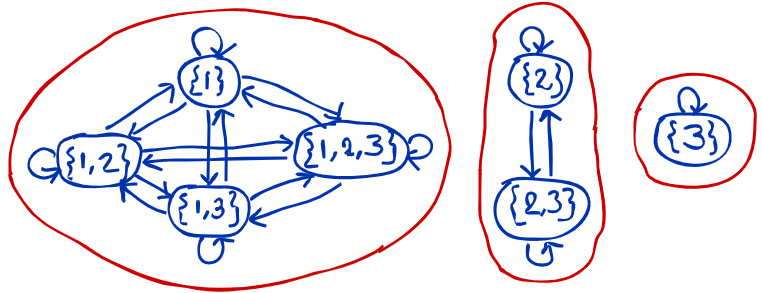
- $R$ is reflexive, symmetric, and transitive.
- So, $R$ is an equivalence relation.
- Equivalence classes: $[\{1\}]$, $[\{2\}]$, and $[\{3\}]$.
Example: Congruence modulo 3
- Suppose $R$ is a relation on $\mathbb{Z}$ such that $m \mathrel{R} n \Leftrightarrow 3 ~|~ (m - n)$.
Is $R$ an equivalence relation?
Solution
- Reflexive. $\forall m \in A,\ 3 ~|~ (m - m)$.
- Symmetric. $\forall m, n \in A$, if $3 ~|~ (m - n)$, then $3 ~|~ (n - m)$.
- Transitive.
$\forall m, n, p \in A$, if $3 ~|~ (m - n)$ and $3 ~|~ (n - p)$, then $3 ~|~ (m - p)$. - So, $R$ is an equivalence relation.
- Equivalence classes.
Three distinct equivalence classes are $[0]$, $[1]$, and $[2]$.
$[0] = \{ a \in \mathbb{Z} ~|~ a \equiv 0 \pmod{3} \} = \{ 0, \pm 3, \pm 6, \pm 9, \ldots \}$
$[1] = \{ a \in \mathbb{Z} ~|~ a \equiv 1 \pmod{3} \} = \{ 1, 1 \pm 3, 1 \pm 6, 1 \pm 9, \ldots \}$
$[2] = \{ a \in \mathbb{Z} ~|~ a \equiv 2 \pmod{3} \} = \{ 2, 2 \pm 3, 2 \pm 6, 2 \pm 9, \ldots \}$
Intuition.
$[0] = $ Set of integers when divided by 3 leave a remainder of $0$.
$[1] = $ Set of integers when divided by 3 leave a remainder of $1$.
$[2] = $ Set of integers when divided by 3 leave a remainder of $2$.
Congruence modulo $n$
Let $a$ and $b$ be integers and $n$ be a positive integer.
The following statements are equivalent:
- $a$ and $b$ leave the same remainder when divided by $n$.
$\fbox{$a \bmod n = b \bmod n$}$ - $\fbox{$n ~|~ (a - b)$}$.
- $a$ is congruent to $b$ modulo $n$.
$\fbox{$a \equiv b \pmod{n}$}$. - $\fbox{$a = b + kn$}$for some integer $k$.
Examples
- $12 \equiv 7 \pmod{5}$
- $6 \equiv -6 \pmod{4}$
- $3 \equiv 3 \pmod{7}$
- Suppose $R$ is a relation on $\mathbb{Z}$ such that
$a \mathrel{R} b \Leftrightarrow a \equiv b \pmod{n}$.
Is $R$ an equivalence relation?
Solution (sketch)
- Reflexive. $\forall a \in \mathbb{Z},\ a \equiv a \pmod{n}$.
- Symmetric.
$\forall a,b \in \mathbb{Z}$, if $a \equiv b \pmod{n}$, then $b \equiv a \pmod{n}$. - Transitive.
$\forall a,b,c \in \mathbb{Z}$, if $a \equiv b \pmod{n}$ and $b \equiv c \pmod{n}$, then $a \equiv c \pmod{n}$.
Equivalence classes: $[0], [1], \ldots, [n - 1]$.
Solution (detailed)
- $R$ is Reflexive. Show that $\forall a \in \mathbb{Z},\ n ~|~ (a - a)$. We know that $a - a = 0$ and $n ~|~ 0$. Hence, $n ~|~ (a - a)$.
- $R$ is Symmetric. Show that $\forall a,b \in \mathbb{Z}$, if $a \equiv b \pmod{n}$, then $b \equiv a \pmod{n}$. We see that $a \equiv b \pmod{n}$ means $n ~|~ (a - b)$.
Let $(a - b) = nk$, for some integer $k$.
$\implies -(a - b) = -nk$ (multiply both sides by $-1$)
$\implies (b - a) = n(-k)$ (simplify)
$\implies n ~|~ (b - a)$ ($-k$ is an integer; use defn. of divisibility)
In other words, $b \equiv a \pmod{n}$. - $R$ is transitive. Show that $\forall a,b,c \in \mathbb{Z}$, if $a \equiv b \pmod{n}$ and $b \equiv c \pmod{n}$, then $a \equiv c \pmod{n}$.
We see that $a \equiv b \pmod{n}$ and $b \equiv c \pmod{n}$ imply that $n ~|~ (a - b)$ and $n ~|~ (b - c)$, respectively.
Let $(a - b) = nk$ and $(b - c) = n\ell$, for some integers $k$ and $\ell$.
Adding the two equations, we get
$(a - c) = (k + \ell)\, n$, where $k + \ell$ is an integer because addition is closed on integers.
By definition of divisibility, $n ~|~ (a - c)$ or $a \equiv c \pmod{n}$.
Modular arithmetic
Let $a, b, c, d, n$ be integers with $n > 1$.
Suppose $a \equiv c \pmod{n}$ and $b \equiv d \pmod{n}$. Then
Suppose $a \equiv c \pmod{n}$ and $b \equiv d \pmod{n}$. Then
- $\fbox{$(a + b) \equiv (c + d) \pmod{n}$}$
- $\fbox{$(a - b) \equiv (c - d) \pmod{n}$}$
- $\fbox{$(ab) \equiv (cd) \pmod{n}$}$
- $\fbox{$(a^m) \equiv (c^m) \pmod{n}$}$ for all positive integers $m$
Units digit
- What is the units digit of $1483^{8650}$?
Solution
- Units digit of $1483^{8650}$ is the units digit of $3^{8650}$.
- Units digit of $3^0, 3^1, 3^2, 3^3$, and $3^4$ are
$1, 3, 9, 7$, and $1$, respectively. - Periodicity is 4. Therefore,
- Units digit of $3^{4k + 0}$ is $1$.
Units digit of $3^{4k + 1}$ is $3$.
Units digit of $3^{4k + 2}$ is $9$.
Units digit of $3^{4k + 3}$ is $7$. - Units digit of $3^{8650} = 3^{4 \times 2162 + 2}$ is $9$.
- Hence, the answer is 9.
Equation solving
- Use modular arithmetic to solve the equations.
$16x + 12y = 32$ and $40x - 9y = 7$.
Solution
- Apply $\bmod~3$ on both sides of the first equation.
$(16x + 12y) \bmod 3 \equiv 32 \bmod 3$
$\implies x \equiv 2 \pmod{3}$
Similarly, apply $\bmod~3$ on both sides of the second equation.
$(40x - 9y) \bmod 3 \equiv 7 \bmod 3$
$\implies x \equiv 1 \pmod{3}$ - These two congruences are contradictory.
Hence, the system of equations does not have a solution.
Universal product code (UPC)
- Check digits are used to reduce errors in universal product codes, tracking operations for shipping, book identification numbers (ISBNs), vehicle numbers, ID for the healthcare industry, etc.
- UPC is a 12-digit number, where the last digit is the check digit.
- Suppose the first 11 digits of the UPC are $a_1 a_2 a_3 a_4 a_5 a_6 a_7 a_8 a_9 a_{10} a_{11}$. Then the check digit can be computed using the following formula
$\fbox{$a_{12} = \left( 210 - k \right) \bmod 10$}$, where
$\fbox{$k = 3(a_1 + a_3 + \cdots + a_{11}) + (a_2 + a_4 + \cdots + a_{10})$}$.
- The first eleven digits of the UPC for a package of ink cartridges are 88442334010. What is the check digit?
Solution
- $k = 3(8 + 4 + 2 + 3 + 0 + 0) + (8 + 4 + 3 + 4 + 1) = 71$
check digit $= (210 - 71) \bmod 10 = 9$