Discrete Mathematics : Functions
Contents
- One-to-one functions
- Onto functions
- One-to-one correspondences
- Inverse functions
- Composition of functions
- Infinite sets
One-to-one functions
What is the difference between the two marriage functions?
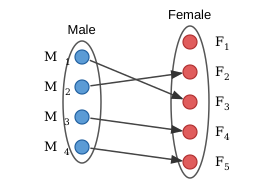
- Every female is a wife of at most one male
- One-to-one function
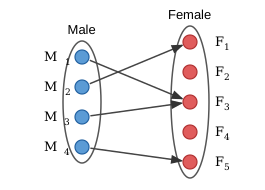
- There is a female who is a wife of at least two males
- Not a one-to-one function
Definition
- A function $F:X \rightarrow Y$ is one-to-one (or injective) iff:
$\forall x_1 \in X, \forall x_2 \in X, \text{if } F(x_1) = F(x_2) \text{ then } x_1 = x_2.$
or equivalently
$\forall x_1 \in X, \forall x_2 \in X, \text{if } x_1 \neq x_2 \text{ then } F(x_1) \neq F(x_2).$ - A function $F:X \rightarrow Y$ is not one-to-one (or non-injective) iff:
$\exists x_1 \in X, \exists x_2 \in X, F(x_1) = F(x_2) \text{ and } x_1 \ne x_2.$
Template
Proof: Direct proof.
- Suppose $x_1, x_2 \in X$ such that $f(x_1) = f(x_2)$.
- Show that $x_1 = x_2$.
Proof: Counterexample.
- Find $x_1, x_2 \in X$ such that $f(x_1) = f(x_2)$ but $x_1 \neq x_2$.
Example 1
Proof:
Direct proof.
\begin{align*}
& \text{Suppose } f(x_1) = f(x_2). \\
& \implies 4x_1 - 1 = 4x_2 - 1 \quad & \text{(Defn. of } f\text{)} \\
& \implies 4x_1 = 4x_2 \quad & \text{(Add 1 on both sides)} \\
& \implies x_1 = x_2 \quad & \text{(Divide by 4)} \\
\end{align*}
Hence, $f$ is one-to-one.
Example 2
Proof (Invalid):
Direct proof.
\begin{align*}
& \text{Suppose } g(n_1) = g(n_2). \\
& \implies n_1^2 = n_2^2 \quad & \text{(Defn. of } g\text{)} \\
& \implies n_1 = n_2 \quad & \text{(Taking square root)} \\
\end{align*}
Hence, $g$ is one-to-one.
Incorrect! What's wrong?
Proof:
Counterexample.
- Let $n_1 = -1$ and $n_2 = 1$.
$g(n_1) = (-1)^2 = 1$ and $g(n_2) = 1^2 = 1$
$\implies g(n_1) = g(n_2)$ but $n_1 \ne n_2$ - Hence, $g$ is not one-to-one.
Onto functions
What is the difference between the two marriage functions?
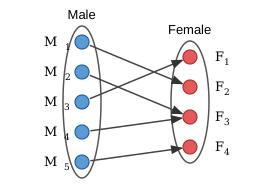
- Every female is a wife
- Onto function
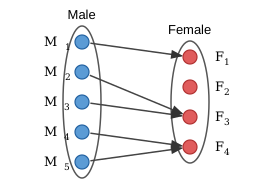
- There is a female who is not a wife
- Not an onto function
Definition
- A function $F:X \rightarrow Y$ is onto (or surjective) if and only if for any $y \in Y$ there exists $x \in X$ such that $y = F(x)$.
- $F$ is onto $\;\Leftrightarrow\;$ $\forall\, y \in Y,\; \exists\, x \in X$ such that $F(x) = y$.
- $F$ is not onto $\;\Leftrightarrow\;$ $\exists\, y \in Y,\; \forall\, x \in X,\; F(x) \ne y$.
Template
Proof
Direct proof.
- Suppose $y$ is any element of $Y$.
- Show there exists $x \in X$ with $F(x) = y$.
Proof:
Counterexample.
- Find $y \in Y$ such that $y \ne F(x)$ for any $x \in X$.
Example 1
Proof:
Direct proof.
\begin{align*}
& \text{Let } y \in \mathbb{R}. \text{ Set } x = \frac{y+1}{4}. \text{ Then:} \\
& f\!\left(\frac{y+1}{4}\right) = 4 \cdot \frac{y+1}{4} - 1 = y \quad & \text{(Defn. of } f\text{, then simplify)}
\end{align*}
Hence, $f$ is onto.
Example 2
Proof (Invalid):
Direct proof.
\begin{align*}
& \text{Let } m \in \mathbb{Z}. \text{ Set } n = \frac{m+1}{4}. \text{ Then:} \\
& g\!\left(\frac{m+1}{4}\right) = 4 \cdot \frac{m+1}{4} - 1 = m \quad & \text{(Defn. of } g\text{, then simplify)}
\end{align*}
Hence, $g$ is onto.
Incorrect! What's wrong?
Proof:
Counterexample.
- Suppose $g(n) = 0$ for some $n \in \mathbb{Z}$: \begin{align*} 4n - 1 = 0 \implies n = \frac{1}{4} \quad & \text{(Defn. of } g\text{, then simplify)} \end{align*} But $\frac{1}{4} \notin \mathbb{Z}$, so $g(n) \ne 0$ for any integer $n$.
- Hence, $g$ is not onto.
One-to-one correspondences
What is the difference between the three marriage functions?
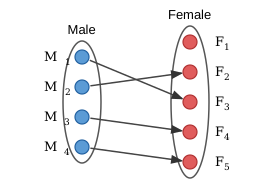
- Every female is a wife of at most one male
- One-to-one
- Not onto
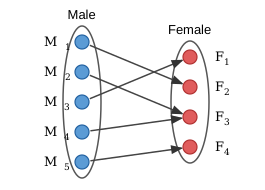
- Every female is a wife
- Onto
- Not one-to-one
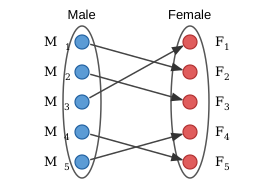
- Every female is a wife of exactly one male
- One-to-one
- Onto
Example 1
| Subset of $\{a,b,c,d\}$ | 4-tuple of $\{0,1\}$ | |
|---|---|---|
| $\{\ \}$ | $\to$ | $(0,0,0,0)$ |
| $\{a\}$ | $\to$ | $(1,0,0,0)$ |
| $\{b\}$ | $\to$ | $(0,1,0,0)$ |
| $\{c\}$ | $\to$ | $(0,0,1,0)$ |
| $\{d\}$ | $\to$ | $(0,0,0,1)$ |
| $\{a,b\}$ | $\to$ | $(1,1,0,0)$ |
| $\{a,c\}$ | $\to$ | $(1,0,1,0)$ |
| $\{a,d\}$ | $\to$ | $(1,0,0,1)$ |
| $\{b,c\}$ | $\to$ | $(0,1,1,0)$ |
| $\{b,d\}$ | $\to$ | $(0,1,0,1)$ |
| $\{c,d\}$ | $\to$ | $(0,0,1,1)$ |
| $\{a,b,c\}$ | $\to$ | $(1,1,1,0)$ |
| $\{a,b,d\}$ | $\to$ | $(1,1,0,1)$ |
| $\{a,c,d\}$ | $\to$ | $(1,0,1,1)$ |
| $\{b,c,d\}$ | $\to$ | $(0,1,1,1)$ |
| $\{a,b,c,d\}$ | $\to$ | $(1,1,1,1)$ |
Example 2
Proof:
To show $F$ is a one-to-one correspondence, we show:
- $F$ is one-to-one.
Suppose $F(x_1,y_1) = F(x_2,y_2)$. \begin{align*} & \implies (x_1{+}y_1,\; x_1{-}y_1) = (x_2{+}y_2,\; x_2{-}y_2) \quad & \text{(Defn. of } F\text{)} \\ & \implies x_1{+}y_1 = x_2{+}y_2 \text{ and } x_1{-}y_1 = x_2{-}y_2 \quad & \text{(Equality of ordered pairs)} \\ & \implies x_1 = x_2 \text{ and } y_1 = y_2 \quad & \text{(Solving the two equations)} \\ & \implies (x_1, y_1) = (x_2, y_2) \quad & \text{(Equality of ordered pairs)} \\ \end{align*} Hence, $F$ is one-to-one. - $F$ is onto.
Let $(u,v) \in \mathbb{R}{\times}\mathbb{R}$. Set $r = \frac{u+v}{2}$ and $s = \frac{u-v}{2}$. Then: $$F(r,s) = \left(\frac{u+v}{2}+\frac{u-v}{2},\;\frac{u+v}{2}-\frac{u-v}{2}\right) = (u,v).$$ Hence, $F$ is onto.
Inverse functions
What is the difference between the two marriage functions?
- Input: male. Output: female.
- $F$
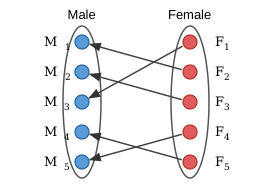
- Input: female. Output: male.
- $F^{-1}$
Definition
- Suppose $F: X \rightarrow Y$ is a one-to-one correspondence. The inverse function $F^{-1}: Y \rightarrow X$ is defined by: given any $y \in Y$, $F^{-1}(y)$ is the unique $x \in X$ such that $F(x) = y$.
- $F^{-1}(y) = x \;\Leftrightarrow\; y = F(x)$.
Example 1
| Subset of $\{a,b,c,d\}$ | 4-tuple of $\{0,1\}$ | |
|---|---|---|
| $\{\ \}$ | $\leftarrow$ | $(0,0,0,0)$ |
| $\{a\}$ | $\leftarrow$ | $(1,0,0,0)$ |
| $\{b\}$ | $\leftarrow$ | $(0,1,0,0)$ |
| $\{c\}$ | $\leftarrow$ | $(0,0,1,0)$ |
| $\{d\}$ | $\leftarrow$ | $(0,0,0,1)$ |
| $\{a,b\}$ | $\leftarrow$ | $(1,1,0,0)$ |
| $\{a,c\}$ | $\leftarrow$ | $(1,0,1,0)$ |
| $\{a,d\}$ | $\leftarrow$ | $(1,0,0,1)$ |
| $\{b,c\}$ | $\leftarrow$ | $(0,1,1,0)$ |
| $\{b,d\}$ | $\leftarrow$ | $(0,1,0,1)$ |
| $\{c,d\}$ | $\leftarrow$ | $(0,0,1,1)$ |
| $\{a,b,c\}$ | $\leftarrow$ | $(1,1,1,0)$ |
| $\{a,b,d\}$ | $\leftarrow$ | $(1,1,0,1)$ |
| $\{a,c,d\}$ | $\leftarrow$ | $(1,0,1,1)$ |
| $\{b,c,d\}$ | $\leftarrow$ | $(0,1,1,1)$ |
| $\{a,b,c,d\}$ | $\leftarrow$ | $(1,1,1,1)$ |
Example 2
Proof:
For any $y \in \mathbb{R}$, find $x$ such that $f(x) = y$:
\begin{align*}
& 4x - 1 = y \quad & \text{(Defn. of } f\text{)} \\
& \implies x = \frac{y+1}{4} \quad & \text{(Simplify)} \\
\end{align*}
Hence, $f^{-1}(y) = \dfrac{y+1}{4}$.
Example 3
Proof:
- $F^{-1}$ is one-to-one. Suppose $F^{-1}(y_1) = F^{-1}(y_2) = x$. Then $y_1 = F(x) = y_2$.
- $F^{-1}$ is onto. For any $x \in X$, let $y = F(x) \in Y$. Then $F^{-1}(y) = x$.
Composition of functions
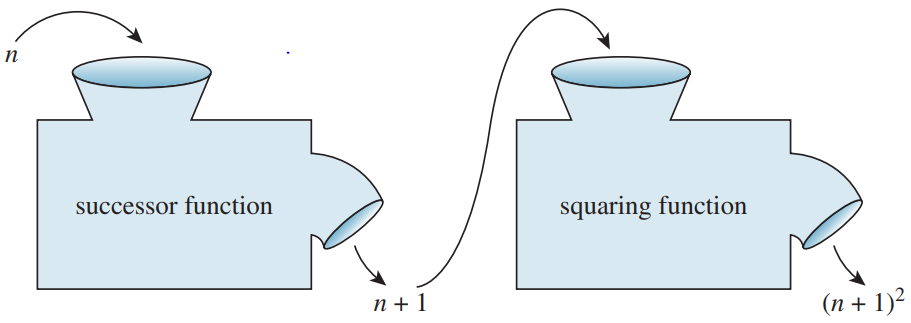
Definition
$(g \circ f)(x) = g(f(x)) \text{ for all } x \in X.$
Read: “$g$ circle $f$”; $g(f(x))$ is “$g$ of $f$ of $x$.”
Example 1
Solution:
- $g \circ f$: $(g \circ f)(n) = g(n+1) = (n+1)^2$.
- $f \circ g$: $(f \circ g)(n) = f(n^2) = n^2 + 1$.
- $g \circ f \ne f \circ g$: e.g., $(g \circ f)(1) = 4$ but $(f \circ g)(1) = 2$.
Example 2
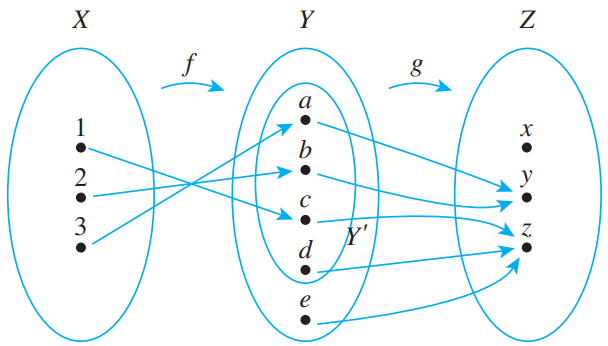
Solution:
- Range of $g \circ f = \{ y, z \}$.
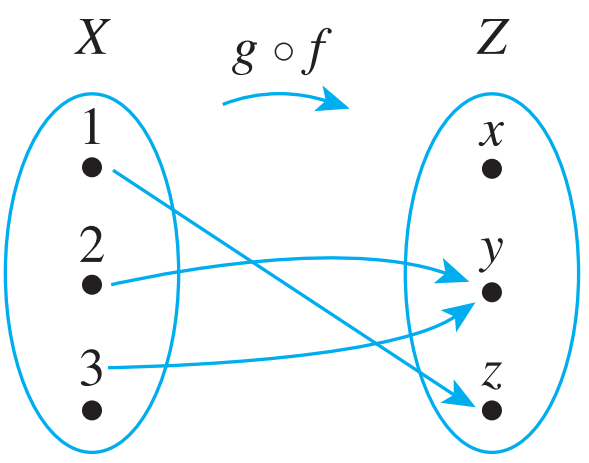
Example 3
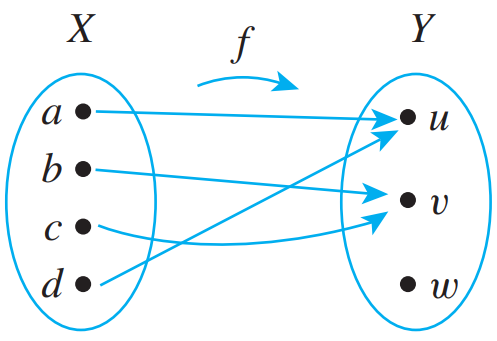
Solution:
$f \circ I_X = f$.
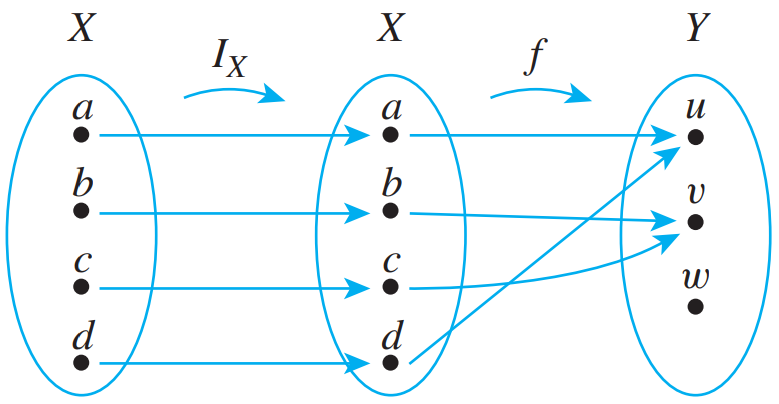
- $(f \circ I_X)(a) = f(I_X(a)) = f(a) = u$
- $(f \circ I_X)(b) = f(I_X(b)) = f(b) = v$
- $(f \circ I_X)(c) = f(I_X(c)) = f(c) = v$
- $(f \circ I_X)(d) = f(I_X(d)) = f(d) = u$
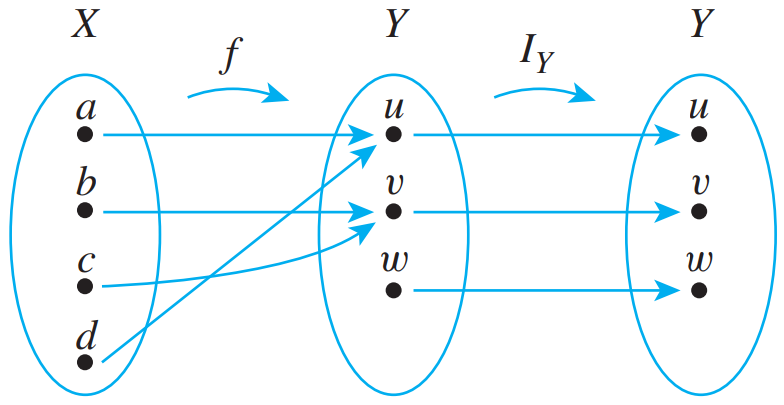
- $(I_Y \circ f)(a) = I_Y(f(a)) = I_Y(u) = u$
- $(I_Y \circ f)(b) = I_Y(f(b)) = I_Y(v) = v$
- $(I_Y \circ f)(c) = I_Y(f(c)) = I_Y(v) = v$
- $(I_Y \circ f)(d) = I_Y(f(d)) = I_Y(u) = u$
Proof:
- $f \circ I_X = f$: $(f \circ I_X)(x) = f(I_X(x)) = f(x)$.
- $I_Y \circ f = f$: $(I_Y \circ f)(x) = I_Y(f(x)) = f(x)$.
Example 4
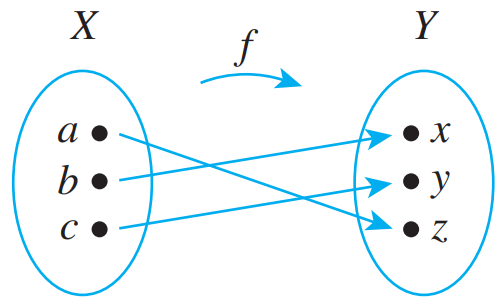
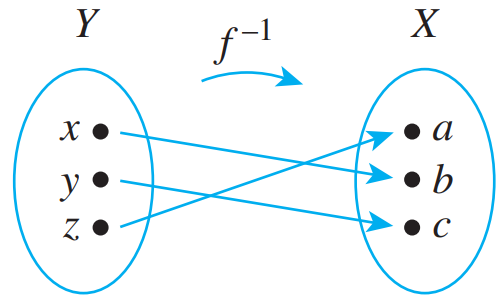
Solution:
$f^{-1} \circ f = I_X$:
- $(f^{-1} \circ f)(a) = f^{-1}(z) = a = I_X(a)$
- $(f^{-1} \circ f)(b) = f^{-1}(x) = b = I_X(b)$
- $(f^{-1} \circ f)(c) = f^{-1}(y) = c = I_X(c)$
- $(f \circ f^{-1})(x) = f(b) = x = I_Y(x)$
- $(f \circ f^{-1})(y) = f(c) = y = I_Y(y)$
- $(f \circ f^{-1})(z) = f(a) = z = I_Y(z)$
Proof:
- $f^{-1} \circ f = I_X$. Let $x \in X$. Suppose $f^{-1}(f(x)) = x'$. \begin{align*} & \implies f(x') = f(x) \quad & \text{(Defn. of inverse)} \\ & \implies x' = x \quad & \text{(}f \text{ is one-to-one)} \\ \end{align*} Hence $(f^{-1} \circ f)(x) = x$, so $f^{-1} \circ f = I_X$.
- $f \circ f^{-1} = I_Y$. Let $y \in Y$. Suppose $f(f^{-1}(y)) = y'$. \begin{align*} & \implies f^{-1}(y') = f^{-1}(y) \quad & \text{(Defn. of inverse)} \\ & \implies y' = y \quad & \text{(}f^{-1} \text{ is one-to-one)} \\ \end{align*} Hence $(f \circ f^{-1})(y) = y$, so $f \circ f^{-1} = I_Y$.
Example 5
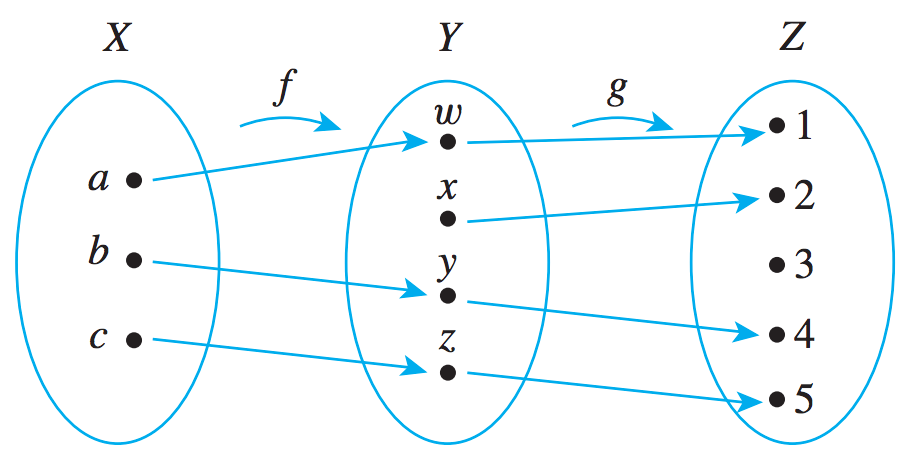
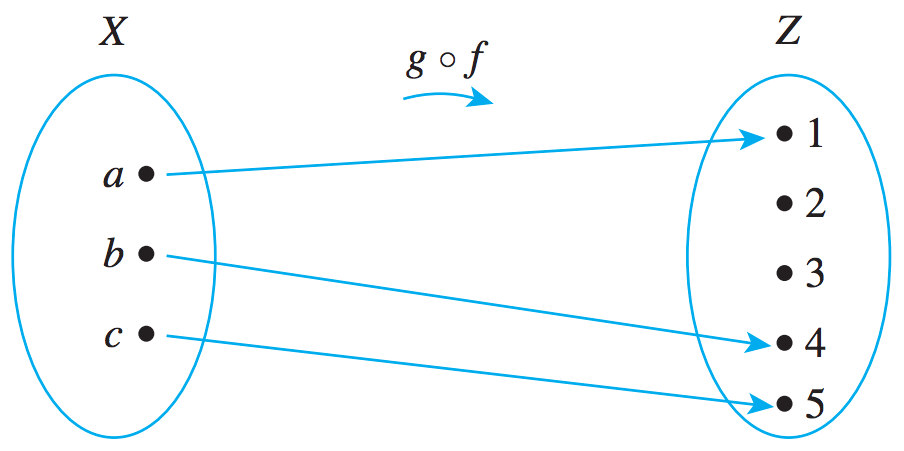
Proof:
Direct proof.
\begin{align*}
& \text{Suppose } (g \circ f)(x_1) = (g \circ f)(x_2). \\
& \implies g(f(x_1)) = g(f(x_2)) && \text{(Defn. of composition)} \\
& \implies f(x_1) = f(x_2) && \text{(}g \text{ is one-to-one)} \\
& \implies x_1 = x_2 && \text{(}f \text{ is one-to-one)} \\
\end{align*}
Hence, $g \circ f$ is one-to-one.
Example 6
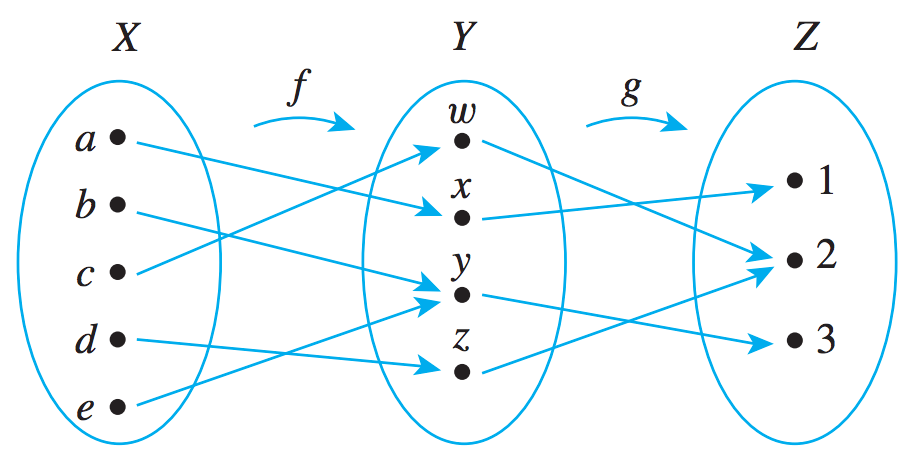
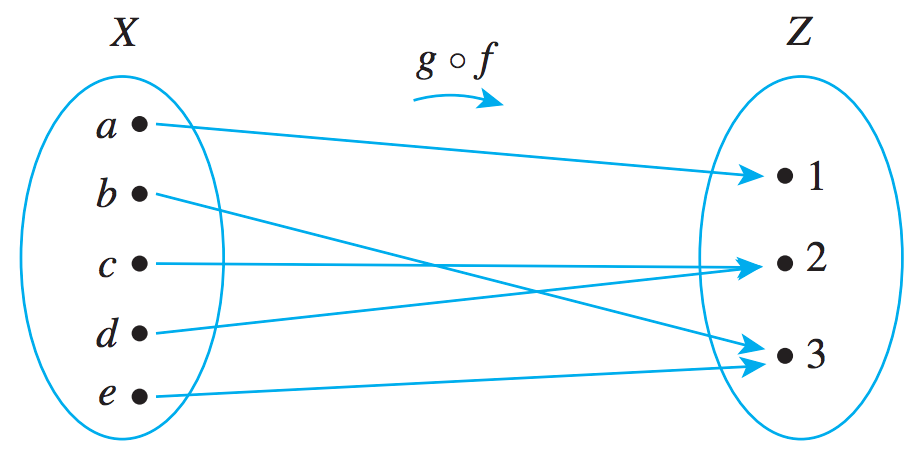
Proof (Core idea):
Proof:
Direct proof.
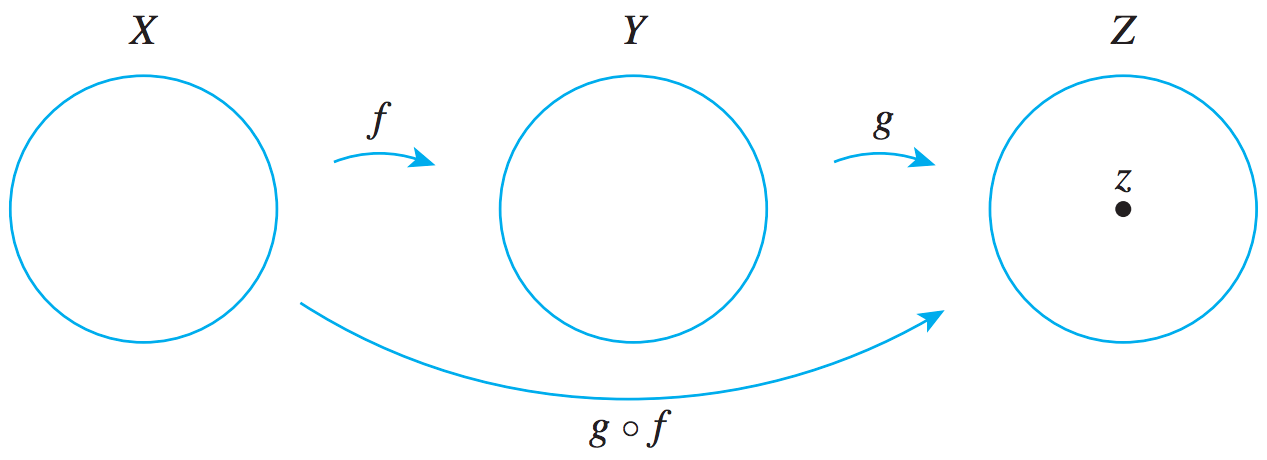
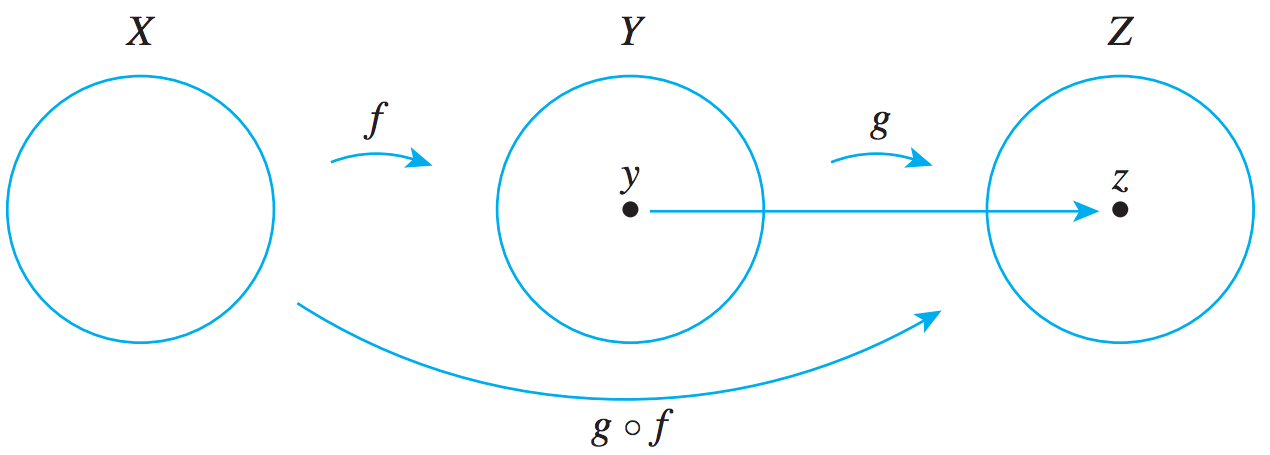
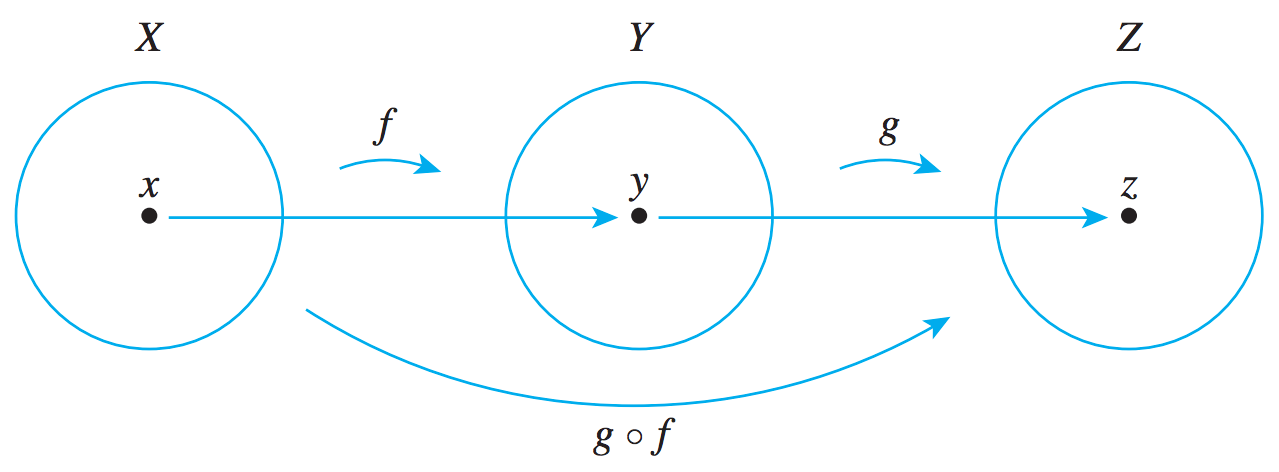
- Let $z \in Z$. Since $g$ is onto, $\exists\, y \in Y$ with $g(y) = z$. Since $f$ is onto, $\exists\, x \in X$ with $f(x) = y$. Then $(g \circ f)(x) = g(f(x)) = g(y) = z$.
- Hence, $g \circ f$ is onto.
Infinite sets
Comparing set sizes
Solution:
- Remove one apple and one mango simultaneously. Repeat until a bag is empty.
- If both bags are empty, they have the same number of fruits.
- If one bag is empty and the other is not, the bag which is not empty has more number of fruits.
Comparing set sizes using one-to-one correspondences
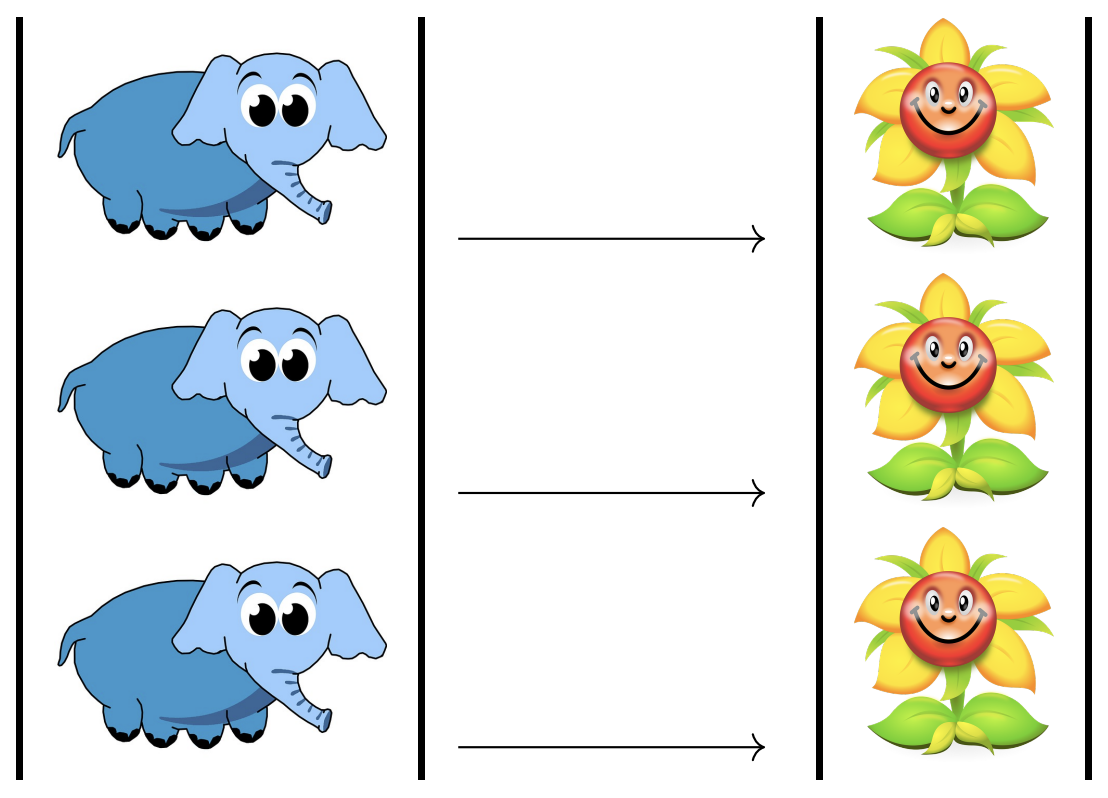
- Two finite sets are of the same size if there is a one-to-one correspondence between them.
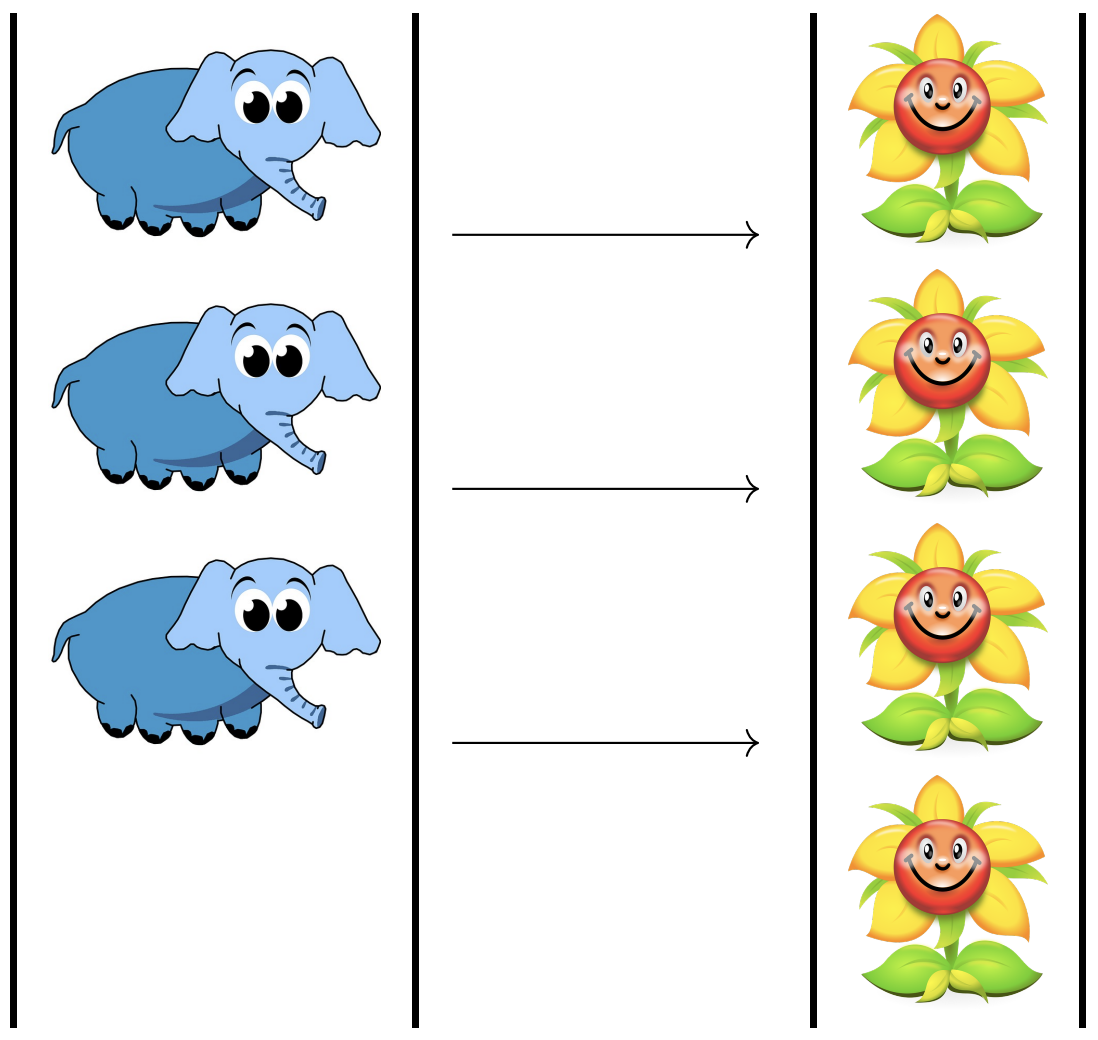
- Two finite sets are not of the same size if there is no one-to-one correspondence between them.
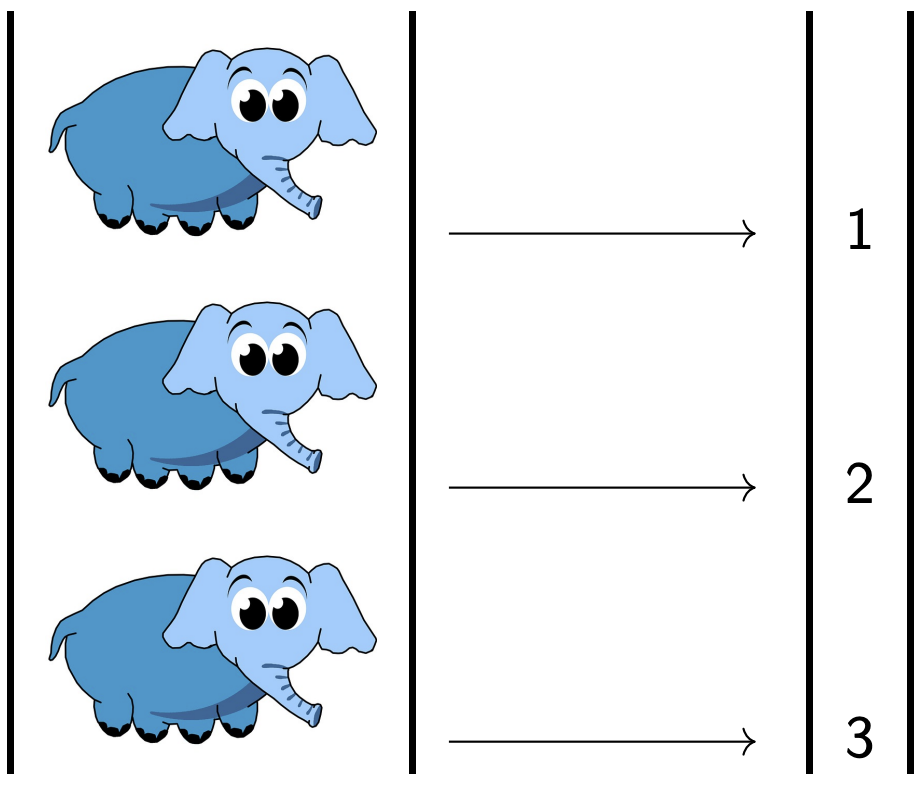
- A finite set is one that is empty or can be put into one-to-one correspondence with $\{1, 2, \ldots, n\}$ for some positive integer $n$.
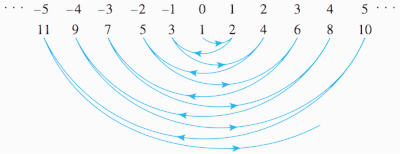
- An infinite set is a nonempty set that cannot be put into one-to-one correspondence with $\{1, 2, \ldots, n\}$ for any positive integer $n$.
Cardinality
- $A$ has the same cardinality as $B$ if and only if there is a one-to-one correspondence from $A$ to $B$.
- $A$ has the same cardinality as $B$ if and only if there is a function $f: A \to B$ that is both one-to-one and onto.
$A$ and $B$ have the same cardinality if and only if $A$ has the same cardinality as $B$ or $B$ has the same cardinality as $A$.
Properties: For all sets $A$, $B$, $C$:
- Reflexive: $A$ has the same cardinality as $A$.
- Symmetric: If $A$ has the same cardinality as $B$, then $B$ has the same cardinality as $A$.
- Transitive: If $A$ has the same cardinality as $B$ and $B$ has the same cardinality as $C$, then $A$ has the same cardinality as $C$.
$|\mathbb{Z}| = |\mathbb{Z}^{\text{even}}|$

- There is no one-to-one correspondence between the two sets.
- So, $|\mathbb{Z}| \ne |\mathbb{Z}^{\text{even}}|$.
- Incorrect! What's wrong?
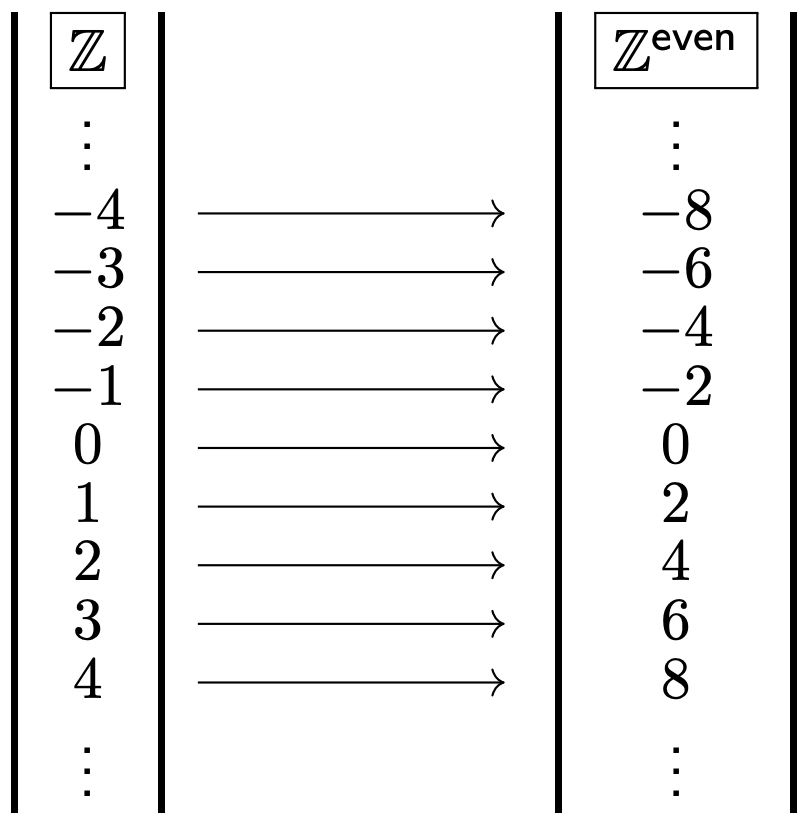
- Failing to find a correspondence doesn't mean one doesn't exist.
- There is a one-to-one correspondence: $f(n) = 2n$.
- So, $|\mathbb{Z}| = |\mathbb{Z}^{\text{even}}|$.
Proof
- Define $f: \mathbb{Z} \to \mathbb{Z}^{\text{even}}$ by $f(n) = 2n$.
- $f$ is one-to-one:
$f(n_1) = f(n_2) \implies 2n_1 = 2n_2 \implies n_1 = n_2.$ - $f$ is onto: for any $m \in \mathbb{Z}^{\text{even}}$, write $m = 2k$ ($k \in \mathbb{Z}$); then $f(k) = m$.
Take-home lesson

Countable sets
| $\mathbb{N}$ | $A$ | |
|---|---|---|
| $1$ | $\to$ | “First” element of $A$ |
| $2$ | $\to$ | “Second” element of $A$ |
| $3$ | $\to$ | “Third” element of $A$ |
| $4$ | $\to$ | “Fourth” element of $A$ |
| $5$ | $\to$ | “Fifth” element of $A$ |
| $\vdots$ | $\vdots$ |
- A set is countably infinite if it has the same cardinality as $\mathbb{N}$.
- A set is countable if it is finite or countably infinite. Otherwise it is uncountable.
$\mathbb{Z}$ is countable
Solution
| $\mathbb{N}$ | $\mathbb{Z}$ | |
|---|---|---|
| $1$ | $\to$ | $0$ |
| $2$ | $\to$ | $1$ |
| $3$ | $\to$ | $-1$ |
| $4$ | $\to$ | $2$ |
| $5$ | $\to$ | $-2$ |
| $\vdots$ | $\vdots$ | |
| $n$ | $\to$ | $f(n)$ |
| $\vdots$ | $\vdots$ |
- Define $f: \mathbb{N} \to \mathbb{Z}$ by: $$f(n) = \left. \begin{cases} \dfrac{n}{2} & \text{if } n \text{ is even},\\[6pt] -\!\left\lfloor\dfrac{n}{2}\right\rfloor & \text{if } n \text{ is odd}. \end{cases} \right\}$$
- $f$ is a one-to-one correspondence, so $\mathbb{Z}$ is countable.
$Q^{+}$ is countable
| $\mathbb{N}$ | $\mathbb{Q}^{+}$ | |
|---|---|---|
| $\vdots$ | ||
| $1$ | $\to$ | $\dfrac{1}{1}$ |
| $\vdots$ | ||
| $2$ | $\to$ | $\dfrac{2}{1}$ |
| $\vdots$ | ||
| $3$ | $\to$ | $\dfrac{3}{1}$ |
| $\vdots$ | $\vdots$ |
- This mapping misses most rationals — not a valid one-to-one correspondence.
- Incorrect! What's wrong?
- Failing to find a one-to-one correspondence does not mean one doesn't exist.
Solution
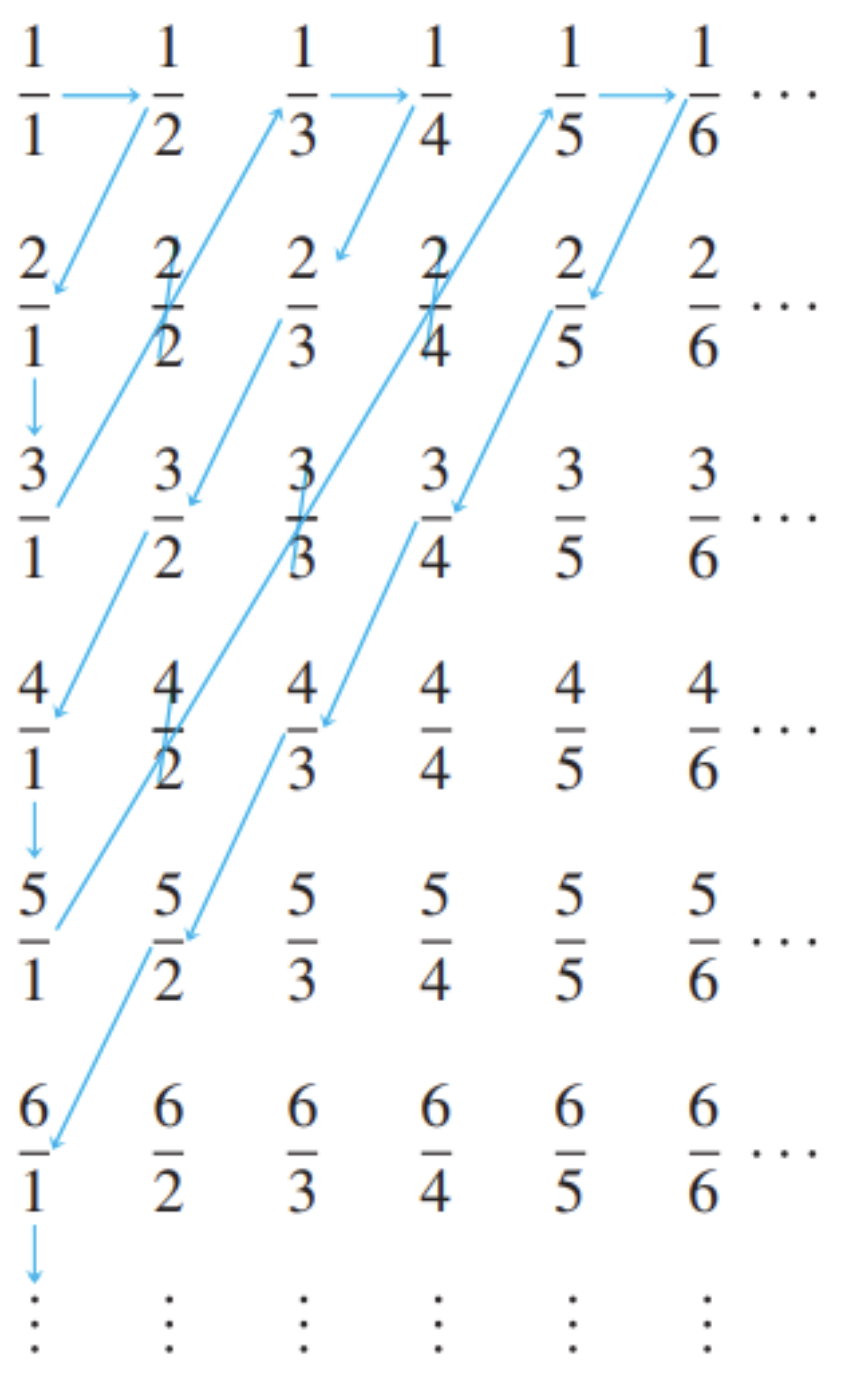
| $\mathbb{N}$ | $\mathbb{Q}^{+}$ | |
|---|---|---|
| $1$ | $\to$ | $1/1$ |
| $2$ | $\to$ | $1/2$ |
| $3$ | $\to$ | $2/1$ |
| $4$ | $\to$ | $3/1$ |
| $5$ | $\to$ | $1/3$ |
| $6$ | $\to$ | $1/4$ |
| $7$ | $\to$ | $2/3$ |
| $8$ | $\to$ | $3/2$ |
| $9$ | $\to$ | $4/1$ |
| $10$ | $\to$ | $5/1$ |
| $\vdots$ | $\vdots$ |
- We exhibit a one-to-one correspondence $f: \mathbb{N} \to \mathbb{Q}^{+}$.
- $f$ is onto: every positive rational appears in the grid and every grid point is eventually reached.
- $f$ is one-to-one: skip already-counted rationals so no rational is counted twice.
$[0, 1]$ is uncountable
Solution
- We prove there is no one-to-one correspondence between $\mathbb{N}$ and $[0,1]$.
- We use proof by contradiction.
- Suppose $[0,1]$ is countable. List all elements:
$\mathbb{N}$ $[0,1]$ $1$ $\to$ $0.a_{11}\,a_{12}\,a_{13}\cdots$ $2$ $\to$ $0.a_{21}\,a_{22}\,a_{23}\cdots$ $3$ $\to$ $0.a_{31}\,a_{32}\,a_{33}\cdots$ $\vdots$ $\vdots$ $\vdots$ $n$ $\to$ $0.a_{n1}\,a_{n2}\,a_{n3}\cdots$ $\vdots$ $\vdots$ $\vdots$ - We construct a real $d \in [0,1]$ not on this list.
- Suppose the list begins (diagonal entries boxed):
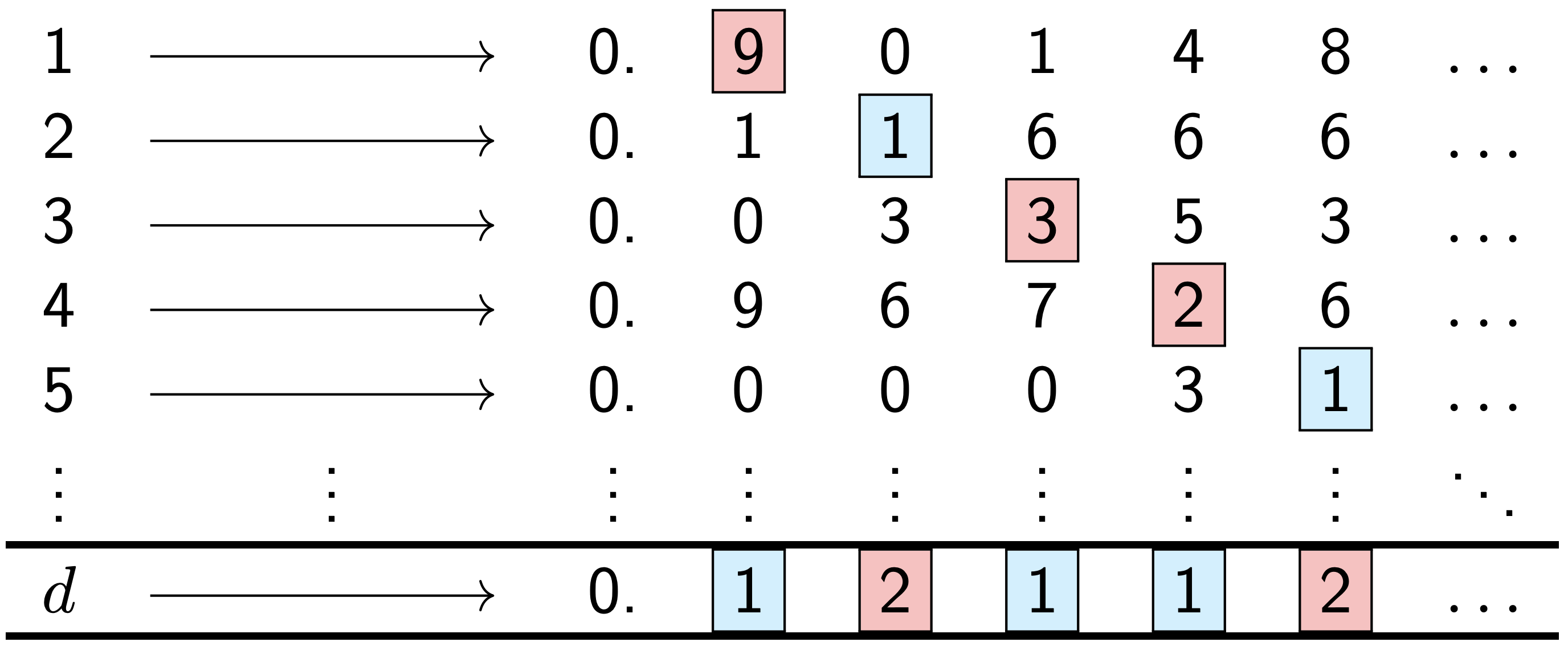
- Construct $d = 0.d_1 d_2 d_3\cdots$ where \begin{align*} d_n = \left. \begin{cases} 1 & \text{if } a_{nn} \ne 1,\\ 2 & \text{if } a_{nn} = 1. \end{cases} \right\} \end{align*} So we get $$d = 0.12112\ldots$$
- Observation: For each natural number $n$, the constructed real number $d$ differs in the $n$th decimal position from the $n$th number on the list.
- Therefore $d \notin$ the list, but $d \in [0,1]$ — contradiction!
- Hence $[0,1]$ is uncountable.
Take-home lesson
More theorems
- A subset of a countable set is countable.
- A set with an uncountable subset is uncountable.
$\mathbb{R}$ and $[0, 1]$ have the same size
Solution
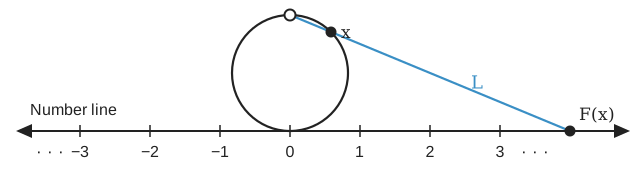
- Let $S = \{ x \in \mathbb{R} \mid 0 < x < 1 \}$. Bend $S$ into a circle and project each point to $\mathbb{R}$, defining $F: S \to \mathbb{R}$.
- $F$ is one-to-one: distinct points on the circle project to distinct points on the line.
- $F$ is onto: for any $y \in \mathbb{R}$, the line through $y$ and the circle's topmost point meets the circle at some $x$ with $F(x) = y$.
Set of bit strings is countable
Solution
- Define $f: \mathbb{N} \to \mathbb{B}$ by:
$$f(n) = \left. \begin{cases} \epsilon & \text{if } n = 1, \\ \text{$k$-bit binary repr. of } n - 2^k & \text{if } n > 1,\; \lfloor \log n \rfloor = k. \end{cases} \right\}$$
$\mathbb{N}$ $\mathbb{B}$ $1$ $\to$ $\epsilon$ $2$ $\to$ $0$ $3$ $\to$ $1$ $4$ $\to$ $00$ $5$ $\to$ $01$ $6$ $\to$ $10$ $7$ $\to$ $11$ $\vdots$ $\vdots$ $n$ $\to$ $f(n)$ $\vdots$ $\vdots$
- $f$ is a one-to-one correspondence, so $\mathbb{B}$ is countably infinite.
- More generally, the set of strings over any finite alphabet is countably infinite.
Set of computer programs is countable
Solution
- Each program is a finite string over a finite alphabet.
- [Encoding] Translate each program to a binary string via ASCII.
- Sort by length, then lexicographically within each length.
- Define $f: \mathbb{N} \to \mathbb{P}$ by $f(n) = n$-th program in this ordering.
-
Programs encoding to bit strings of length $\le 5$:
$\mathbb{N}$ $\mathbb{P}$ $1$ $\to$ $01$ $2$ $\to$ $11$ $3$ $\to$ $0010$ $4$ $\to$ $1010$ $5$ $\to$ $1011$ $6$ $\to$ $00010$ $7$ $\to$ $00100$ $8$ $\to$ $10111$ $\vdots$ $\vdots$ $n$ $\to$ $f(n)$ $\vdots$ $\vdots$ - $f$ is a one-to-one correspondence, so $\mathbb{P}$ is countably infinite.
Set of all functions $\mathbb{N} \to \{0, 1\}$ is uncountable
Solution
- Let $\mathbb{S}$ = reals in $[0,1]$ of the form $0.a_1 a_2 a_3\cdots$ with $a_i \in \{0,1\}$ (omit sequences ending in all 1's for uniqueness).
- Map each $0.a_1 a_2 a_3\cdots \in \mathbb{S}$ to the function $g \in \mathbb{L}$ with $g(n) = a_n$.
This gives a one-to-one correspondence between $\mathbb{S}$ and a subset of $\mathbb{L}$.
$\mathbb{S}$ Subset of $\mathbb{L}$ $0.a_1 a_2 a_3 \cdots a_n \cdots$ $\to$ $\mathbb{N}$ $\{0,1\}$ $1$ $\to$ $a_1$ $2$ $\to$ $a_2$ $3$ $\to$ $a_3$ $\vdots$ $\vdots$ $n$ $\to$ $a_n$ $\vdots$ $\vdots$ - Since $\mathbb{S} \subseteq [0,1]$ is uncountable, $\mathbb{L}$ is uncountable.
Take-home lesson