Trees
Contents
Dictionary ADT
Dictionary ADT represents a collection of items, where each item can be a key or a (key, value) pair.
| ADT | Item | Ordered? | Duplicates? | Implementation |
|---|---|---|---|---|
| Set | key | ✗ | ✗ | Hash table |
| Sorted set | key | ✓ | ✗ | Balanced tree |
| Multiset | key | ✗ | ✓ | Hash table |
| Sorted multiset | key | ✓ | ✓ | Balanced tree |
| Map | (key, value) | ✗ | ✗ | Hash table |
| Sorted map | (key, value) | ✓ | ✗ | Balanced tree |
| Multimap | (key, value) | ✗ | ✓ | Hash table |
| Sorted multimap | (key, value) | ✓ | ✓ | Balanced tree |
Map
A map is a collection of key-value pairs (k, v), where keys are unique.
| Key | Value |
|---|---|
| Dictionary word | Word meaning |
| User ID | User record |
| Employee ID | Employee record |
| Student ID | Student record |
| Patient ID | Patient record |
| Profile ID | Person details |
| Order ID | Order details |
| Transaction ID | Transaction details |
| URL | Web page |
| Full file name | File |
Set ADT (java.util.Set interface)
| Method | Functionality |
|---|---|
| add(e) | Adds the element e to S if it is not already present. |
| remove(e) | Removes the element e from S if it is present. |
| contains(e) | Returns whether e is an element of S. |
| iterator() | Returns an iterator of the elements of S. |
| addAll(T) | Updates S to also include all elements of set T, effectively replacing S by S ∪ T. |
| retainAll(T) | Updates S so that it only keeps those elements that are also elements of set T, effectively replacing S by S ∩ T. |
| removeAll(T) | Updates S by removing any of its elements that also occur in set T, effectively replacing S by S − T. |
-
Set = unordered set; Map = unordered map.
java.util.HashSet is an implementation of the set ADT.
java.util.HashMap is an implementation of the map ADT.
Sorted set ADT (java.util.SortedSet interface)
| Method | Functionality |
|---|---|
| first() | Returns the smallest element in S. |
| last() | Returns the largest element in S. |
| ceiling(e) | Returns the smallest element ≥ e. |
| floor(e) | Returns the largest element ≤ e. |
| lower(e) | Returns the largest element < e. |
| higher(e) | Returns the smallest element > e. |
| subSet(e1,e2) | Returns an iteration of all elements greater than or equal to e1, but strictly less than e2. |
| pollFirst() | Returns and removes the smallest element in S. |
| pollLast() | Returns and removes the largest element in S. |
-
java.util.TreeSet is an implementation of the sorted set ADT.
java.util.TreeMap is an implementation of the sorted map ADT. - TreeSet and TreeMap use balanced search trees.
Multiset ADT
| Method | Functionality |
|---|---|
| add(e) | Adds a single occurrence of e to the multiset. |
| contains(e) | Returns true if the multiset contains an element equal to e. |
| count(e) | Returns the number of occurrences of e in the multiset. |
| remove(e) | Removes a single occurrence of e from the multiset. |
| remove(e, n) | Removes n occurrences of e from the multiset. |
| size() | Returns the number of elements of the multiset (including duplicates). |
| iterator() | Returns an iteration of all elements of the multiset (repeating those with multiplicity greater than one). |
-
Java does not include any form of a multiset.
Guava = Google Core Libraries for Java.Guava's Multiset is an implementation of the multiset ADT.Guava's Multimap is an implementation of the multimap ADT.
- Similarly, one can define a sorted multiset ADT.
Dictionary operations (for unique keys)
| Worst case | Average case | |||||
|---|---|---|---|---|---|---|
| Data structure | Search | Insert | Delete | Search | Insert | Delete |
| Sorted array | $\Theta(\log n)$ | $\Theta(n)$ | $\Theta(n)$ | $\Theta(\log n)$ | $\Theta(n)$ | $\Theta(n)$ |
| Unsorted list | $\Theta(n)$ | $\Theta(1)$ | $\Theta(n)$ | $\Theta(n)$ | $\Theta(1)$ | $\Theta(n)$ |
| Hashing | $\Theta(n)$ | $\Theta(n)$ | $\Theta(n)$ | $\Theta(1)^*$ | $\Theta(1)^*$ | $\Theta(1)^*$ |
| BST | $\Theta(n)$ | $\Theta(n)$ | $\Theta(n)$ | $\Theta(\log n)$ | $\Theta(\log n)$ | $\Theta(\log n)$ |
| Splay tree | $\Theta(\log n)^*$ | $\Theta(\log n)^*$ | $\Theta(\log n)^*$ | $\Theta(\log n)^*$ | $\Theta(\log n)^*$ | $\Theta(\log n)^*$ |
| Scapegoat tree | $\Theta(\log n)$ | $\Theta(\log n)^*$ | $\Theta(\log n)^*$ | $\Theta(\log n)$ | $\Theta(\log n)$ | $\Theta(\log n)$ |
| AVL tree | $\Theta(\log n)$ | $\Theta(\log n)$ | $\Theta(\log n)$ | $\Theta(\log n)$ | $\Theta(\log n)$ | $\Theta(\log n)$ |
| Red-black tree | $\Theta(\log n)$ | $\Theta(\log n)$ | $\Theta(\log n)$ | $\Theta(\log n)$ | $\Theta(\log n)$ | $\Theta(\log n)$ |
| AA tree | $\Theta(\log n)$ | $\Theta(\log n)$ | $\Theta(\log n)$ | $\Theta(\log n)$ | $\Theta(\log n)$ | $\Theta(\log n)$ |
| (a,b)-tree | $\Theta(\log n)$ | $\Theta(\log n)$ | $\Theta(\log n)$ | $\Theta(\log n)$ | $\Theta(\log n)$ | $\Theta(\log n)$ |
| B-tree | $\Theta(\log n)$ | $\Theta(\log n)$ | $\Theta(\log n)$ | $\Theta(\log n)$ | $\Theta(\log n)$ | $\Theta(\log n)$ |
* = Amortized
General Trees
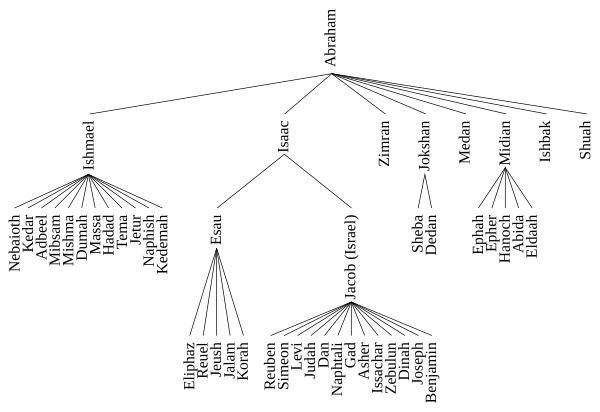
Family tree
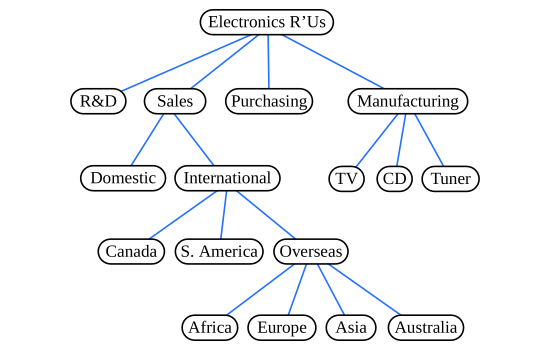
Company organization tree
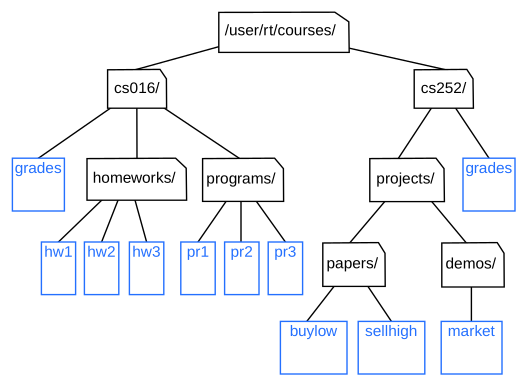
File system tree
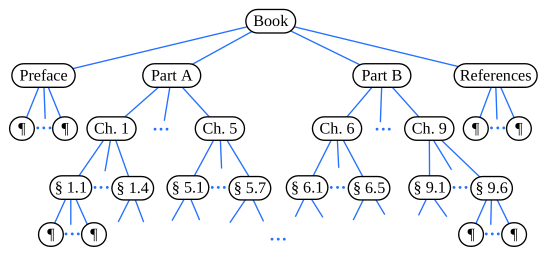
Book organization tree
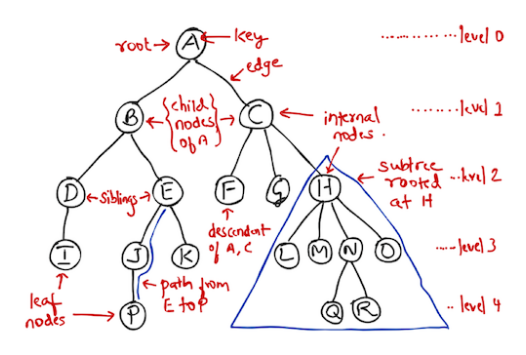
Terminology
| Term | Meaning |
|---|---|
| Tree | ADT that stores elements hierarchically |
| Parent node | Immediate previous-level node |
| Child nodes | Immediate next-level nodes |
| Root node | Top node of the tree |
| Sibling nodes | Nodes that are children of the same parent |
| External nodes | Nodes without children |
| Internal nodes | Nodes with one or more children |
| Ancestor node | Parent node or ancestor of parent node |
| Descendent node | Child node or descendent of child node |
| Subtree | Tree consisting of the node and its descendants |
| Edge | Pair of nodes denoting a parent-child relation |
| Path | Pair of nodes denoting an ancestor-descendant relation |
| Ordered tree | Tree with a meaningful linear order among child nodes |
Terminology
Binary Trees
A binary tree is an ordered tree with the following properties:
- Every node has at most two children.
- Each child node is labeled as a left child or a right child.
- A left child precedes a right child in the order of children.
A recursive definition of the binary tree:
- An empty tree.
- A nonempty tree having a root node $r$, which stores an element, and two binary trees that are respectively the left and right subtrees of $r$.
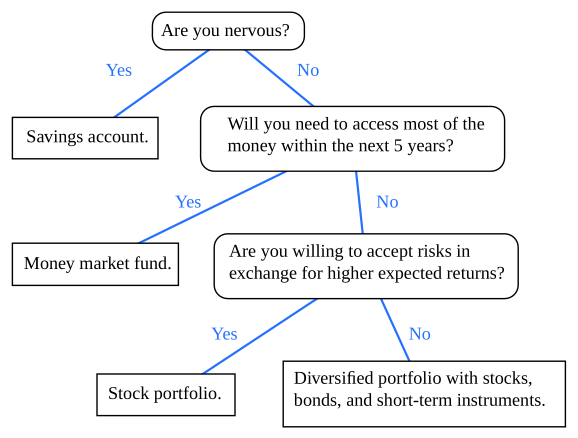
Decision tree
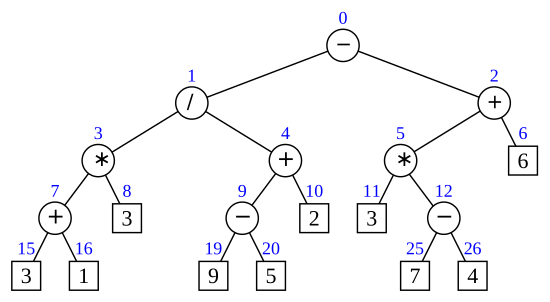
Arithmetic expression tree
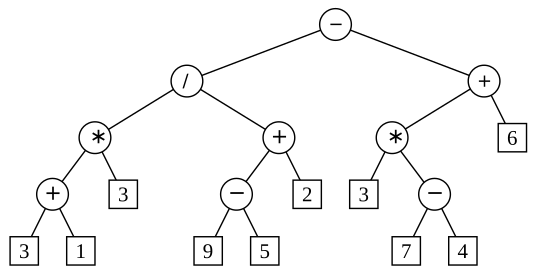
Tree represents $((((3+1)*3)/((9-5)+2))-((3*(7-4))+6))$.
Terminology
| Term | Meaning |
|---|---|
| Left subtree | Subtree rooted at the left child of an internal node |
| Right subtree | Subtree rooted at the right child of an internal node |
| Proper/full tree | A tree in which every node has either 0 or 2 children |
| Complete tree | Tree in which all except possibly the last level is completely filled and the nodes in the last level are as far left as possible |
| Perfect tree | Complete tree in which the last level is completely filled |
Tree examples
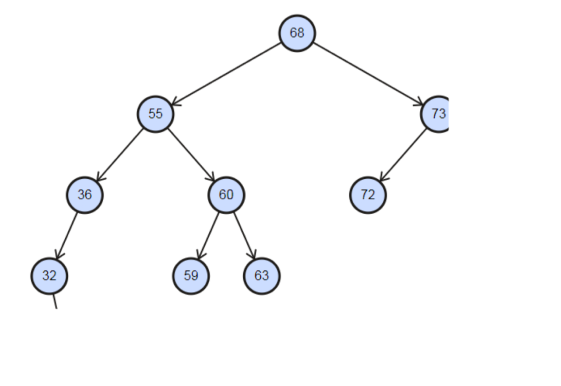
Binary ✓, Proper ✗, Complete ✗, Perfect ✗
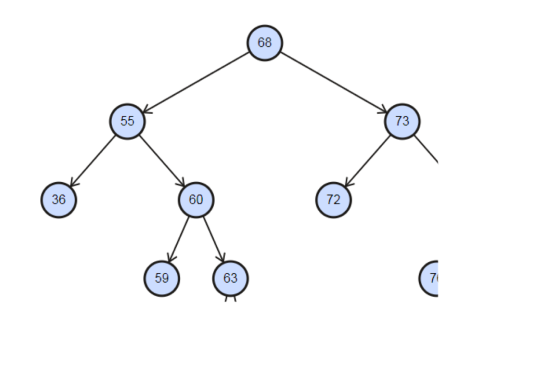
Binary ✓, Proper ✓, Complete ✗, Perfect ✗
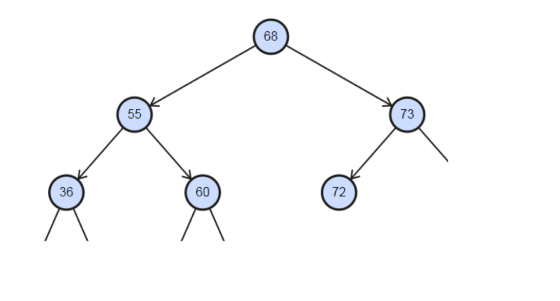
Binary ✓, Proper ✓, Complete ✗, Perfect ✗

Binary ✓, Proper ✗, Complete ✓, Perfect ✗
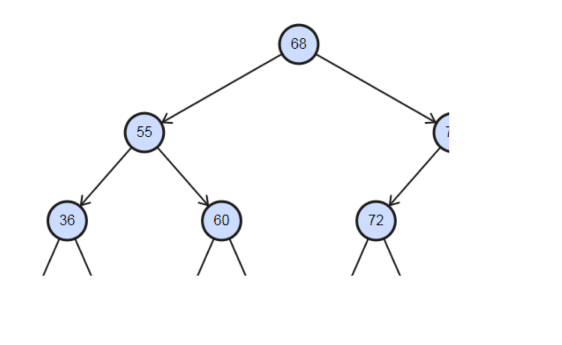
Binary ✓, Proper ✓, Complete ✓, Perfect ✗
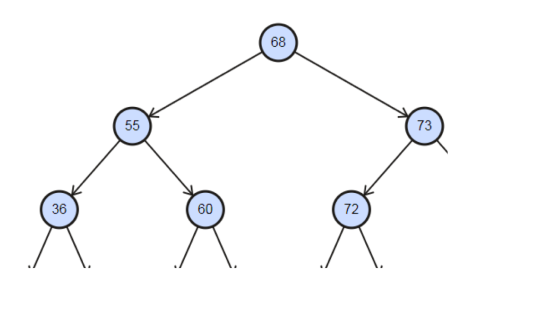
Binary ✓, Proper ✓, Complete ✓, Perfect ✓
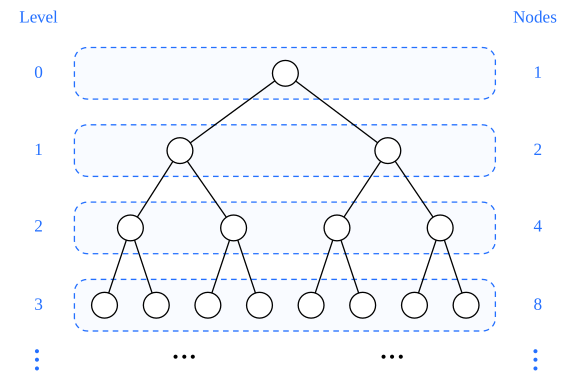
Levels and maximum number of nodes
Properties of binary tree
Let
- $T =$ nonempty binary tree
- $n_{\text{external}} =$ number of external nodes
- $n_{\text{internal}} =$ number of internal nodes
- $n = n_{\text{external}} + n_{\text{internal}}$
- $d_{\text{max}} =$ maximum depth of the tree
Then
- $d_{\text{max}} + 1 \le n \le 2^{d_{\text{max}} + 1} - 1$
- $1 \le n_{\text{external}} \le 2^{d_{\text{max}}}$
- $d_{\text{max}} \le n_{\text{internal}} \le 2^{d_{\text{max}}} - 1$
- $\log(n + 1) - 1 \le d_{\text{max}} \le n - 1$
Properties of proper binary tree
If $T$ is a proper nonempty binary tree,
- $2d_{\text{max}} + 1 \le n \le 2^{d_{\text{max}} + 1} - 1$
- $d_{\text{max}} + 1 \le n_{\text{external}} \le 2^{d_{\text{max}}}$
- $d_{\text{max}} \le n_{\text{internal}} \le 2^{d_{\text{max}}} - 1$
- $\log(n + 1) - 1 \le d_{\text{max}} \le (n - 1)/2$
- $n_{\text{external}} = n_{\text{internal}} + 1$
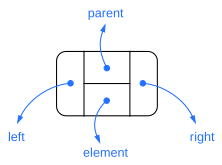
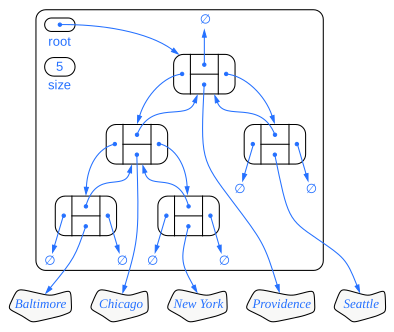
Implementing a binary tree using linked structure
Implementing a binary tree using array
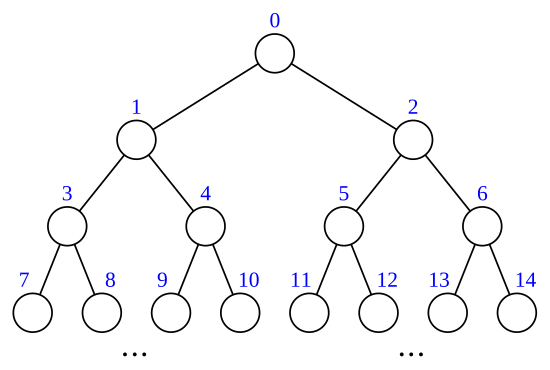
Implementing a binary tree using array
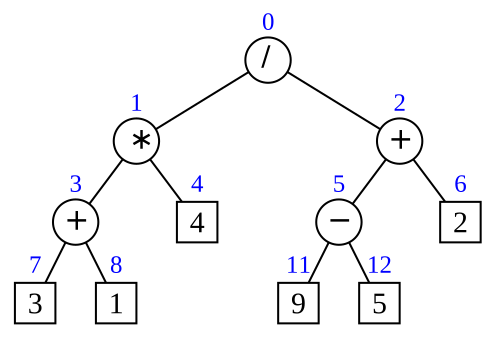

Implementing a binary tree using array
-
Level numbering for 0-indexed arrays:
$$
\text{index}(curr) = \left. \begin{cases} 0 & \text{if $curr$ is the root} \\
2 \times \text{index}(curr.parent) + 1 &
\text{if $curr$ is the left child} \\
2 \times \text{index}(curr.parent) + 2 & \text{if
$curr$ is the right child} \end{cases} \right\}
$$
Indices of the array are in the range $[0, 2^{n}-2]$, where $n$ is the height of the tree.
-
Level numbering for 1-indexed arrays:
$$
\text{index}(curr) = \left. \begin{cases} 1 & \text{if $curr$ is the root} \\
2 \times \text{index}(curr.parent) &
\text{if $curr$ is the left child} \\
2 \times \text{index}(curr.parent) + 1 & \text{if
$curr$ is the right child} \end{cases} \right\}
$$
Indices of the array are in the range $[1, 2^{n}-1]$, where $n$ is the height of the tree.
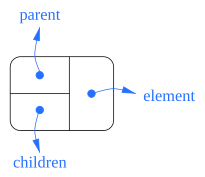
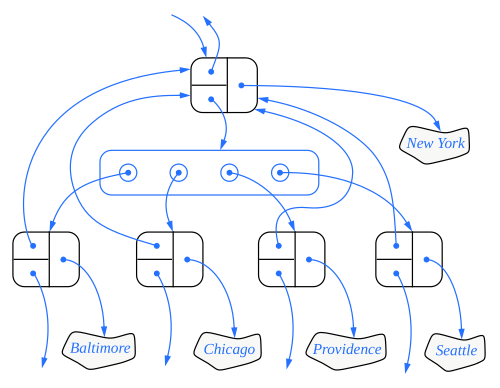
Implementing a general tree using linked structure
Tree traversals
- A traversal of a tree $T$ is a systematic way of accessing or visiting all the nodes of $T$.
| Traversal | Binary tree? | General tree? |
|---|---|---|
| Preorder traversal | ✓ | ✓ |
| Inorder traversal | ✓ | ✗ |
| Postorder traversal | ✓ | ✓ |
| Breadth-first traversal | ✓ | ✓ |
Preorder / inorder / postorder traversals
\begin{algorithm}
\begin{algorithmic}
\FUNCTION{PreorderTraversal}{$root$}
    \IF{$root \ne null$}
        \STATE \CALL{Visit}{$root$}
        \STATE \CALL{PreorderTraversal}{$root.left$}
        \STATE \CALL{PreorderTraversal}{$root.right$}
    \ENDIF
\ENDFUNCTION
\end{algorithmic}
\end{algorithm}
\begin{algorithm}
\begin{algorithmic}
\FUNCTION{InorderTraversal}{$root$}
    \IF{$root \ne null$}
        \STATE \CALL{InorderTraversal}{$root.left$}
        \STATE \CALL{Visit}{$root$}
        \STATE \CALL{InorderTraversal}{$root.right$}
    \ENDIF
\ENDFUNCTION
\end{algorithmic}
\end{algorithm}
\begin{algorithm}
\begin{algorithmic}
\FUNCTION{PostorderTraversal}{$root$}
    \IF{$root \ne null$}
        \STATE \CALL{PostorderTraversal}{$root.left$}
        \STATE \CALL{PostorderTraversal}{$root.right$}
        \STATE \CALL{Visit}{$root$}
    \ENDIF
\ENDFUNCTION
\end{algorithmic}
\end{algorithm}
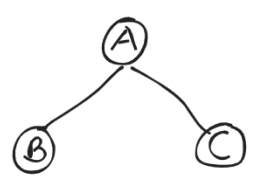
- Preorder traversal = A B C
- Inorder traversal = B A C
- Postorder traversal = B C A
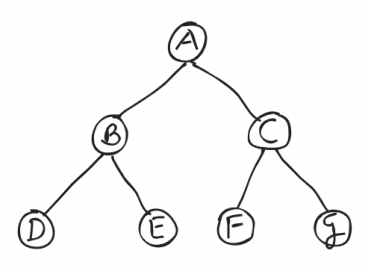
- Preorder traversal = A [left] [right] = A B D E C F G
- Inorder traversal = [left] A [right] = D B E A F C G
- Postorder traversal = [left] [right] A = D E B F G C A
Preorder traversal
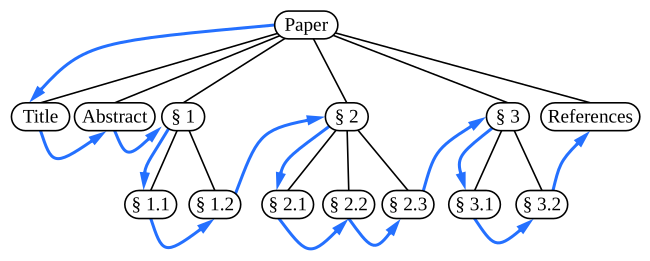
Preorder traversal: Table of contents
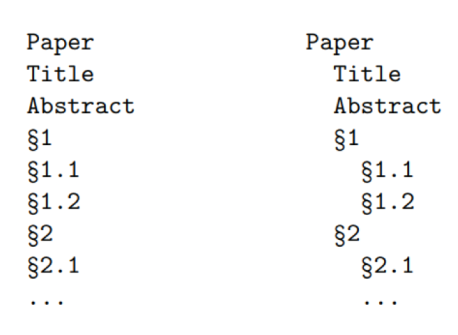
Postorder traversal
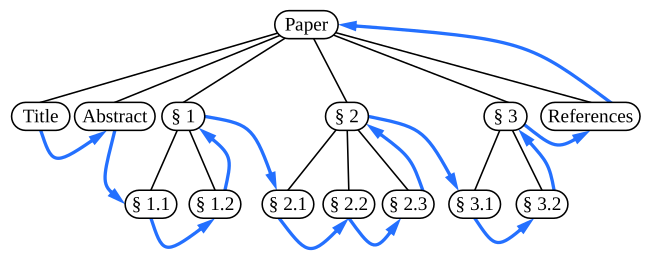
Postorder traversal: Compute disk space
\begin{algorithm}
\begin{algorithmic}
\FUNCTION{ComputeDiskSpace}{$root$}
    \STATE $space \gets root.key$
    \FORALL{child $child$ of $root$ node}
        \STATE $space \gets space +$ \CALL{ComputeDiskSpace}{$root.child$}
    \ENDFOR
    \RETURN $space$
\ENDFUNCTION
\end{algorithmic}
\end{algorithm}
Inorder traversal: Arithmetic expression
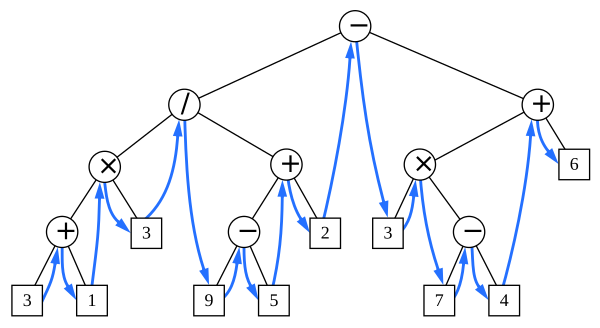
$(((3+1) \times 3) / ((9-5) + 2)) - ((3 \times (7-4)) + 6)$
Breadth-first traversal: Game trees
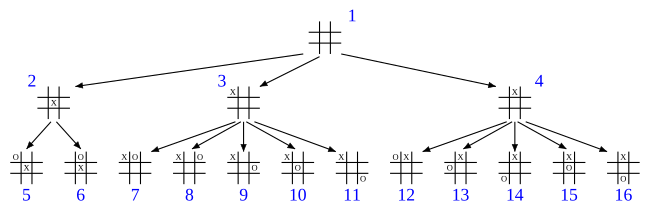
Breadth-first traversal
General tree.
\begin{algorithm}
\begin{algorithmic}
\FUNCTION{BreadthFirstTraversal}{$root$}
    \STATE $Q$.Enqueue($root$)
    \WHILE{$Q$ is not empty}
        \STATE $curr \gets Q$.Dequeue$()$
        \STATE \CALL{Visit}{$curr$}
        \FORALL{child $child$ of $curr$ node}
            \STATE $Q$.Enqueue$(curr.child)$
        \ENDFOR
    \ENDWHILE
\ENDFUNCTION
\end{algorithmic}
\end{algorithm}
Binary tree.
\begin{algorithm}
\begin{algorithmic}
\FUNCTION{BreadthFirstTraversal}{$root$}
    \STATE $Q$.Enqueue($root$)
    \WHILE{$Q$ is not empty}
        \STATE $curr \gets Q$.Dequeue$()$
        \STATE \CALL{Visit}{$curr$}
        \IF{$curr.left \ne null$}
            \STATE $Q$.Enqueue$(curr.left)$
        \ENDIF
        \IF{$curr.right \ne null$}
            \STATE $Q$.Enqueue$(curr.right)$
        \ENDIF
    \ENDWHILE
\ENDFUNCTION
\end{algorithmic}
\end{algorithm}
Binary Search Trees (BST)
Binary search tree (BST)
A binary search tree is a binary tree $T$ such that, for each internal node $p$ of $T$:
- Node $p$ stores an element, say $p.key$.
- Keys stored in the left subtree of $p$ are less than $p.key$.
- Keys stored in the right subtree of $p$ are greater than $p.key$.
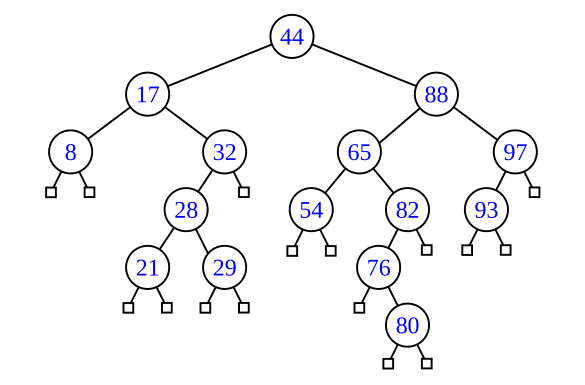
Binary search tree node
class Node<T>
{
    T key;
    Node<T> left;
    Node<T> right;

    Node(T item, Node<T> lchild, Node<T> rchild)
    { key = item; left = lchild; right = rchild; }

    Node(T item)
    { this(item, null, null); }
}
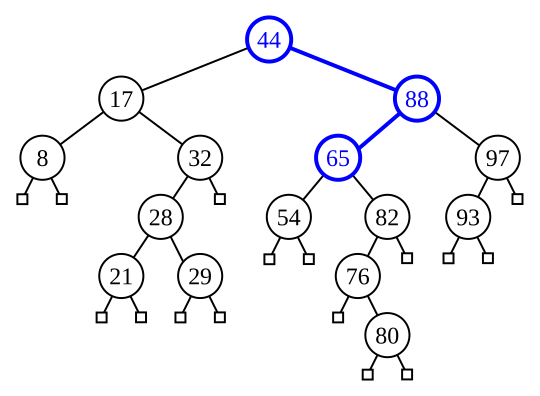
Search: 65 exists
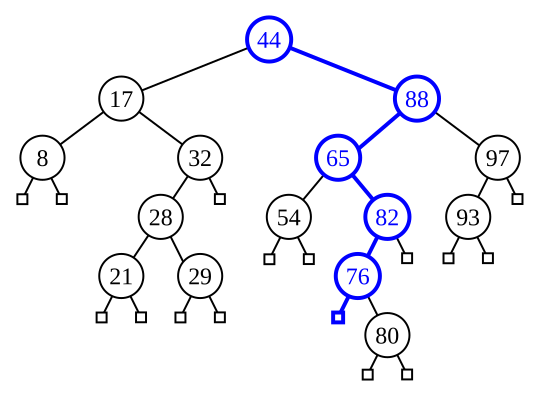
Search: 68 does not exist
Search: Recursive algorithm
\begin{algorithm}
\begin{algorithmic}
\FUNCTION{Search}{$curr, target$}
    \IF{$curr = null$}
        \RETURN $curr$ \COMMENT{unsuccessful search}
    \ENDIF
    \IF{$target < curr.key$}
        \RETURN \CALL{Search}{$curr.left, target$} \COMMENT{recur on left subtree}
    \ENDIF
    \IF{$target > curr.key$}
        \RETURN \CALL{Search}{$curr.right, target$} \COMMENT{recur on right subtree}
    \ENDIF
    \IF{$target = curr.key$}
        \RETURN $curr$ \COMMENT{successful search}
    \ENDIF
\ENDFUNCTION
\end{algorithmic}
\end{algorithm}
Search: Non-recursive algorithm
\begin{algorithm}
\begin{algorithmic}
\FUNCTION{Search}{$curr, target$}
    \WHILE{$curr \ne null$}
        \IF{$target < curr.key$}
            \STATE $curr \gets curr.left$ \COMMENT{recur on left subtree}
        \ELSIF{$target > curr.key$}
            \STATE $curr \gets curr.right$ \COMMENT{recur on right subtree}
        \ELSIF{$target = curr.key$}
            \RETURN $curr$ \COMMENT{successful search}
        \ENDIF
    \ENDWHILE
    \RETURN $null$ \COMMENT{unsuccessful search}
\ENDFUNCTION
\end{algorithmic}
\end{algorithm}
Search: Analysis
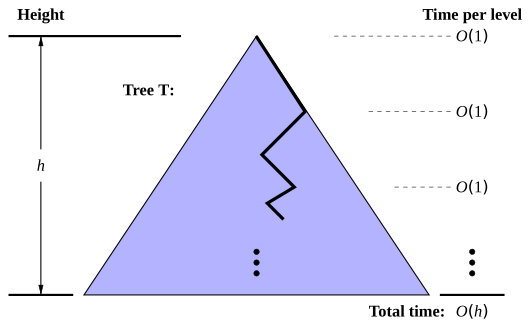
$\text{Time} = O(h) = O(n)$
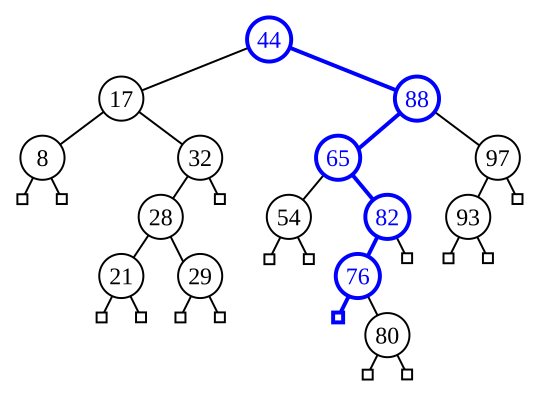
Add 68
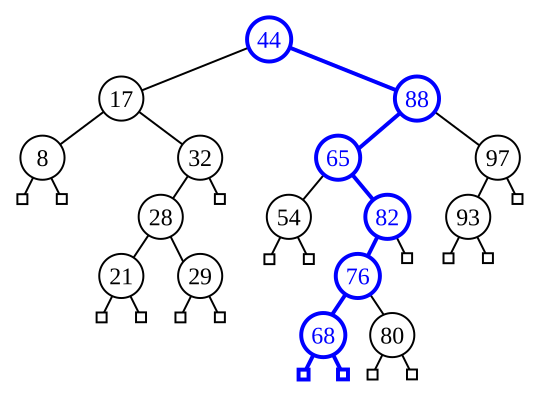
Add: Recursive algorithm
\begin{algorithm}
\begin{algorithmic}
\FUNCTION{Add}{$curr, item$}
    \IF{$curr = null$}
        \STATE $curr \gets$ Node$(item)$ \COMMENT{item does not exist}
    \ELSIF{$curr \ne null$}
        \IF{$item < curr.key$}
            \STATE $curr.left \gets$ \CALL{Add}{$curr.left, item$} \COMMENT{recur on left subtree}
        \ELSIF{$item > curr.key$}
            \STATE $curr.right \gets$ \CALL{Add}{$curr.right, item$} \COMMENT{recur on right subtree}
        \ELSIF{$item = curr.key$}
            \STATE do nothing \COMMENT{item exists}
        \ENDIF
    \ENDIF

    \RETURN $curr$
\ENDFUNCTION
\end{algorithmic}
\end{algorithm}
Add: Non-recursive algorithm
\begin{algorithm}
\begin{algorithmic}
\FUNCTION{Add}{$curr, item$}
    \STATE $parent \gets null$
    \WHILE{$curr \ne null$}
        \STATE $parent \gets curr$
        \IF{$item < curr.key$}
            \STATE $curr \gets curr.left$ \COMMENT{recur on left subtree}
        \ELSIF{$item > curr.key$}
            \STATE $curr \gets curr.right$ \COMMENT{recur on right subtree}
        \ELSIF{$item = curr.key$}
            \RETURN $curr$ \COMMENT{item exists}
        \ENDIF
    \ENDWHILE

    \STATE $curr \gets$ Node$(item)$ \COMMENT{item does not exist}
    \IF{$parent \ne null$}
        \IF{$item < parent.key$}
            \STATE $parent.left \gets curr$
        \ENDIF
        \IF{$item > parent.key$}
            \STATE $parent.right \gets curr$
        \ENDIF
    \ENDIF

    \RETURN $curr$
\ENDFUNCTION
\end{algorithmic}
\end{algorithm}
Add: Analysis
$\text{Time} = O(h) = O(n)$
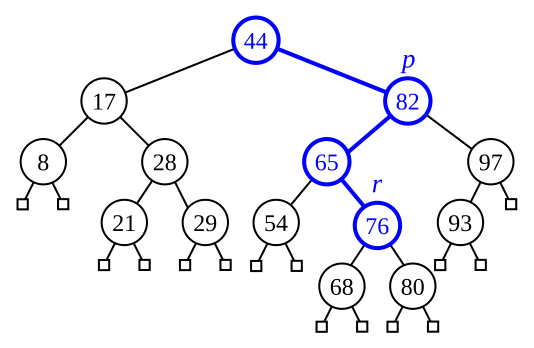
Remove 32: Node 32 has one child
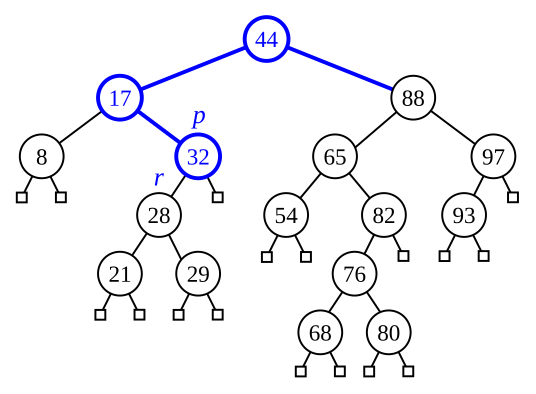
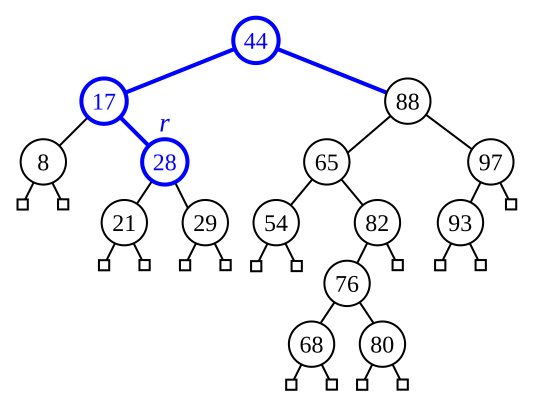
Remove 88: Node 88 has two children
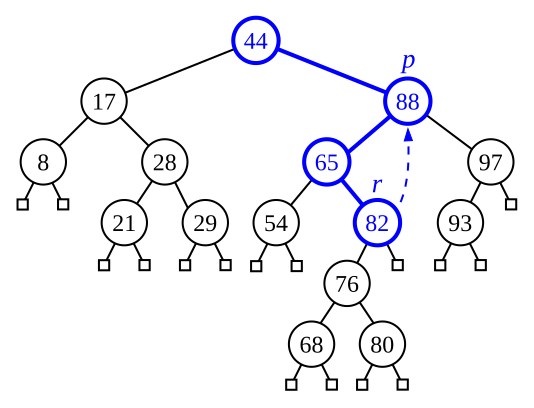
Remove
Removing a node (with a particular key) has four cases:
- Node is not found.
Do nothing. -
Node is found and it has 0 nonempty children.
Remove the node. -
Node is found and it has 1 nonempty child.
Remove the node.
Its nonempty child will take the location of the node. -
Node is found and it has 2 nonempty children.
Locate the predecessor of the node.
Predecessor = curr.left.right.right........right
Predecessor will take the location of the node.
Predecessor's left child will take the location of the predecessor.
(Can we use successor instead of predecessor?)
Remove: Recursive algorithm
\begin{algorithm}
\begin{algorithmic}
\FUNCTION{Remove}{$curr, item$}
    \IF{$curr = null$}
        \STATE do nothing \COMMENT{item does not exist}
    \ELSIF{$item < curr.key$}
        \STATE $curr.left \gets$ \CALL{Remove}{$curr.left, item$} \COMMENT{recur on left}
    \ELSIF{$item > curr.key$}
        \STATE $curr.right \gets$ \CALL{Remove}{$curr.right, item$} \COMMENT{recur on right}
    \ELSE
        \IF{$curr.left = null$}
            \STATE $curr \gets curr.right$ \COMMENT{0 or 1 child}
        \ELSIF{$curr.right = null$}
            \STATE $curr \gets curr.left$ \COMMENT{1 child}
        \ELSE
            \STATE $curr.key \gets$ \CALL{Maximum}{$curr.left$}.key \COMMENT{find predecessor}
            \STATE $curr.left \gets$ \CALL{Remove}{$curr.left, curr.key$} \COMMENT{remove predecessor}
        \ENDIF
    \ENDIF

    \RETURN $curr$
\ENDFUNCTION
\end{algorithmic}
\end{algorithm}
Remove: Non-recursive algorithm
Remove: Analysis
$\text{Runtime} = O(h) = O(n)$
Balanced Search Trees
Balanced search trees: Motivation
| Data structure | Search | Add | Remove |
|---|---|---|---|
| Binary search tree | $O(n)$ | $O(n)$ | $O(n)$ |
| Balanced search tree | $O(\log n)$ | $O(\log n)$ | $O(\log n)$ |
(2,4)-trees
- A (2,4)-tree or 2-3-4 tree is a balanced search tree.
-
A (2,4)-tree satisfies two properties:
- Size property. Every non-empty node has 2, 3, or 4 children.
- Depth property. All empty nodes have the same depth.
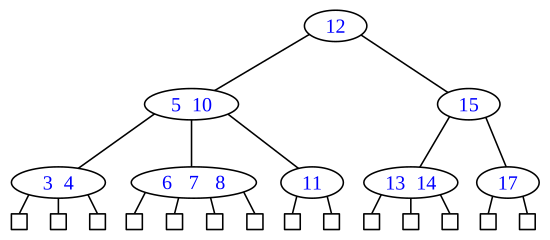
There are three types of non-empty nodes:
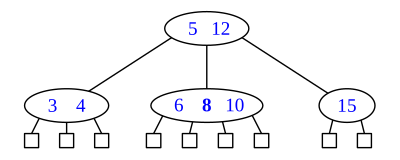
- 2-nodes have 2 children and 1 key. e.g.: [11], [12], [15], [17]
- 3-nodes have 3 children and 2 keys. e.g.: [3 4], [5 10], [13 14]
- 4-nodes have 4 children and 3 keys. e.g.: [6 7 8]
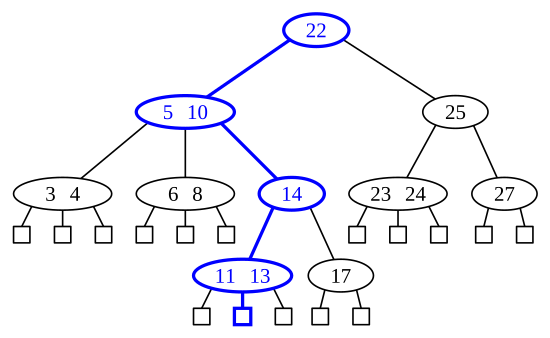
Search: 24 exists
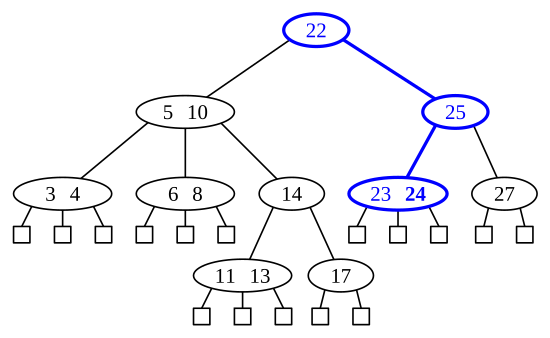
Search: 12 does not exist
Add 17
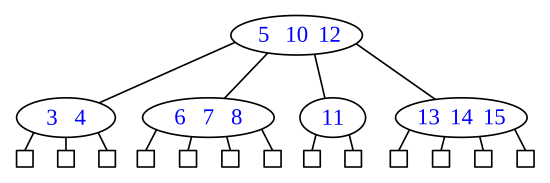
Size and depth properties are satisfied.
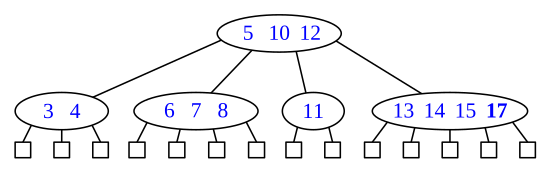
Overflow: Size property is violated at [13 14 15 17].
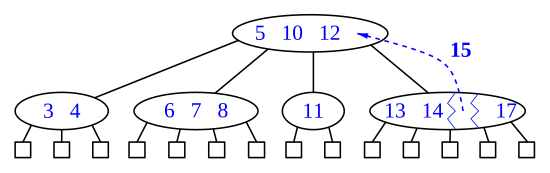
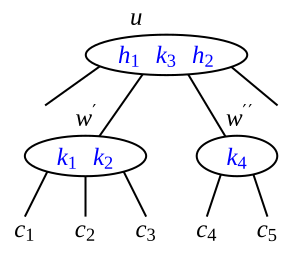
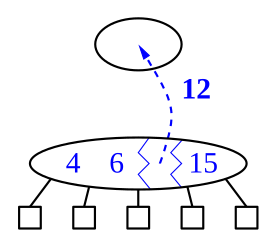
Size property at [13 14 15 17] will be fixed via split operation.
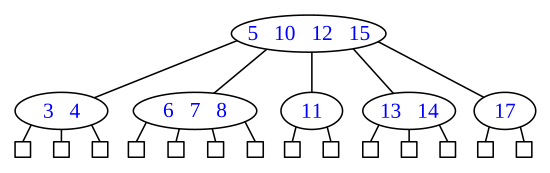
Overflow: Size property is violated at [5 10 12 15].
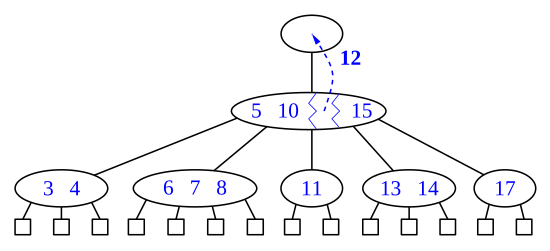
Size property at [5 10 12 15] will be fixed via split operation.
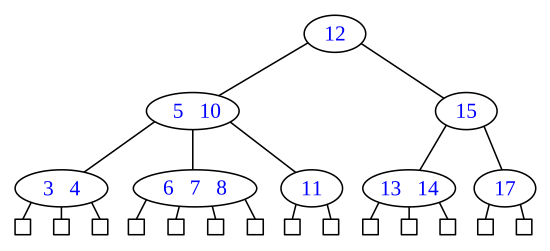
Size and depth properties are satisfied.
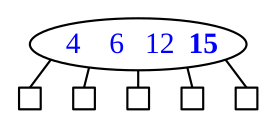
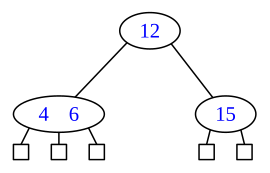
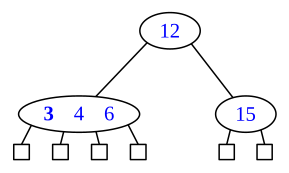
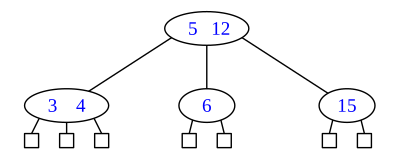
Add: Node split
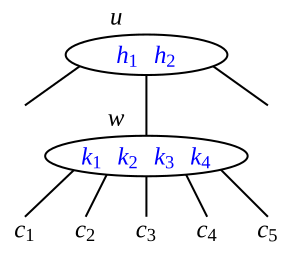
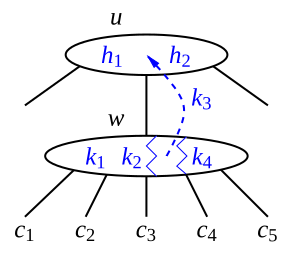
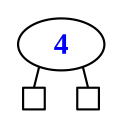
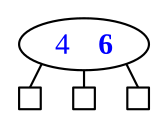
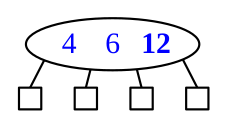
Add 4, 6, 12, 15
Add 3, 5
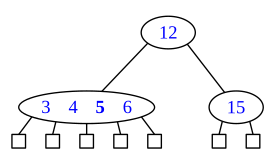
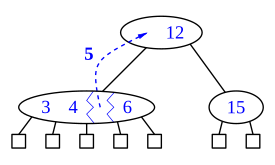
Add 10, 8
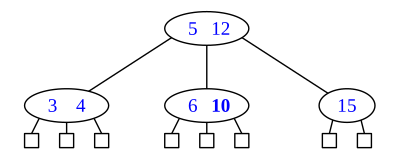
Remove 4
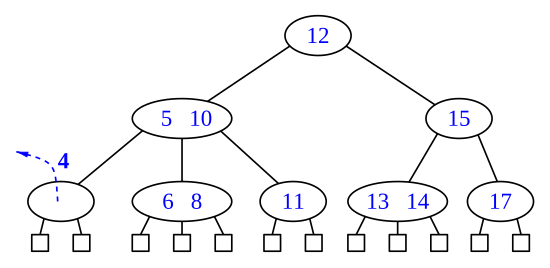
Underflow: Size property is violated is [4].
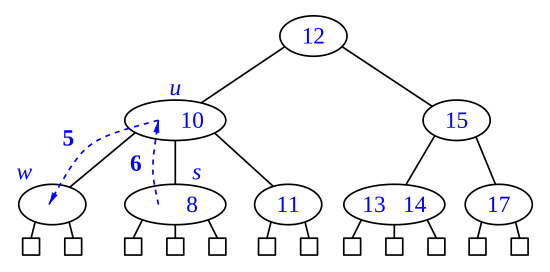
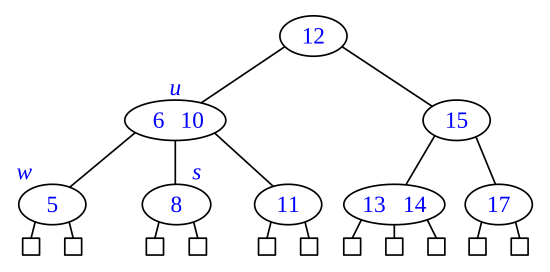
Size property will be fixed via transfer operation.
Remove 12
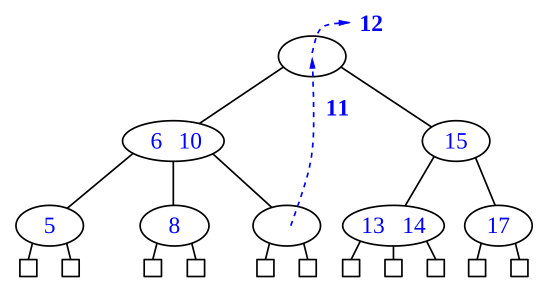
Underflow: Size property is violated is [12], which has non-empty children. It will be fixed via swap with predecessor.
Underflow: Size property is violated is [11].
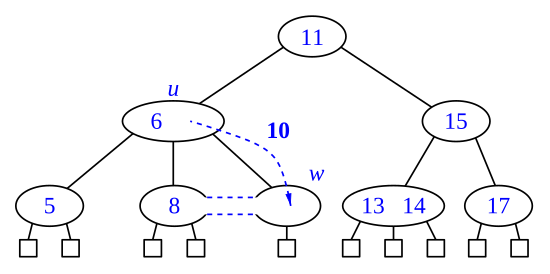
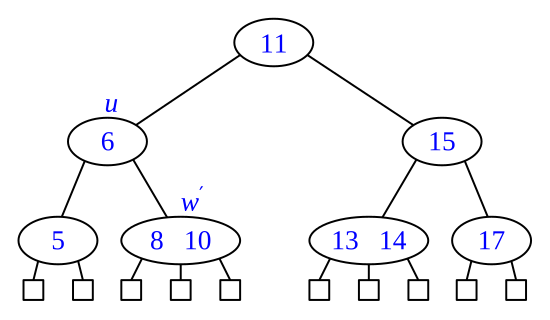
Size property will be fixed via fusion operation.
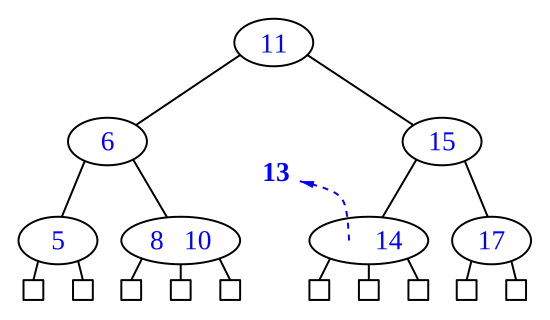
Remove 13
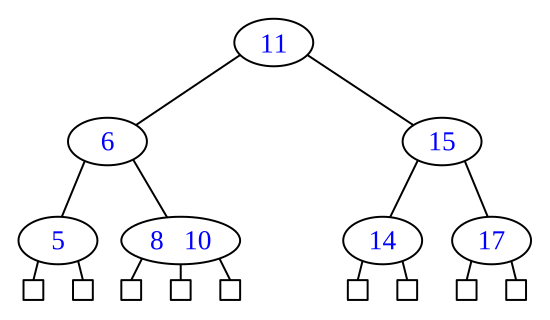
Remove
$n_e =$ node with empty children
$n_{\ne e} =$ node with non-empty children
$s_{3,4} =$ immediate sibling of $n_e$ is a 3-node or a 4-node
$s_2 =$ immediate sibling of $n_e$ is a 2-node
$p =$ parent of $n_e$
- Removal of $n_{\ne e}$ can always be reduced to $n_e$
-
Suppose removed node is:
- $n_{\ne e}$.
Swap with the $n_e$ predecessor -
$n_e$ and $s_{3,4}$ exists.
Transfer a child and key of $s_{3,4}$ to $p$ and a key of $p$ to $n_e$. -
$n_e$ and $s_{3,4}$ does not exist.
Fuse/merge $n_e$ with $s_2$ to get $n_e'$. Move key from $p$ to $n_e'$.
- $n_{\ne e}$.
(2,4)-trees: Complexity
| Method | Running time |
|---|---|
| Search | $O(\log n)$ |
| Add | $O(\log n)$ |
| Remove | $O(\log n)$ |
B Trees
Computer memory
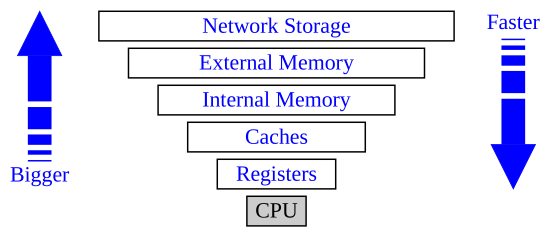
Cache-efficient algorithms: Example
Reducing communication (via good use of cache) leads to reduced running time. An algorithm that makes good use of cache is called cache-efficient. A cache-efficient sorting algorithm might take just a few minutes to sort a 1 GB file of numbers.
Example: External-memory merge sort.Cache data locality
An algorithm must have the following two features in order to make good use of cache.
- Spatial data locality
- Temporal data locality
Spatial data locality:
-
Meaning?
Whenever a cache block is brought into the cache, it contains as much useful data as possible. -
How to exploit?
Group data in blocks (or pages). Move data in blocks.
Temporal data locality:
-
Meaning?
Whenever a cache block is brought into the cache, as much useful work as possible is performed on this data before removing the block from the cache. -
Necessary condition?
Total computations is asymptotically greater than space
i.e., $T(n) \in \omega(S(n))$ -
How to exploit?
Design recursive divide-and-conquer algorithms
Cache complexity
- Cache complexity is the asymptotic number of cache misses or page faults incurred by an algorithm.
- Cache-efficient algorithms incur fewer cache misses.
- Cache-efficient algorithms try to exploit both spatial and temporal data locality.
- Terminology: $B$ = data block size, $M$ = cache size
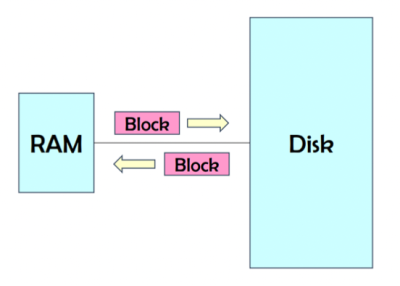
Cache-efficient algorithms
| Problem | Cache-inefficient algorithm | Cache-efficient algorithm |
|---|---|---|
| Sorting | Merge sort $O(n \log n)$ |
Ext-memory merge sort $O(\frac{n}{B}\log_{\frac{M}{B}}\frac{n}{B})$ |
| Balanced tree | (2,4)-tree $O(\log n)$ |
B tree $O(\log_B n)$ |
| Matrix product | Iterative $O(n^3)$ |
Recursive D&C $O(\frac{n^3}{B\sqrt{M}})$ |
$(a, b)$-trees
- $(a, b)$-tree is a straightforward generalization of (2,4)-tree in which the complexities depend on $a$ and $b$.
- By choosing proper values for $a$ and $b$, we get a balanced search tree that has excellent external-memory performance.
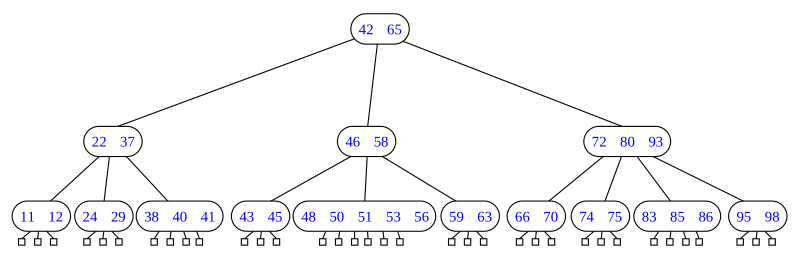
- (a, b)-tree is a multiway search tree such that each node has between $a$ and $b$ children and stores between $a-1$ and $b-1$ entries.
- An $(a,b)$-tree is a balanced multiway search tree.
- An $(a,b)$-tree satisfies three properties:
- $2 \le a \le (b+1)/2$
- Size property. Every non-empty node has children in the range $[a, b]$.
- Depth property. All empty nodes have the same depth.
B trees
- B tree of order $d$ is an $(a, b)$ tree with $a = \lceil d/2 \rceil$ and $b = d$.
- B trees are analyzed for cache complexity.
- B trees are cache-efficient when $d = B$, as they exploit spatial data locality.
B trees: Complexity
| (2,4)-tree | B tree | |||
|---|---|---|---|---|
| Method | Communication | Computation | Communication | Computation |
| Search | $O(\log n)$ | $O(\log n)$ | $O(\log_B n)$ | $O(\log n)$ |
| Add | $O(\log n)$ | $O(\log n)$ | $O(\log_B n)$ | $O(\log n)$ |
| Remove | $O(\log n)$ | $O(\log n)$ | $O(\log_B n)$ | $O(\log n)$ |
Applications
B trees (and variants such as B+ trees, B* trees, B# trees) are used for file systems and databases.
- Microsoft: NTFS
- Mac: HFS, HFS+
- Linux: BTRFS, EXT4, JFS2
- Databases: Oracle, DB2, Ingres, SQL, PostgreSQL