Stacks, Queues, and Deques
Contents
Time Complexity
| Stack ADT | Push | Pop | Top |
|---|---|---|---|
| Dynamic Array / SLL / CLL / DLL | $\Theta(1)$ | $\Theta(1)$ | $\Theta(1)$ |
| Queue ADT | Enqueue | Dequeue | Front |
|---|---|---|---|
| Circular Dynamic Array / SLL / CLL / DLL | $\Theta(1)$ | $\Theta(1)$ | $\Theta(1)$ |
| Deque ADT | AddFirst | AddLast | RemoveFirst | RemoveLast |
|---|---|---|---|---|
| Circular Dynamic Array / DLL | $\Theta(1)$ | $\Theta(1)$ | $\Theta(1)$ | $\Theta(1)$ |
| SLL / CLL | $\Theta(1)$ | $\Theta(1)$ | $\Theta(1)$ | $\Theta(n)$ |
Stacks
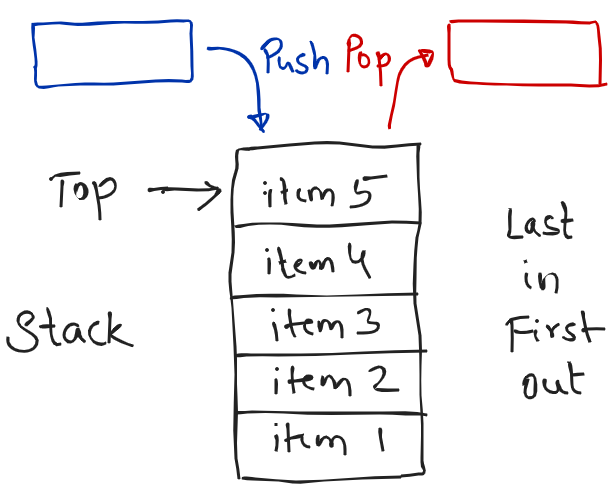
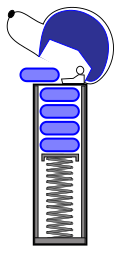
- A stack is a one-ended linear data structure.
- A stack uses the last in, first out (FIFO) principle.
- A stack has two major operations: push and pop, meaning insert and delete respectively.
Stack ADT
| Method | Functionality |
|---|---|
| push(e) | Adds element e to the top of the stack. |
| pop() | Removes and returns the top element from the stack (or null if the stack is empty). |
| top() | Returns the top element of the stack, without removing it (or null if the stack is empty). |
| size() | Returns the number of elements in the stack. |
| isEmpty() | Returns a boolean indicating whether the stack is empty |
Operations
| Method | Return value | Stack contents |
|---|---|---|
| push(5) | - | (5) |
| push(3) | - | (5, 3) |
| size() | 2 | (5, 3) |
| pop() | 3 | (5) |
| isEmpty() | false | (5) |
| pop() | 5 | () |
| isEmpty() | true | () |
| pop() | null | () |
| push(7) | - | (7) |
| push(9) | - | (7, 9) |
| top() | 9 | (7, 9) |
| push(4) | - | (7, 9, 4) |
| size() | 3 | (7, 9, 4) |
| pop() | 4 | (7, 9) |
| push(6) | - | (7, 9, 6) |
| push(8) | - | (7, 9, 6, 8) |
| pop() | 8 | (7, 9, 6) |
java.util.Stack class
| Our Stack ADT | Class java.util.Stack |
|---|---|
| size() | size() |
| isEmpty() | empty() |
| push(e) | push(e) |
| pop() | pop() |
| top() | peek() |
Stack ADT Interface
public interface Stack {

  // Returns the number of elements in the stack.
  int size();

  // Tests whether the stack is empty.
  boolean isEmpty();

  // Inserts an element at the top of the stack.
  void push(E e);

  // Returns, but does not remove, the element at the top of the stack.
  E top();

  // Removes and returns the top element from the stack.
  E pop();
}
Stack ADT $\rightarrow$ Array Implementation (0-indexed)

- Stack top index = $t$
- Stack top element = $data[t]$
- Stack size (or number of elements) = $t + 1$
public class ArrayStack implements Stack {
  /** Default array capacity. */
  public static final int CAPACITY=1000;   // default array capacity

  /** Generic array used for storage of stack elements. */
  private E[] data;                        // generic array used for storage

  /** Index of the top element of the stack in the array. */
  private int t = -1;                      // index of the top element in stack

  /** Constructs an empty stack using the default array capacity. */
  public ArrayStack() { this(CAPACITY); }  // constructs stack with default capacity

  /**
   * Constructs and empty stack with the given array capacity.
   * @param capacity length of the underlying array
   */
  @SuppressWarnings({"unchecked"})
  public ArrayStack(int capacity) {        // constructs stack with given capacity
    data = (E[]) new Object[capacity];     // safe cast; compiler may give warning
  }

  /**
   * Returns the number of elements in the stack.
   * @return number of elements in the stack
   */
  @Override
  public int size() { return (t + 1); }

  /**
   * Tests whether the stack is empty.
   * @return true if the stack is empty, false otherwise
   */
  @Override
  public boolean isEmpty() { return (t == -1); }

  /**
   * Inserts an element at the top of the stack.
   * @param e   the element to be inserted
   * @throws IllegalStateException if the array storing the elements is full
   */
  @Override
  public void push(E e) throws IllegalStateException {
    if (size() == data.length) throw new IllegalStateException("Stack is full");
    data[++t] = e;                           // increment t before storing new item
  }

  /**
   * Returns, but does not remove, the element at the top of the stack.
   * @return top element in the stack (or null if empty)
   */
  @Override
  public E top() {
    if (isEmpty()) return null;
    return data[t];
  }

  /**
   * Removes and returns the top element from the stack.
   * @return element removed (or null if empty)
   */
  @Override
  public E pop() {
    if (isEmpty()) return null;
    E answer = data[t];
    data[t] = null;                        // dereference to help garbage collection
    t--;
    return answer;
  }

  /**
   * Produces a string representation of the contents of the stack.
   * (ordered from top to bottom). This exists for debugging purposes only.
   *
   * @return textual representation of the stack
   */
  public String toString() {
    StringBuilder sb = new StringBuilder("(");
    for (int j = t; j >= 0; j--) {
      sb.append(data[j]);
      if (j > 0) sb.append(", ");
    }
    sb.append(")");
    return sb.toString();
  }

  /** Demonstrates sample usage of a stack. */
  public static void main(String[] args) {
    Stack S = new ArrayStack<>();  // contents: ()
    S.push(5);                              // contents: (5)
    S.push(3);                              // contents: (5, 3)
    System.out.println(S.size());           // contents: (5, 3)     outputs 2
    System.out.println(S.pop());            // contents: (5)        outputs 3
    System.out.println(S.isEmpty());        // contents: (5)        outputs false
    System.out.println(S.pop());            // contents: ()         outputs 5
    System.out.println(S.isEmpty());        // contents: ()         outputs true
    System.out.println(S.pop());            // contents: ()         outputs null
    S.push(7);                              // contents: (7)
    S.push(9);                              // contents: (7, 9)
    System.out.println(S.top());            // contents: (7, 9)     outputs 9
    S.push(4);                              // contents: (7, 9, 4)
    System.out.println(S.size());           // contents: (7, 9, 4)  outputs 3
    System.out.println(S.pop());            // contents: (7, 9)     outputs 4
    S.push(6);                              // contents: (7, 9, 6)
    S.push(8);                              // contents: (7, 9, 6, 8)
    System.out.println(S.pop());            // contents: (7, 9, 6)  outputs 8
  }
}
Data Overflow Problem
Problem: Stack array is of fixed size. If capacity is low, the program throws exception when there is overflow. If capacity is high, a lot of memory is wasted.
Solution: Use a dynamic array or a linked list.
Stack ADT $\rightarrow$ SLL Implementation
SLL or CLL or DLL?
- Which list to choose: SLL, CLL, DLL? SLL. Why?
- Should SLL head be stack top or stack bottom? Stack top. Why?
| Stack method | SLL method |
|---|---|
| size() | list.size() |
| isEmpty() | list.isEmpty() |
| push(e) | list.addFirst(e) |
| pop() | list.removeFirst() |
| top() | list.first() |
public class LinkedStack implements Stack {
	private SinglyLinkedList list = new SinglyLinkedList<>(); // an empty list

	public LinkedStack() { }      // new stack relies on the initially empty list

	public int size() { return list.size(); }
	public boolean isEmpty() { return list.isEmpty(); }

	public E top() { return list.first(); }
	public void push(E element) { list.addFirst(element); }
	public E pop() { return list.removeFirst(); }
}
Stacks $\rightarrow$ Applications
Function calls use a stack
Every function call is pushed onto the call stack. Local variables, parameters, and return addresses are stored there. The entire execution of most programs can be understood through this single idea.- When a program runs "main() -> F() -> G()",
Stack contents are "main, F, G". - When G returns,
Stack contents are "main, F". - When F returns,
Stack contents are "main".
Infix to postfix/prefix conversion and expression evaluation
- Arithmetic expressions written by humans in calculators and compilers are converted into machine-friendly forms using stacks.
Example: Infix expression $(A + B) \times C$ is converted to postfix expression: $A~B~+~C ~\times$. - Evaluating postfix/prefix expressions using stacks.
Example: Postfix expression $15 ~3 ~+ ~2 ~\times $ is evaluated to $(15 + 3) \times 2 = 90$.
Undo operations and back bottons
- Undo operations in text editors, code editors, and photo editors.
- Back and forward buttons in browsers
Parenthesis matching in parsing
- Verify balanced $(~)$, $\{~\}$, $[~]$ for checking syntax as part of parsing programming languages
Example: $\{~[~(~)~]~\}$ is balanced, $\{~[~(~]~)~\}$ is not balanced - Checking if open and closed brackets or tags are present in C, C++, Java, Python, HTML, XML, JSON, etc
- Pushdown automaton (PDA) = Finite automaton + Stack
PDA is used to recognize context-free languages (CFLs)
Reverse
A stack naturally reverses order.Example: Input is ABCDE, Output is EDCBA
Queues
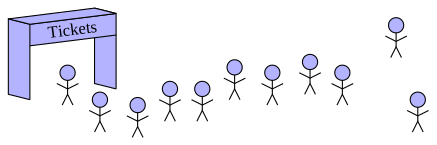
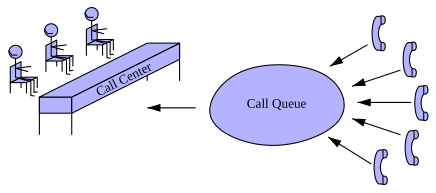
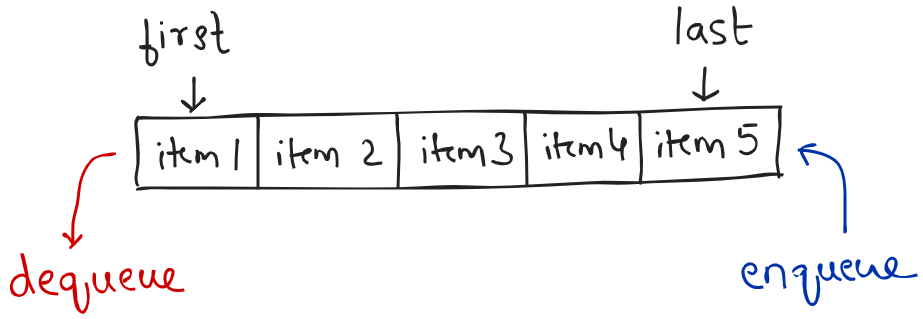
- A queue is a two-ended linear data structure.
- A queue uses the first in, first out (FIFO) principle.
- A queue has two major operations: enqueue and dequeue, meaning insert and delete respectively.
Applications
- Client/customer requests severed
- Movie tickets, bus tickets, plane tickets, etc
- Process scheduling in operating systems
Queue ADT
| Method | Functionality |
|---|---|
| enqueue(e) | Adds element e to the back of queue. |
| dequeue() | Removes and returns the first element from the queue (or null if the queue is empty). |
| first() | Returns the first element of the queue, without removing it (or null if the queue is empty). |
| size() | Returns the number of elements in the queue. |
| isEmpty() | Returns a boolean indicating whether the queue is empty |
Queue ADT Interface
public interface Queue {
  /** Returns the number of elements in the queue. */
  int size();

  /** Tests whether the queue is empty. */
  boolean isEmpty();

  /** Inserts an element at the rear of the queue. */
  void enqueue(E e);

  /** Returns, but does not remove, the first element of the queue. */
  E first();

  /** Removes and returns the first element of the queue. */
  E dequeue();
}
Operations
| Method | Return value | first $\rightarrow$ Q $\rightarrow$ last |
|---|---|---|
| enqueue(5) | – | (5) |
| enqueue(3) | – | (5, 3) |
| size() | 2 | (5, 3) |
| dequeue() | 5 | (3) |
| isEmpty() | false | (3) |
| dequeue() | 3 | () |
| isEmpty() | true | () |
| dequeue() | null | () |
| enqueue(7) | – | (7) |
| enqueue(9) | – | (7, 9) |
| first() | 7 | (7, 9) |
| enqueue(4) | – | (7, 9, 4) |
java.util.Queue Interface
| Our Queue ADT | Interface java.util.Queue | |
|---|---|---|
| throws exceptions | returns special value | |
| enqueue(e) | add(e) | offer(e) |
| dequeue() | remove() | poll() |
| first() | element() | peek() |
| size() | size() | |
| isEmpty() | isEmpty() | |
Queue ADT $\rightarrow$ Array Implementation (0-indexed)
Queue front at index 0 always. Is there a problem?

Queue front at $f$. Is there a problem?

Queue front at $f$ in circular array.

Enqueue
An element will be enqueued at location $availability$.
$availability = (front + n) \bmod N$
Example: If $front = 5$, size $n = 3$, capacity $N = 10$, then $availability = (5 + 3) \bmod 10 = 8$
Dequeue
An element will be dequeued at location $front$.
$front = (front + 1) \bmod N$
Example: If $front = 3$, capacity $N = 10$, then an element will be dequeued at location $front$ and then $front = (3 + 1) \bmod 10 = 4$
public class ArrayQueue implements Queue {
  // instance variables
  /** Default array capacity. */
  public static final int CAPACITY = 1000;      // default array capacity

  /** Generic array used for storage of queue elements. */
  private E[] data;                             // generic array used for storage

  /** Index of the top element of the queue in the array. */
  private int f = 0;                            // index of the front element

  /** Current number of elements in the queue. */
  private int sz = 0;                           // current number of elements

  // constructors
  /** Constructs an empty queue using the default array capacity. */
  public ArrayQueue() {this(CAPACITY);}         // constructs queue with default capacity

  /**
   * Constructs and empty queue with the given array capacity.
   * @param capacity length of the underlying array
   */
  @SuppressWarnings({"unchecked"})
  public ArrayQueue(int capacity) {             // constructs queue with given capacity
    data = (E[]) new Object[capacity];          // safe cast; compiler may give warning
  }

  // methods
  /**
   * Returns the number of elements in the queue.
   * @return number of elements in the queue
   */
  @Override
  public int size() { return sz; }

  /** Tests whether the queue is empty. */
  @Override
  public boolean isEmpty() { return (sz == 0); }

  /**
   * Inserts an element at the rear of the queue.
   * This method runs in O(1) time.
   * @param e   new element to be inserted
   * @throws IllegalStateException if the array storing the elements is full
   */
  @Override
  public void enqueue(E e) throws IllegalStateException {
    if (sz == data.length) throw new IllegalStateException("Queue is full");
    int avail = (f + sz) % data.length;   // use modular arithmetic
    data[avail] = e;
    sz++;
  }

  /**
   * Returns, but does not remove, the first element of the queue.
   * @return the first element of the queue (or null if empty)
   */
  @Override
  public E first() {
    if (isEmpty()) return null;
    return data[f];
  }

  /**
   * Removes and returns the first element of the queue.
   * @return element removed (or null if empty)
   */
  @Override
  public E dequeue() {
    if (isEmpty()) return null;
    E answer = data[f];
    data[f] = null;                             // dereference to help garbage collection
    f = (f + 1) % data.length;
    sz--;
    return answer;
  }

  /**
   * Returns a string representation of the queue as a list of elements.
   * This method runs in O(n) time, where n is the size of the queue.
   * @return textual representation of the queue.
   */
  public String toString() {
    StringBuilder sb = new StringBuilder("(");
    int k = f;
    for (int j=0; j < sz; j++) {
      if (j > 0)
        sb.append(", ");
      sb.append(data[k]);
      k = (k + 1) % data.length;
    }
    sb.append(")");
    return sb.toString();
  }
}
Queue ADT $\rightarrow$ SLL Implementation
/** Realization of a FIFO queue as an adaptation of a SinglyLinkedList. */
public class LinkedQueue implements Queue {
	private SinglyLinkedList list = new SinglyLinkedList<>(); // an empty list
	public LinkedQueue() { } // new queue relies on the initially empty list
	public int size() { return list.size(); }
	public boolean isEmpty() { return list.isEmpty(); }
	public void enqueue(E element) { list.addLast(element); }
	public E first() { return list.first(); }
	public E dequeue() { return list.removeFirst(); }
}
Circular Queue ADT $\rightarrow$ CLL Implementation
public interface CircularQueue extends Queue {
	/** Rotates the front element of the queue to the back of the queue.
	This does nothing if the queue is empty. */
	void rotate();
}
- Circular queues are useful for multiplayer, turn-based games, or round-robin scheduling of computing processes.
- LinkedCircularQueue class = CircularQueue interface + CircularlyLinkedList class.
Deques (Double-Ended Queues)
- A double-ended queue or deque is a double-ended linear data structure that is more general than stack and queue.
- A deque has four major operations:
addfirst, addlast, removefirst, and removelast.
Deque ADT
| Method | Functionality |
|---|---|
| addFirst(e) | Insert a new element e at the front of the deque. |
| addLast(e) | Insert a new element e at the back of the deque. |
| removeFirst() | Remove and return the first element of the deque (or null if the deque is empty). |
| removeLast() | Remove and return the last element of the deque (or null if the deque is empty). |
| first() | Returns the first element of the deque without removing (or null if the deque is empty). |
| last() | Returns the last element of the deque without removing (or null if the deque is empty). |
| size() | Returns the number of elements in the deque. |
| isEmpty() | Returns a boolean indicating whether the deque is empty. |
Deque ADT Interface
public interface Deque {
  /** Returns the number of elements in the deque. */
  int size();
  /** Tests whether the deque is empty. */
  boolean isEmpty();

  /** Returns (but does not remove) the first element of the deque. */
  E first();
  /** Returns (but does not remove) the last element of the deque. */
  E last();

  /** Inserts an element at the front of the deque. */
  void addFirst(E e);
  /** Inserts an element at the back of the deque. */
  void addLast(E e);

  /** Removes and returns the first element of the deque. */
  E removeFirst();
  /** Removes and returns the last element of the deque. */
  E removeLast();
}
Operations
| Method | Return value | Deque |
|---|---|---|
| addLast(5) | – | (5) |
| addFirst(3) | – | (3, 5) |
| addFirst(7) | – | (7, 3, 5) |
| first() | 7 | (7, 3, 5) |
| removeLast() | 5 | (7, 3) |
| size() | 2 | (7, 3) |
| removeLast() | 3 | (7) |
| removeFirst() | 7 | () |
| addFirst(6) | – | (6) |
| last() | 6 | (6) |
| addFirst(8) | – | (8, 6) |
| isEmpty() | false | (8, 6) |
| last() | 6 | (8, 6) |
java.util.Deque Interface
| Our Deque ADT | Interface java.util.Deque | |
|---|---|---|
| throws exceptions | returns special value | |
| first() | getFirst() | peekFirst() |
| last() | getLast() | peekLast() |
| addFirst(e) | addFirst(e) | offerFirst(e) |
| addLast(e) | addLast(e) | offerLast(e) |
| removeFirst() | removeFirst() | pollFirst() |
| removeLast() | removeLast() | pollLast() |
| size() | size() | |
| isEmpty() | isEmpty() | |
Deque ADT $\rightarrow$ Array Implementation
Use circular dynamic array.removeFirst
Element is removed at $front$.
Update $front$ as $front = (front + 1) \bmod N$.
removeLast
Find the last location: $last = (front + n - 1) \bmod N$.
Element is removed at $last$.
(No update to $front$.)
addLast
Find the available location: $emptyslot = (front + n) \bmod N$.
Element is added at $emptyslot$.
(No update to $front$.)
addFirst
Find the available location: $emptyslot = (front - 1 + N) \bmod N$.
Element is added at $emptyslot$.
Update $front$ as $front = emptyslot$.
The statement $emptyslot = (front - 1) \bmod N$ is mathematically correct but leads to problems in Java. In Java, when $front = 0$, we get $emptyslot = (front - 1) \bmod N = -1 \bmod N = -1$. Therefore, to avoid negative integers, we add $N$ before taking mod.
Deque ADT $\rightarrow$ DLL Implementation
public class LinkedDeque implements Deque {
	private DoublyLinkedList list = new DoublyLinkedList<>(); // an empty list
	public LinkedDeque() { } // new deque relies on the initially empty list

	public int size() { return list.size(); }
	public boolean isEmpty() { return list.isEmpty(); }
	public E first() { return list.first(); }
	public E last() { return list.last(); }

	public void addFirst(E element) { list.addFirst(element); }
	public void addLast(E element) { list.addLast(element); }
	public E removeFirst() { return list.removeFirst(); }
	public E removeLast() { return list.removeLast(); }
}