Priority Queues
Contents
- Priority Queues
- Implementations
- Unsorted List
- Sorted List
- Array-Based Heap
- Tree-Based Heap
- Priority Queue Sort
- Selection Sort
- Insertion Sort
- Heap Sort
- Applications
Time Complexity
| Method | Unsorted list | Sorted list | Array heap | Linked-tree heap |
|---|---|---|---|---|
| size | $O(1)$ | $O(1)$ | $O(1)$ | $O(1)$ |
| isEmpty | $O(1)$ | $O(1)$ | $O(1)$ | $O(1)$ |
| min | $O(n)$ | $O(1)$ | $O(1)$ | $O(1)$ |
| insert | $O(1)$ | $O(n)$ | $O(\log n)^*$ | $O(\log n)$ |
| removeMin | $O(n)$ | $O(1)$ | $O(\log n)^*$ | $O(\log n)$ |
* = amortized complexity
Priority Queues
- A priority queue is a tree-based data structure consisting of key-value pairs.
- A priority queue uses the whatever in, priority-out principle.
- A priority queue has two major operations: insert and delete-min.
Priority Queue ADT
| Method | Functionality |
|---|---|
| insert(k, v) | Creates an entry with key k and value v in the priority queue. |
| min() | Returns (but does not remove) a priority queue entry (k,v) having minimal key; returns null if the priority queue is empty. |
| removeMin() | Removes and returns an entry (k,v) having minimal key from the priority queue; returns null if the priority queue is empty. |
| size() | Returns the number of entries in the priority queue. |
| isEmpty() | Returns a boolean indicating whether the priority queue is empty. |
Operations
| Method | Return value | Priority queue contents |
|---|---|---|
| insert(5,A) | $\{$ (5,A) $\}$ | |
| insert(9,C) | $\{$ (5,A), (9,C) $\}$ | |
| insert(3,B) | $\{$ (3,B), (5,A), (9,C) $\}$ | |
| min() | (3,B) | $\{$ (3,B), (5,A), (9,C) $\}$ |
| removeMin() | (3,B) | $\{$ (5,A), (9,C) $\}$ |
| insert(7,D) | $\{$ (5,A), (7,D), (9,C) $\}$ | |
| removeMin() | (5,A) | $\{$ (7,D), (9,C) $\}$ |
| removeMin() | (7,D) | $\{$ (9,C) $\}$ |
| removeMin() | (9,C) | $\{$ $\}$ |
| removeMin() | null | $\{$ $\}$ |
| isEmpty() | true | $\{$ $\}$ |
Priority Queue ADT $\rightarrow$ Unsorted List Implementation
- We use a PositionalList which in turn uses DLL.
- insert method inserts a key-value entry at the end of the list in $O(1)$ time.
- min or removeMin requires scanning the entire list in $O(n)$ time.
| Method | Unsorted list |
|---|---|
| size | $O(1)$ |
| isEmpty | $O(1)$ |
| insert | $O(1)$ |
| min | $O(n)$ |
| removeMin | $O(n)$ |
Priority Queue ADT $\rightarrow$ Sorted List Implementation
- We use a PositionalList which in turn uses DLL but sorted by nondecreasing keys.
- min or removeMin requires the retrieval or removal of the first element in $O(1)$ time.
- insert method inserts a key-value entry at the appropriate position after scanning the list in $O(n)$ time.
| Method | Sorted list |
|---|---|
| size | $O(1)$ |
| isEmpty | $O(1)$ |
| insert | $O(n)$ |
| min | $O(1)$ |
| removeMin | $O(1)$ |
Heap
- Unsorted list has excellent insert time but worse removeMin time.
Sorted list has excellent removeMin time but worse insert time. - Is it possible to get the best of both the worlds?
No! It is impossible to construct a data structure that has $O(1)$ for both insert and removeMin. Why? - We can definitely get the better of both the worlds using the heap data structure.
- Heap is the tree-based data structure for implementing the priority queue ADT.
| Method | Unsorted list | Sorted list | Heap |
|---|---|---|---|
| insert | $O(1)$ | $O(n)$ | $O(\log n)$ |
| removeMin | $O(n)$ | $O(1)$ | $O(\log n)$ |
java.util.PriorityQueue class
- User-defined priority can be given to the class by sending a comparator object when constructing the priority queue.
- Key-value pair can be considered by using java.util.AbstractMap.SimpleEntry class
| Our Priority Queue ADT | java.util.PriorityQueue class |
|---|---|
| insert(k,v) | add(new SimpleEntry(k,v)) |
| min() | peek() |
| removeMin() | remove() |
| size() | size() |
| isEmpty() | isEmpty() |
Example
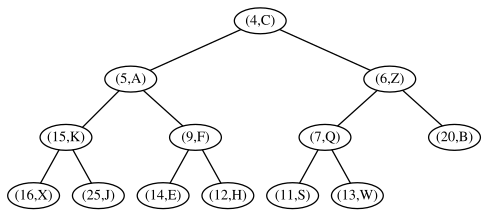
Properties
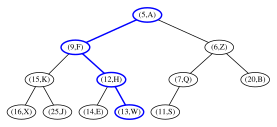
A heap is a binary tree $T$ that satisfies two properties:
- Relational property. Deals with how keys are stored in $T$.
Heap-order property. Key stored at a node is less than or equal to the keys stored at its child nodes. - Structural property. Deals with the shape of $T$.
Complete binary tree property. A heap $T$ with maximum level $\ell$ is an almost-complete binary tree if levels $0,1,2,\ldots ,(\ell - 1)$ of $T$ have the maximal number of nodes possible (namely, level $i$ has $2i$ nodes, for $0 \le i \le \ell - 1$) and the remaining nodes at level $\ell$ reside in the leftmost possible positions at that level.
A heap $T$ storing $n$ entries has maximum level $\ell = \lfloor \log_2 n \rfloor$.
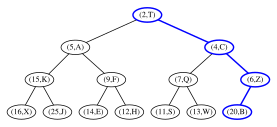
Operation $\rightarrow$ Insert
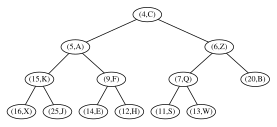
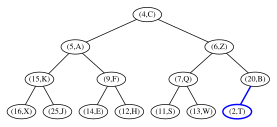
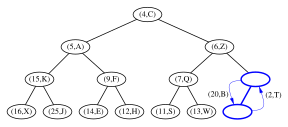
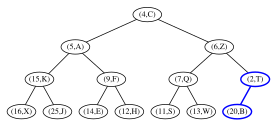
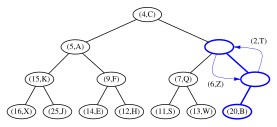
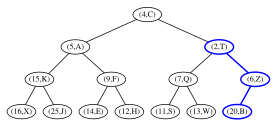
Insert$(k, v)$
- Insert pair $(k, v)$ at the last node
- Up-heap bubble until heap-order property is not violated
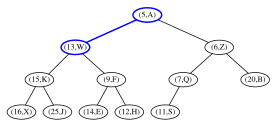
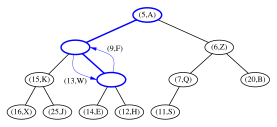
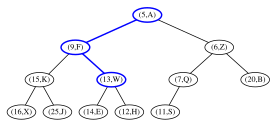
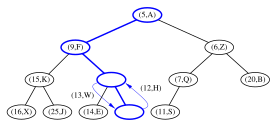
Operation $\rightarrow$ RemoveMin
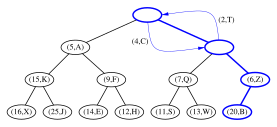
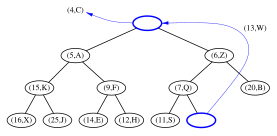
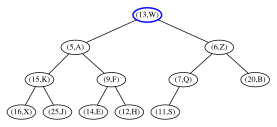
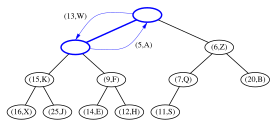
RemoveMin$(k, v)$
- Remove the root node
- Move the last node to the root node position
- Down-heap bubble until heap-order property is not violated
Priority Queue ADT $\rightarrow$ Array-Based Heap Implementation
Array representation
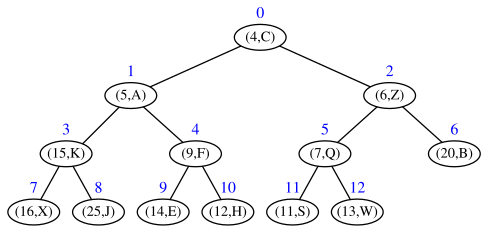

Check the section of array representation of trees in the trees topic.
Array implementation
import java.util.ArrayList;
import java.util.Comparator;

public interface Entry {
  /**
   * Returns the key stored in this entry.
   * @return the entry's key
   */
  K getKey();

  /**
   * Returns the value stored in this entry.
   * @return the entry's value
   */
  V getValue();
}

public interface PriorityQueue {

  /**
   * Returns the number of items in the priority queue.
   * @return number of items
   */
  int size();

  /**
   * Tests whether the priority queue is empty.
   * @return true if the priority queue is empty, false otherwise
   */
  boolean isEmpty();

  /**
   * Inserts a key-value pair and returns the entry created.
   * @param key     the key of the new entry
   * @param value   the associated value of the new entry
   * @return the entry storing the new key-value pair
   * @throws IllegalArgumentException if the key is unacceptable for this queue
   */
  Entry insert(K key, V value) throws IllegalArgumentException;

  /**
   * Returns (but does not remove) an entry with minimal key.
   * @return entry having a minimal key (or null if empty)
   */
  Entry min();

  /**
   * Removes and returns an entry with minimal key.
   * @return the removed entry (or null if empty)
   */
  Entry removeMin();
}

public abstract class AbstractPriorityQueue implements PriorityQueue {
  //---------------- nested PQEntry class ----------------
  /**
   * A concrete implementation of the Entry interface to be used within
   * a PriorityQueue implementation.
   */
  protected static class PQEntry implements Entry {
    private K k;  // key
    private V v;  // value

    public PQEntry(K key, V value) {
      k = key;
      v = value;
    }

    // methods of the Entry interface
    public K getKey() { return k; }
    public V getValue() { return v; }

    // utilities not exposed as part of the Entry interface
    protected void setKey(K key) { k = key; }
    protected void setValue(V value) { v = value; }
  } //----------- end of nested PQEntry class -----------

  // instance variable for an AbstractPriorityQueue
  /** The comparator defining the ordering of keys in the priority queue. */
  private Comparator comp;

  /**
   * Creates an empty priority queue using the given comparator to order keys.
   * @param c comparator defining the order of keys in the priority queue
   */
  protected AbstractPriorityQueue(Comparator c) { comp = c; }

  /** Creates an empty priority queue based on the natural ordering of its keys. */
  protected AbstractPriorityQueue() { this(new DefaultComparator()); }

  /** Method for comparing two entries according to key */
  protected int compare(Entry a, Entry b) {
    return comp.compare(a.getKey(), b.getKey());
  }

  /** Determines whether a key is valid. */
  protected boolean checkKey(K key) throws IllegalArgumentException {
    try {
      return (comp.compare(key,key) == 0);  // see if key can be compared to itself
    } catch (ClassCastException e) {
      throw new IllegalArgumentException("Incompatible key");
    }
  }

  /**
   * Tests whether the priority queue is empty.
   * @return true if the priority queue is empty, false otherwise
   */
  @Override
  public boolean isEmpty() { return size() == 0; }
}


public class HeapPriorityQueue extends AbstractPriorityQueue {
  /** primary collection of priority queue entries */
  protected ArrayList> heap = new ArrayList<>();

  /** Creates an empty priority queue based on the natural ordering of its keys. */
  public HeapPriorityQueue() { super(); }

  /**
   * Creates an empty priority queue using the given comparator to order keys.
   * @param comp comparator defining the order of keys in the priority queue
   */
  public HeapPriorityQueue(Comparator comp) { super(comp); }

  /**
   * Creates a priority queue initialized with the respective
   * key-value pairs.  The two arrays given will be paired
   * element-by-element. They are presumed to have the same
   * length. (If not, entries will be created only up to the length of
   * the shorter of the arrays)
   * @param keys an array of the initial keys for the priority queue
   * @param values an array of the initial values for the priority queue
   */
  public HeapPriorityQueue(K[] keys, V[] values) {
    super();
    for (int j=0; j < Math.min(keys.length, values.length); j++)
      heap.add(new PQEntry<>(keys[j], values[j]));
    heapify();
  }

  // protected utilities
  protected int parent(int j) { return (j-1) / 2; }     // truncating division
  protected int left(int j) { return 2*j + 1; }
  protected int right(int j) { return 2*j + 2; }
  protected boolean hasLeft(int j) { return left(j) < heap.size(); }
  protected boolean hasRight(int j) { return right(j) < heap.size(); }

  /** Exchanges the entries at indices i and j of the array list. */
  protected void swap(int i, int j) {
    Entry temp = heap.get(i);
    heap.set(i, heap.get(j));
    heap.set(j, temp);
  }

  /** Moves the entry at index j higher, if necessary, to restore the heap property. */
  protected void upheap(int j) {
    while (j > 0) {            // continue until reaching root (or break statement)
      int p = parent(j);
      if (compare(heap.get(j), heap.get(p)) >= 0) break; // heap property verified
      swap(j, p);
      j = p;                                // continue from the parent's location
    }
  }

  /** Moves the entry at index j lower, if necessary, to restore the heap property. */
  protected void downheap(int j) {
    while (hasLeft(j)) {               // continue to bottom (or break statement)
      int leftIndex = left(j);
      int smallChildIndex = leftIndex;     // although right may be smaller
      if (hasRight(j)) {
          int rightIndex = right(j);
          if (compare(heap.get(leftIndex), heap.get(rightIndex)) > 0)
            smallChildIndex = rightIndex;  // right child is smaller
      }
      if (compare(heap.get(smallChildIndex), heap.get(j)) >= 0)
        break;                             // heap property has been restored
      swap(j, smallChildIndex);
      j = smallChildIndex;                 // continue at position of the child
    }
  }

  /** Performs a bottom-up construction of the heap in linear time. */
  protected void heapify() {
    int startIndex = parent(size()-1);    // start at PARENT of last entry
    for (int j=startIndex; j >= 0; j--)   // loop until processing the root
      downheap(j);
  }

  // public methods

  /**
   * Returns the number of items in the priority queue.
   * @return number of items
   */
  @Override
  public int size() { return heap.size(); }

  /**
   * Returns (but does not remove) an entry with minimal key.
   * @return entry having a minimal key (or null if empty)
   */
  @Override
  public Entry min() {
    if (heap.isEmpty()) return null;
    return heap.get(0);
  }

  /**
   * Inserts a key-value pair and return the entry created.
   * @param key     the key of the new entry
   * @param value   the associated value of the new entry
   * @return the entry storing the new key-value pair
   * @throws IllegalArgumentException if the key is unacceptable for this queue
   */
  @Override
  public Entry insert(K key, V value) throws IllegalArgumentException {
    checkKey(key);      // auxiliary key-checking method (could throw exception)
    Entry newest = new PQEntry<>(key, value);
    heap.add(newest);                      // add to the end of the list
    upheap(heap.size() - 1);               // upheap newly added entry
    return newest;
  }

  /**
   * Removes and returns an entry with minimal key.
   * @return the removed entry (or null if empty)
   */
  @Override
  public Entry removeMin() {
    if (heap.isEmpty()) return null;
    Entry answer = heap.get(0);
    swap(0, heap.size() - 1);              // put minimum item at the end
    heap.remove(heap.size() - 1);          // and remove it from the list;
    downheap(0);                           // then fix new root
    return answer;
  }

  /** Used for debugging purposes only */
  private void sanityCheck() {
    for (int j=0; j < heap.size(); j++) {
      int left = left(j);
      int right = right(j);
      if (left < heap.size() && compare(heap.get(left), heap.get(j)) < 0)
        System.out.println("Invalid left child relationship");
      if (right < heap.size() && compare(heap.get(right), heap.get(j)) < 0)
        System.out.println("Invalid right child relationship");
    }
  }
}
Complexity
| Method | Array heap | Linked-tree heap |
|---|---|---|
| size, isEmpty, min | $O(1)$ | $O(1)$ |
| insert | $O(\log n)^*$ | $O(\log n)$ |
| removeMin | $O(\log n)^*$ | $O(\log n)$ |
* = amortized complexity
- Up-heap and down-heap bubbling take $O(\log n)$ time.
- Array runtimes are amortized due to array resizing.
Priority Queue Sort
Priority-Queue-Sort(sequence $S$, priority queue $P$)
- Insert the $n$ elements of $S$ into $P$
- RemoveMin the $n$ elements of $P$ into $S$
/** Sorts sequence S, using initially empty priority queue P. */
public static  void pqSort(PositionalList S, PriorityQueue P) {
	int n = S.size();
	for (int j = 0; j < n; j++) {
		E element = S.remove(S.first());
		P.insert(element, null); // element is key; null value
	}
	for (int j = 0; j < n; j++) {
		E element = P.removeMin().getKey();
		S.addLast(element); // the smallest key in P is next placed in S
	}
}
Selection Sort (Set $P =$ Unsorted List)
| Sequence S | Priority Queue P | ||
|---|---|---|---|
| Input | (7, 4, 8, 2, 5, 3, 9) | () | |
| insert | (a) | (4, 8, 2, 5, 3, 9) | (7) |
| (b) | (8, 2, 5, 3, 9) | (7, 4) | |
| $\vdots$ | $\vdots$ | $\vdots$ | |
| (g) | () | (7, 4, 8, 2, 5, 3, 9) | |
| removeMin | (a) | (2) | (7, 4, 8, 5, 3, 9) |
| (b) | (2, 3) | (7, 4, 8, 5, 9) | |
| (c) | (2, 3, 4) | (7, 8, 5, 9) | |
| (d) | (2, 3, 4, 5) | (7, 8, 9) | |
| (e) | (2, 3, 4, 5, 7) | (8, 9) | |
| (f) | (2, 3, 4, 5, 7, 8) | (9) | |
| (g) | (2, 3, 4, 5, 7, 8, 9) | () |
- Phase 1 time $= \sum_{i = 1}^{n} \Theta(1) = \Theta(n)$
- Phase 2 time $= \sum_{i = n}^{1} O(i) = O(n^2)$
- Total time $= O(n^2)$
Insertion Sort (Set $P =$ Sorted List)
| Sequence S | Priority Queue P | ||
|---|---|---|---|
| Input | (7, 4, 8, 2, 5, 3, 9) | () | |
| insert | (a) | (4, 8, 2, 5, 3, 9) | (7) |
| (b) | (8, 2, 5, 3, 9) | (4, 7) | |
| (c) | (2, 5, 3, 9) | (4, 7, 8) | |
| (d) | (5, 3, 9) | (2, 4, 7, 8) | |
| (e) | (3, 9) | (2, 4, 5, 7, 8) | |
| (f) | (9) | (2, 3, 4, 5, 7, 8) | |
| (g) | () | (2, 3, 4, 5, 7, 8, 9) | |
| removeMin | (a) | (2) | (3, 4, 5, 7, 8, 9) |
| (b) | (2, 3) | (4, 5, 7, 8, 9) | |
| $\vdots$ | $\vdots$ | $\vdots$ | |
| (g) | (2, 3, 4, 5, 7, 8, 9) | () |
- Phase 1 time $= \sum_{i = 1}^{n} O(i) = O(n^2)$
- Phase 2 time $= \sum_{i = n}^{1} \Theta(1) = \Theta(n)$
- Total time $= O(n^2)$
Heap Sort (Set $P =$ Heap)
| Sequence S | Priority Queue P | ||
|---|---|---|---|
| Input | (7, 4, 8, 2, 5, 3, 9) | () | |
| insert | (a) | (4, 8, 2, 5, 3, 9) | (7) |
| (b) | (8, 2, 5, 3, 9) | (4, 7) | |
| $\vdots$ | $\vdots$ | $\vdots$ | |
| (g) | () | (2, 4, 3, 7, 5, 8, 9) | |
| removeMin | (a) | (2) | (3, 4, 8, 7, 5, 9) |
| (b) | (2, 3) | (4, 5, 8, 7, 9) | |
| (c) | (2, 3, 4) | (5, 7, 8, 9) | |
| (d) | (2, 3, 4, 5) | (7, 9, 8) | |
| (e) | (2, 3, 4, 5, 7) | (8, 9) | |
| (f) | (2, 3, 4, 5, 7, 8) | (9) | |
| (g) | (2, 3, 4, 5, 7, 8, 9) | () |
- Phase 1 time $= \sum_{i = 1}^{n} O(\log n) = O(n \log n)$
- Phase 2 time $= \sum_{i = n}^{1} O(\log n) = O(n \log n)$
- Total time $= O(n \log n)$
Complexity
| Sorting algorithm | Running time |
|---|---|
| Selection sort | $O(n^2)$ |
| Insertion sort | $O(n^2)$ |
| Heap sort | $O(n \log n)$ |
Applications
- Operating system process scheduling uses priority queues
- Single-source all-target shortest path algorithm uses priority queues
- Jarnik's minimum spanning tree algorithm uses priority queues
- Network packet routing uses priority queues in routers to prioritize packets based on quality-of-service requirements
- Huffman coding uses priority queues
- Air traffic control uses priority queues to manage landing and takeoff requests
- Best-first search uses priority queues to always expand the most promising node first
- A* search uses priority queues to select nodes based on their estimated total cost
- Technical support uses priority queues to handle higher-severity support requests first
- Heap sort $\rightarrow$ All applications of sorting