Hash Tables
Contents
- Hash Functions
- Hash Tables
- Collisions
- Collision-Avoiding Techniques
- Applications
Time Complexity
- Balanced search tree is ideal for sorted collection
- Hash table is ideal for unsorted collection
| Balanced tree | Hash table | |||
|---|---|---|---|---|
| Operations | (worst) | (average) | (worst) | |
| Sorting-unrelated operations | Insert | $O(\log n)$ | $O(1)$ | $O(n)$ |
| Delete | $O(\log n)$ | $O(1)$ | $O(n)$ | |
| Search | $O(\log n)$ | $O(1)$ | $O(n)$ | |
| Sorting-related operations | Sort | $O(n)$ | ✘ | |
| Minimum | $O(\log n)$ | ✘ | ||
| Maximum | $O(\log n)$ | ✘ | ||
| Predecessor | $O(\log n)$ | ✘ | ||
| Successor | $O(\log n)$ | ✘ | ||
| Range-Minimum | $O(\log n)$ | ✘ | ||
| Range-Maximum | $O(\log n)$ | ✘ | ||
| Range-Sum | $O(n)$ | ✘ | ||
Hash Functions
Hash function
A hash function is a function that maps arbitrary size data to fixed size data.
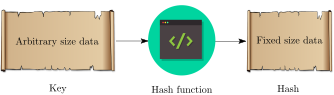
Properties of a good hash function
- Hash function is deterministic and fast
- Computing message from hash value is infeasible
- Computing two messages having same hash value is infeasible
- Tiny change in message changes the hash value drastically
Hash Tables
Hash table
- A hash table is a data structure to implement dictionary ADT
- A hash table is an efficient implementation of a set/multiset/map/multimap.
- A hash table performs insert, delete, and search operations in constant expected time.
Hash function
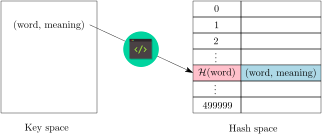
- A hash function is a mapping from arbitrary objects to the set of indices $[0, N - 1]$.
- The key-value pair $(k, v)$ is stored at $A[H(k)]$ in the hash table.
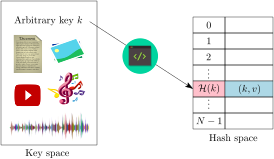
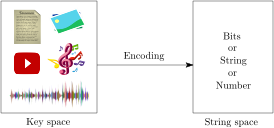
Two stages of hash function
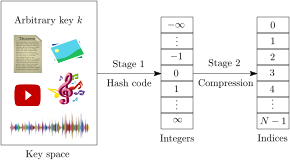
Hash function $\rightarrow$ Stage 1 (Hash code)
Polynomial hash codes.
Hashcode$(x_0, x_1, \ldots, x_{n-1}) = x_0a^{n-1} + x_1a^{n-2} + \cdots + x_{n-2}a + x_{n-1}$ (polynomial)
\begin{algorithm}
\caption{Stage 1 of hash function}
\begin{algorithmic}
\REQUIRE $key$: a string of characters (of any object) that needs to be hashed
\ENSURE $hashcode$: the hash code of the string $key$
\FUNCTION{HashCode}{$key$}
    \STATE $hashcode \gets 0$
    \FOR{$i \gets 0$ \TO $|key| - 1$}
        \STATE $hashcode \gets hashcode \times 31 + \text{CharacterCode}(key[i])$
    \ENDFOR
    \RETURN $hashcode$
\ENDFUNCTION
\end{algorithmic}
\end{algorithm}
Hash function $\rightarrow$ Stage 2 (Compression)
A good compression function minimizes the number of collisions for a given set of distinct hash codes.
Division method.
Compression($i$) $= i \bmod N$ (remainder)
$N \ge 1$ is the size of the bucket array.
Choose $N$ as prime for better distribution of keys.
\begin{algorithm}
\caption{Stage 2 of hash function}
\begin{algorithmic}
\REQUIRE $hashcode$: hashcode obtained from stage 1; $tablesize$: the size of the hash table
\ENSURE $hash$: an index between $0$ and $(tablesize-1)$ of the hash table
\FUNCTION{Hash}{$hashcode, tablesize$}
    \STATE $hash \gets hashcode \bmod tablesize$
    \RETURN $hash$
\ENDFUNCTION
\end{algorithmic}
\end{algorithm}
Sample application $\rightarrow$ English dictionary
Collisions
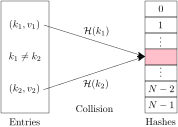
Collision-handling schemes
There are two major collision-handling schemes or collision-resolution strategies.
| Collision-handling scheme | Secondary data structures apart from array | Implementation |
|---|---|---|
| Separate chaining | yes | simpler |
| Open addressing | no | more complicated |
Separate chaining
- Each $bucket[index]$ stores its own secondary container.
- We use secondary data structures (e.g. array list, linked list, balanced search trees, etc) for each bucket.
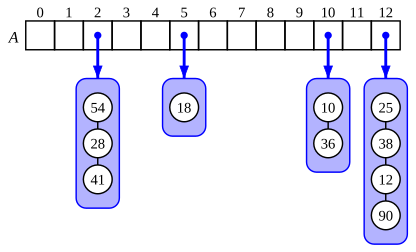
Separate Chaining $\rightarrow$ Singly Linked List
\begin{algorithm}
\begin{algorithmic}
\STATE \textbf{class} \textsc{HashTable-SeparateChaining-SLL}$()$
    \STATE $N$ (hash table size)
    \STATE Create a $bucket[0 \ldots (N-1)]$ array, where each $bucket[i]$ points to a SinglyLinkedList.
    \STATE
    \STATE Methods:
    \STATE \textsc{HashCode}$(key)$
    \STATE \textsc{Hash}$(key)$
    \STATE \textsc{Print}$()$
    \STATE \textsc{Get}$(key)$
    \STATE \textsc{Put}$(\langle key, value \rangle)$
    \STATE \textsc{Remove}$(key)$
\end{algorithmic}
\end{algorithm}
\begin{algorithm}
\begin{algorithmic}
\FUNCTION{Print}{}
    \FOR{$i \gets 0$ \TO $N - 1$}
        \STATE \textbf{print} ``Bucket $i$:''
        \STATE \textbf{print} entire SLL contents of $bucket[i]$
    \ENDFOR
\ENDFUNCTION
\end{algorithmic}
\end{algorithm}
\begin{algorithm}
\begin{algorithmic}
\FUNCTION{Get}{$key$}
    \STATE $index \gets \text{Hash}(key)$
    \IF{$key$ exists in $bucket[index]$ SLL at node $x$}
        \RETURN $x.value$
    \ELSE
        \RETURN $null$
    \ENDIF
\ENDFUNCTION
\end{algorithmic}
\end{algorithm}
\begin{algorithm}
\begin{algorithmic}
\FUNCTION{Put}{$\langle key, value \rangle$}
    \STATE $index \gets \text{Hash}(key)$
    \IF{$key$ exists in $bucket[index]$ SLL at node $x$}
        \STATE Update $x.value$ with $value$
    \ELSE
        \STATE $bucket[index].\text{AddLast}(\langle key, value \rangle)$
    \ENDIF
    \IF{load factor is high}
        \STATE Resize the hash table
    \ENDIF
\ENDFUNCTION
\end{algorithmic}
\end{algorithm}
\begin{algorithm}
\begin{algorithmic}
\FUNCTION{Remove}{$key$}
    \STATE $index \gets \text{Hash}(key)$
    \IF{$key$ exists in $bucket[index]$ SLL at node $x$}
        \STATE Remove node $x$
    \ENDIF
\ENDFUNCTION
\end{algorithmic}
\end{algorithm}
Open Addressing
All entries are stored in the bucket array itself.
| Scheme | Function |
|---|---|
| Linear probing | $f(i) = i$ |
| Quadratic probing | $f(i) = i^2$ |
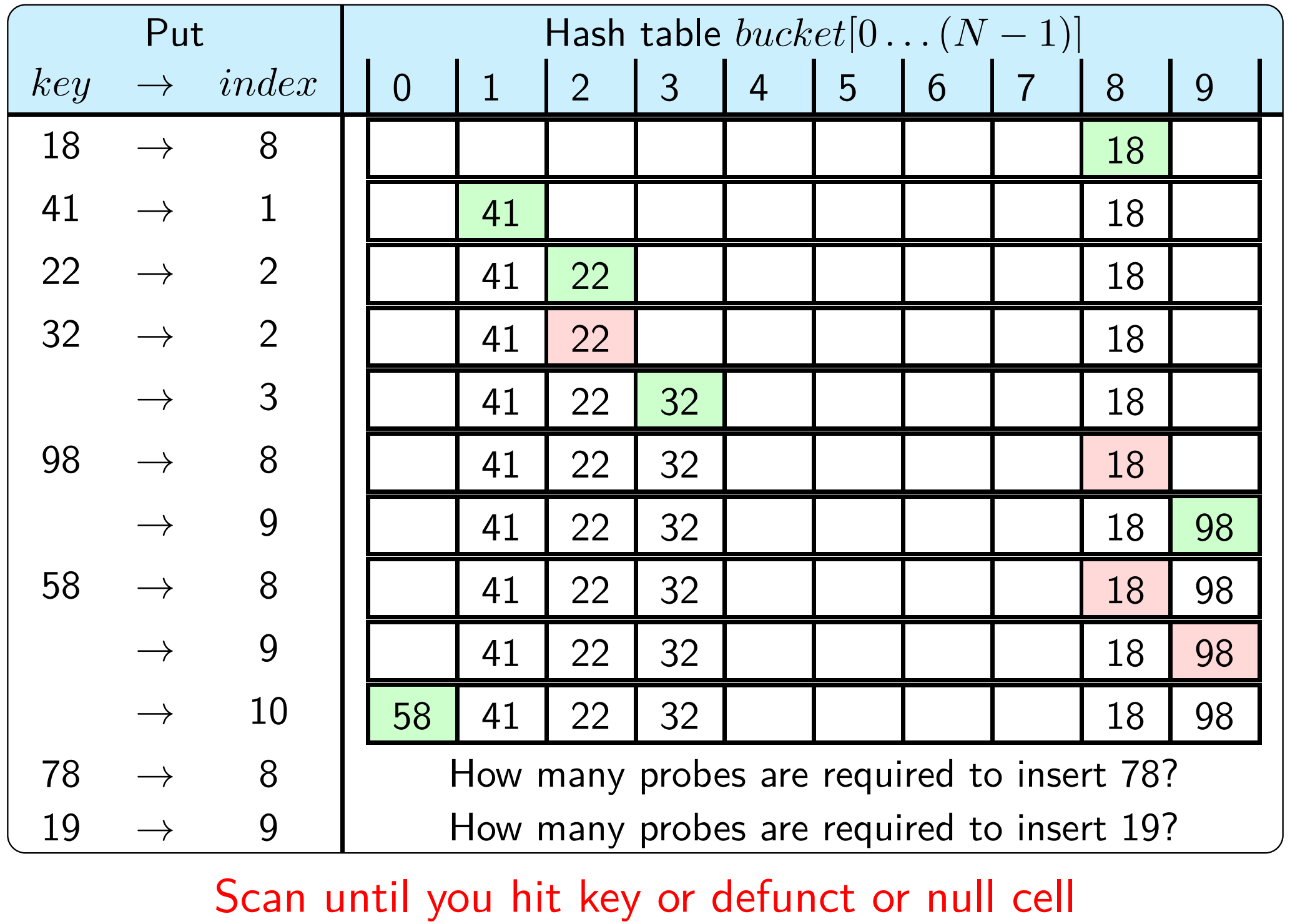
Open addressing $\rightarrow$ Linear probing $\rightarrow$ Put
Suppose HashCode($key$) $= key$ and $N = 10$.
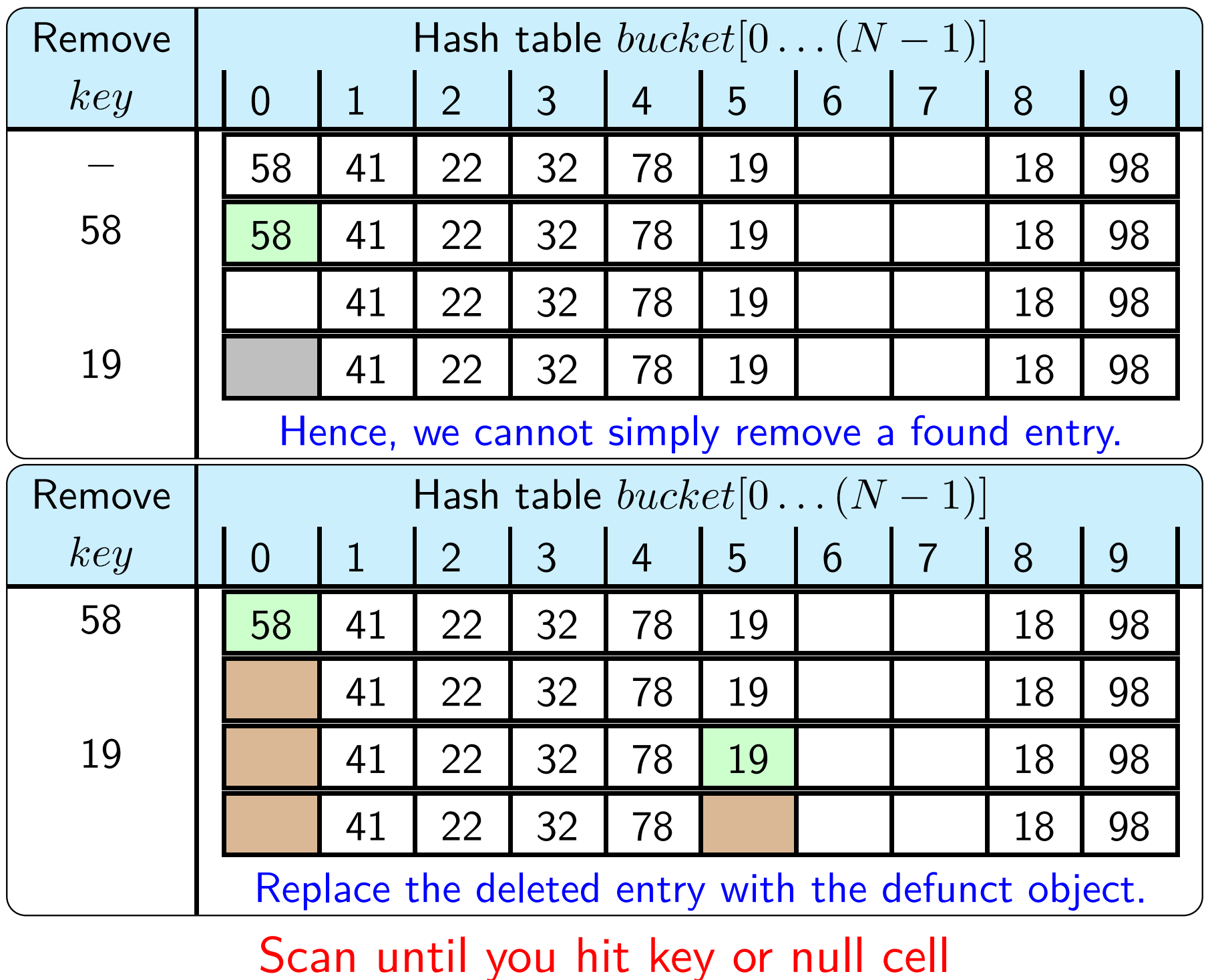
Open addressing $\rightarrow$ Linear probing $\rightarrow$ Remove
Suppose HashCode($key$) $= key$ and $N = 10$.
Open addressing $\rightarrow$ Linear probing
\begin{algorithm}
\begin{algorithmic}
\STATE \textbf{class} \textsc{HashTable-OpenAddressing-LinearProbing}$()$
    \STATE $capacity$ \COMMENT{}
    \STATE $size$
    \STATE MAXLOADFACTOR $= 0.5$
    \STATE Create arrays $bucketkey[0 \ldots capacity-1]$, $bucketvalue[0 \ldots capacity-1]$.
    \STATE
    \STATE Methods:
    \STATE \textsc{HashCode}$(key)$
    \STATE \textsc{Hash}$(key)$
    \STATE \textsc{Print}$()$
    \STATE \textsc{Get}$(key)$
    \STATE \textsc{Put}$(\langle key, value \rangle)$
    \STATE \textsc{Remove}$(key)$
    \STATE \textsc{Resize}$()$
\end{algorithmic}
\end{algorithm}
\begin{algorithm}
\begin{algorithmic}
\FUNCTION{Print}{}
    \FOR{$i \gets 0$ \TO $capacity - 1$}
        \STATE \textbf{print} ``Bucket $i$:''
        \IF{$bucketkey[i] = null$}
            \STATE \textbf{print} ``NULL''
        \ELSIF{$bucketkey[i] = \texttt{DEFUNCT}$}
            \STATE \textbf{print} ``DEFUNCT''
        \ELSE
            \STATE \textbf{print} $\langle bucketkey[i], bucketvalue[i] \rangle$
        \ENDIF
    \ENDFOR
\ENDFUNCTION
\end{algorithmic}
\end{algorithm}
\begin{algorithm}
\begin{algorithmic}
\FUNCTION{Get}{$key$}
    \STATE $index \gets \text{HashCode}(key)$
    \WHILE{$bucketkey[index] \neq null$}
        \IF{$bucketkey[index] \neq \texttt{DEFUNCT}$ \AND $bucketkey[index] = key$}
            \RETURN $bucketvalue[index]$
        \ENDIF
        \STATE $index \gets (index + 1) \bmod capacity$
    \ENDWHILE
    \RETURN $null$ \COMMENT{key not found}
\ENDFUNCTION
\end{algorithmic}
\end{algorithm}
\begin{algorithm}
\begin{algorithmic}
\FUNCTION{Put}{$\langle key, value \rangle$}
    \STATE $index \gets \text{HashCode}(key)$
    \WHILE{$bucketkey[index] \neq null$ \AND $bucketkey[index] \neq \texttt{DEFUNCT}$}
        \IF{$bucketkey[index] = key$}
            \STATE $bucketvalue[index] \gets value$
            \RETURN
        \ENDIF
        \STATE $index \gets (index + 1) \bmod capacity$
    \ENDWHILE
    \STATE $bucketkey[index] \gets key$; $bucketvalue[index] \gets value$
    \STATE $size \gets size + 1$
    \IF{$size / capacity > \texttt{MAXLOADFACTOR}$}
        \STATE \CALL{Resize}{}
    \ENDIF
\ENDFUNCTION
\end{algorithmic}
\end{algorithm}
\begin{algorithm}
\begin{algorithmic}
\FUNCTION{Remove}{$key$}
    \STATE $index \gets \text{HashCode}(key)$
    \WHILE{$bucketkey[index] \neq null$}
        \IF{$bucketkey[index] \neq \texttt{DEFUNCT}$ \AND $bucketkey[index] = key$}
            \STATE $bucketkey[index] \gets \texttt{DEFUNCT}$; $bucketvalue[index] \gets null$
            \STATE $size \gets size - 1$
            \RETURN true
        \ENDIF
        \STATE $index \gets (index + 1) \bmod capacity$
    \ENDWHILE
    \RETURN false
\ENDFUNCTION
\end{algorithmic}
\end{algorithm}
Load factor
Load factor $\displaystyle (\lambda) = \frac{n}{N} = \frac{\text{size}}{\text{capacity}} = \frac{\text{number of stored entries}}{\text{table capacity}}$
| Collision-handling scheme | Common policy |
|---|---|
| Separate chaining | If $\lambda > 0.75$, grow (doubling) and rehash If $\lambda < 0.25$, shrink (halving) and rehash If $\lambda > 1$, valid but chains become longer |
| Open addressing (linear probing) | If $\lambda > 0.5$, grow (doubling) and rehash If $\lambda < 0.2$, shrink (halving) and rehash If $\lambda > 1$, operations become impossible |
Applications
- Web page search using URLs
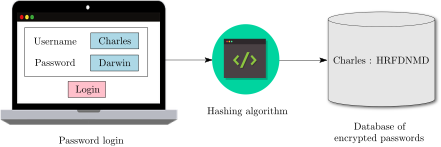
- Password verification
- Symbol tables in compilers
- Filename-filepath linking in operating systems
- Plagiarism detection using Rabin-Karp string matching algorithm
- English dictionary search
- Used as part of the following concepts:
- finding distinct elements
- counting frequencies of items
- finding duplicates
- message digests
- commitment
- Bloom filters
Sample application: Password authentication