Dynamic Programming
Contents
Introduction
What is dynamic programming (DP)?
- DP is an algorithm design technique
- DP can be better renamed as store-and-conquer
- DP finds optimal solutions to a problem by combining optimal solutions to its overlapping subproblems by saving solutions to subproblems in a table and never recomputing them
- DP is a table filling method where the value at each cell (solution to a subproblem) depends on the values at two or more other cells (solutions to overlapping subproblems)
Recurrence leads to recursive/DP algorithms
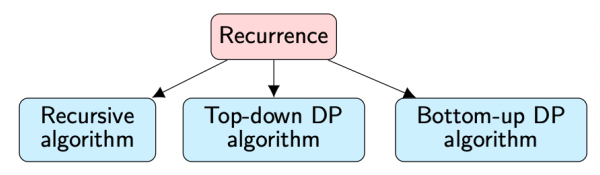
- Recurrence is the brain of dynamic programming.
- Once we have a recurrence, it is relatively easy to derive a recursive or top-down DP or bottom-up DP algorithm.
- Bottom-up DP is typically the fastest in practice.
| Feature | Recursive | Top-down DP | Bottom-up DP |
|---|---|---|---|
| Uses | Recursion | Memoization | Tabulation |
| Each subproblem computed | $\ge 1$ time | $\le 1$ time | $= 1$ time |
| Computation graph | Tree | DAG | DAG |
| Coding | Very easy | Easy | Okay |
| Complexity | Exponential | Polynomial | Polynomial |
Problem-Solving Template
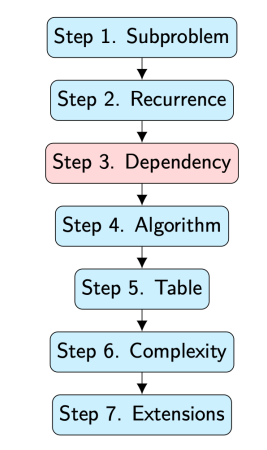
Problems and Solutions
Sanskrit Poetry
Problem
- short, denoted by $\square$, which takes $1$ beat
- long, denoted by $\sqsubset \sqsupset$, which takes $2$ beats
Given a natural number $n$, in how many ways can one create an $n$-beat poetry line consisting of short and long syllables?
The solution to this problem is the first known DP logic in literature. The recurrence is discovered by Pingala in the second half of 1st millenium BCE and published in the book ChandahSuthra. The book is on combinatorics and gives several recursive algorithms for computing power (or exponentiation), binomial coefficients, permutation generation, and converting binary to decimal.
Step 1. Subproblem
\[ \begin{align*} &S[i] = \text{Count ways to create an $i$-beats line using $\square$ and $\sqsubset \sqsupset$ such that}\\ &\qquad\qquad \text{$\square$ occupies the last position.}\\ &L[i] = \text{Count ways to create an $i$-beats line using $\square$ and $\sqsubset \sqsupset$ such that}\\ &\qquad\qquad \text{$\sqsubset \sqsupset$ occupies the last position.}\\ &\text{Compute $(S[n] + L[n]).$} \end{align*} \]Step 2. Recurrence
For all $i \in [1, n]$,
\[ \begin{aligned} &S[i] = \left. \begin{cases} 1 & \text{if } i \le 2,\\ S[i - 1] + L[i - 1] & \text{if } i > 2. \end{cases} \right\}\\ &L[i] = \left. \begin{cases} (i - 1) & \text{if } i \le 2,\\ S[i - 2] + L[i - 2] & \text{if } i > 2. \end{cases} \right\} \end{aligned} \]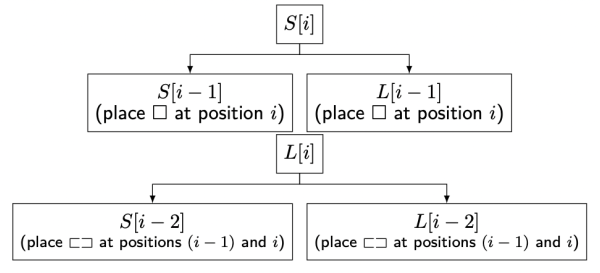
Step 3. Dependency
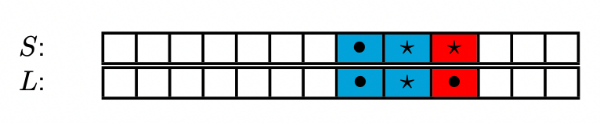
Step 4. Algorithm
\begin{algorithm}
\begin{algorithmic}

\FUNCTION{BottomUp}{$n$}

\STATE Create arrays $S[1 \ldots \max(2, n)]$ and $L[1 \ldots \max(2, n)]$

\STATE $S[1] \gets 1$; $S[2] \gets 1$
\STATE $L[1] \gets 0$; $L[2] \gets 1$

\FOR{$i \gets 3$ \TO $n$}
\STATE $S[i] \gets S[i - 1] + L[i - 1]$
\STATE $L[i] \gets S[i - 2] + L[i - 2]$
\ENDFOR

\RETURN $(S[n] + L[n])$

\ENDFUNCTION

\end{algorithmic}
\end{algorithm}
Step 5. Table
| $i$ | $1$ | $2$ | $3$ | $4$ | $5$ | $6$ | $7$ | $8$ | $9$ | $10$ | $11$ | $12$ | $13$ | $14$ | $15$ |
|---|---|---|---|---|---|---|---|---|---|---|---|---|---|---|---|
| $S[i]$ | $1$ | $1$ | $2$ | $3$ | $5$ | $8$ | $13$ | $21$ | $34$ | $55$ | $89$ | $144$ | $233$ | $377$ | $610$ |
| $L[i]$ | $0$ | $1$ | $1$ | $2$ | $3$ | $5$ | $8$ | $13$ | $21$ | $34$ | $55$ | $89$ | $144$ | $233$ | $377$ |
Step 6. Complexity
Time $\asymp n$. Space $\asymp n$.
Step 7. Extensions
\begin{algorithm}
\begin{algorithmic}

\FUNCTION{SpaceOptimized}{$n$} \COMMENT{Time $\asymp n$, Space $\asymp 1$}

\STATE $sprev \gets 0$; $scurr \gets 1$
\STATE $\ell prev \gets 1$; $\ell curr \gets 0$

\FOR{$i \gets 2$ \TO $n$}
\STATE $snext \gets scurr + \ell curr$
\STATE $\ell next \gets sprev + \ell prev$
\STATE $sprev \gets scurr$
\STATE $scurr \gets snext$
\STATE $\ell prev \gets \ell curr$
\STATE $\ell curr \gets \ell next$
\ENDFOR

\RETURN $(scurr + \ell curr)$

\ENDFUNCTION

\end{algorithmic}
\end{algorithm}
Better Solution
Step 1. Subproblem
\[ \begin{aligned} &C[i] = \text{Count ways to create an $i$-beats line using $\square$ and $\sqsubset \sqsupset$.}\\ &\text{Compute $C[n].$} \end{aligned} \]Step 2. Recurrence
For all $i \in [1, n]$,
\[ C[i] = \left. \begin{cases} i & \text{if } i \le 2,\\ C[i - 1] + C[i - 2] & \text{if } i > 2. \end{cases} \right\} \]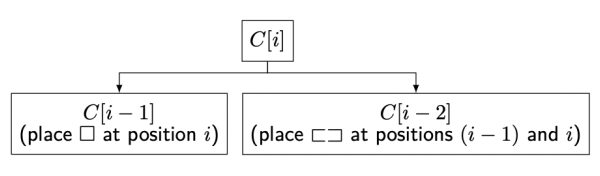
Step 3. Dependency

Step 4. Algorithm
\begin{algorithm}
\begin{algorithmic}

\FUNCTION{BottomUp}{$n$}

\STATE Create an array $C[1 \ldots \max(2, n)]$
\STATE $C[1] \gets 1$; $C[2] \gets 2$

\FOR{$i \gets 3$ \TO $n$}
\STATE $C[i] \gets C[i - 1] + C[i - 2]$
\ENDFOR

\RETURN $C[n]$

\ENDFUNCTION

\end{algorithmic}
\end{algorithm}
Step 5. Table
| $i$ | $1$ | $2$ | $3$ | $4$ | $5$ | $6$ | $7$ | $8$ | $9$ | $10$ | $11$ | $12$ | $13$ | $14$ | $15$ |
|---|---|---|---|---|---|---|---|---|---|---|---|---|---|---|---|
| $C[i]$ | $1$ | $2$ | $3$ | $5$ | $8$ | $13$ | $21$ | $34$ | $55$ | $89$ | $144$ | $233$ | $377$ | $610$ | $987$ |
Step 6. Complexity
Time $\asymp n$. Space $\asymp n$.
Step 7. Extensions
\begin{algorithm}
\begin{algorithmic}

\FUNCTION{SpaceOptimized}{$n$} \COMMENT{Time $\asymp n$, Space $\asymp 1$}

\STATE $prev \gets 1$; $curr \gets 1$

\FOR{$i \gets 2$ \TO $n$}
\STATE $next \gets curr + prev$
\STATE $prev \gets curr$
\STATE $curr \gets next$
\ENDFOR

\RETURN $curr$

\ENDFUNCTION

\end{algorithmic}
\end{algorithm}
Binomial Coefficient
Problem
Step 1. Subproblem
\[ \begin{aligned} &C[i][j] = {^i}C_j, \text{ where } 0 \le j \le i.\\ &\text{Compute $C[n][r]$.} \end{aligned} \]Step 2. Recurrence
For all $i \in [0, n]$, $j \in [0, n]$,
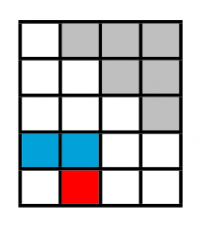
\[ C[i][j] = \left. \begin{cases} 0 & \text{if } j > i,\\ 1 & \text{if } j = 0 \text{ or } j = i,\\ C[i - 1][j - 1] + C[i - 1][j] & \text{if } j \in [1, (i-1)]. \end{cases} \right\} \]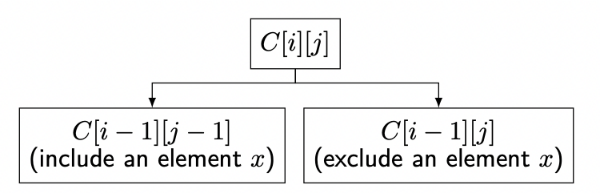
Step 3. Dependency
Step 4. Algorithm
\begin{algorithm}
\begin{algorithmic}

\FUNCTION{BottomUp}{$n, r$}

\STATE Create a $2$-D array $C[0 \ldots n][0 \ldots r]$
\STATE $C[0 \ldots n][0] \gets [1 \ldots 1]$

\FOR{$i \gets 1$ \TO $n$}
\FOR{$j \gets 1$ \TO $\min(i, r)$}
\STATE $C[i][j] \gets C[i - 1][j - 1] + (~ j < i ~?~ C[i - 1][j] ~:~ 0 ~)$
\ENDFOR
\ENDFOR

\RETURN $C[n][r]$

\ENDFUNCTION

\end{algorithmic}
\end{algorithm}
Step 5. Table
| $C[i][j]$ | $j=0$ | $j=1$ | $j=2$ | $j=3$ |
|---|---|---|---|---|
| $i=0$ | $1$ | $0$ | $0$ | $0$ |
| $i=1$ | $1$ | $1$ | $0$ | $0$ |
| $i=2$ | $1$ | $2$ | $1$ | $0$ |
| $i=3$ | $1$ | $3$ | $3$ | $1$ |
| $i=4$ | $1$ | $4$ | $6$ | $4$ |
Step 6. Complexity
Time $\asymp n \cdot \min(n, r)$. Space $\asymp n \cdot \min(n, r)$.
Step 7. Extensions
\begin{algorithm}
\begin{algorithmic}

\FUNCTION{SpaceOptimized}{$n, r$} \COMMENT{Time $\asymp n \cdot \min(n, r)$, Space $\asymp \min(n, r)$}

\STATE Create arrays $curr[0 \ldots r]$ and $next[0 \ldots r]$
\STATE $curr[0] \gets 1$; $next[0] \gets 1$

\FOR{$i \gets 1$ \TO $n$}
\FOR{$j \gets 1$ \TO $\min(i, r)$}
\STATE $next[j] \gets curr[j - 1] + (~ j < i ~?~ curr[j] ~:~ 0 ~)$
\ENDFOR
\STATE $\text{swap}(curr, next)$
\ENDFOR

\RETURN $curr[r]$

\ENDFUNCTION

\end{algorithmic}
\end{algorithm}
Longest Common Subsequence
Problem
Step 1. Subproblem
\[ \begin{aligned} &L[i][j] = \text{Length of the LCS between strings $x[1 \ldots i]$ and $y[1 \ldots j]$.}\\ &\text{Compute $L[m][n]$.} \end{aligned} \]Step 2. Recurrence
For all $i \in [0, m]$, $j \in [0, n]$,
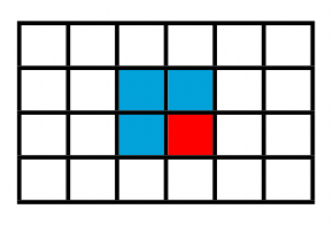
\[ L[i][j] = \left. \begin{cases} 0 & \text{if } i = 0 \text{ or } j = 0,\\ \left. \begin{cases} 1 + L[i-1][j-1] & \text{if } x[i] = y[j],\\ \max \left( \begin{array}{@{}l@{}} L[i][j-1],\\ L[i-1][j] \end{array} \right) & \text{if } x[i] \ne y[j]. \end{cases} \right\} & \text{if } i > 0, j > 0. \end{cases} \right\} \]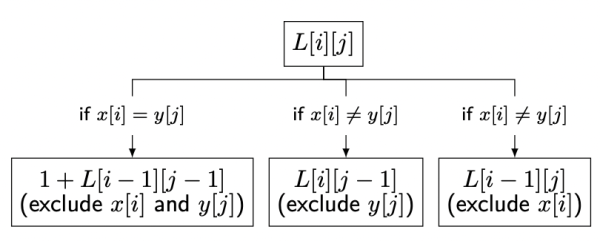
Step 3. Dependency
Step 4. Algorithm
\begin{algorithm}
\begin{algorithmic}

\FUNCTION{BottomUp}{$x[1 \ldots m], y[1 \ldots n]$}

\STATE Create a 2-D array $L[0 \ldots m][0 \ldots n]$
\STATE $L[0 \ldots m][0] \gets [0 \ldots 0]$; $L[0][1 \ldots n] \gets [0 \ldots 0]$

\FOR{$i \gets 1$ \TO $m$}
\FOR{$j \gets 1$ \TO $n$}
\IF{$x[i] = y[j]$}
\STATE $L[i][j] \gets 1 + L[i-1][j-1]$
\ELSE
\STATE $L[i][j] \gets \max(L[i-1][j], L[i][j-1])$
\ENDIF
\ENDFOR
\ENDFOR

\RETURN $L[m][n]$

\ENDFUNCTION

\end{algorithmic}
\end{algorithm}
Step 5. Table
| $L[i][j]$ | $0$ | $1~(y[1]=e)$ | $2~(y[2]=i)$ | $3~(y[3]=n)$ | $4~(y[4]=s)$ | $5~(y[5]=t)$ | $6~(y[6]=e)$ | $7~(y[7]=i)$ | $8~(y[8]=n)$ |
|---|---|---|---|---|---|---|---|---|---|
| $0$ | $0$ | $0$ | $0$ | $0$ | $0$ | $0$ | $0$ | $0$ | $0$ |
| $1~(x[1]=n)$ | $0$ | $0$ | $0$ | $1$ | $1$ | $1$ | $1$ | $1$ | $1$ |
| $2~(x[2]=e)$ | $0$ | $1$ | $1$ | $1$ | $1$ | $1$ | $2$ | $2$ | $2$ |
| $3~(x[3]=w)$ | $0$ | $1$ | $1$ | $1$ | $1$ | $1$ | $2$ | $2$ | $2$ |
| $4~(x[4]=t)$ | $0$ | $1$ | $1$ | $1$ | $1$ | $2$ | $2$ | $2$ | $2$ |
| $5~(x[5]=o)$ | $0$ | $1$ | $1$ | $1$ | $1$ | $2$ | $2$ | $2$ | $2$ |
| $6~(x[6]=n)$ | $0$ | $1$ | $1$ | $2$ | $2$ | $2$ | $2$ | $2$ | $3$ |
Step 6. Complexity
Time $\asymp mn$. Space $\asymp mn$.
Step 7. Extensions
\begin{algorithm}
\begin{algorithmic}

\FUNCTION{SpaceOptimized}{$x[1 \ldots m], y[1 \ldots n]$} \COMMENT{Time $\asymp mn$, Space $\asymp \min(m,n)$}

\IF{$m < n$}
\STATE $\text{swap}(x, y)$; $\text{swap}(m, n)$
\ENDIF

\STATE Create arrays $curr[0 \ldots n] \gets [0 \ldots 0]$, $next[0 \ldots n] \gets [0 \ldots 0]$

\FOR{$i \gets 1$ \TO $m$}
\FOR{$j \gets 1$ \TO $n$}
\IF{$x[i] = y[j]$}
\STATE $next[j] \gets 1 + curr[j-1]$
\ELSE
\STATE $next[j] \gets \max(curr[j], next[j-1])$
\ENDIF
\ENDFOR
\STATE $\text{swap}(curr, next)$
\ENDFOR

\RETURN $curr[n]$

\ENDFUNCTION

\end{algorithmic}
\end{algorithm}
\begin{algorithm}
\begin{algorithmic}

\FUNCTION{GetSolution}{$x[1 \ldots m], y[1 \ldots n]$} \COMMENT{Time $\asymp mn$, Space $\asymp mn$}

\STATE // Forward Phase
\STATE Construct $L[0 \ldots m][0 \ldots n]$ using code from BottomUp
\STATE // Backward Phase
\STATE Create an empty string $lcs[1 \ldots L[m][n]]$
\STATE $i \gets m$; $j \gets n$; $k \gets L[m][n]$

\WHILE{$k > 0$}
\IF{$x[i] = y[j]$}
\STATE $lcs[k] \gets x[i]$
\STATE $i \gets i-1$
\STATE $j \gets j-1$
\STATE $k \gets k-1$
\ELSIF{$L[i-1][j] > L[i][j-1]$}
\STATE $i \gets i-1$
\ELSE
\STATE $j \gets j-1$
\ENDIF
\ENDWHILE

\RETURN $\langle L[m][n], lcs[1 \ldots L[m][n]] \rangle$

\ENDFUNCTION

\end{algorithmic}
\end{algorithm}
Edit Distance
Problem
Example: minimum edits required to convert "newton" to "einstein" is $6$:
\[ \begin{aligned} &\text{newton} \xrightarrow{\text{ins}} \text{newtoin} \xrightarrow{\text{rep}} \text{newtein} \xrightarrow{\text{ins}} \text{newstein} \xrightarrow{\text{ins}} \text{newnstein} \xrightarrow{\text{rep}} \text{neinstein} \xrightarrow{\text{del}} \text{einstein} \end{aligned} \]Step 1. Subproblem
\[ \begin{aligned} &D[i][j] = \text{Least editing distance between strings $x[1 \ldots i]$ and $y[1 \ldots j]$.}\\ &\text{Compute $D[m][n]$.} \end{aligned} \]Step 2. Recurrence
For all $i \in [0, m]$, $j \in [0, n]$,
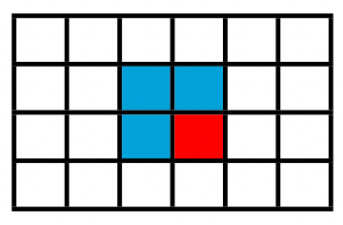
\[ D[i][j] = \left. \begin{cases} i & \text{if } j = 0,\\ j & \text{if } i = 0,\\ \left. \begin{cases} D[i-1][j-1] & \text{if } x[i] = y[j],\\ 1 + \min \left( \begin{array}{@{}l@{}} D[i-1][j],\\ D[i][j-1],\\ D[i-1][j-1] \end{array} \right) & \text{if } x[i] \ne y[j]. \end{cases} \right\} & \text{if } i > 0, j > 0. \end{cases} \right\} \]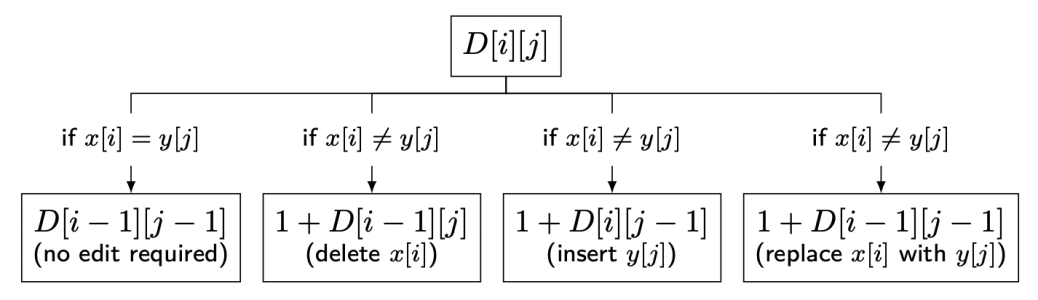
Step 3. Dependency
Step 4. Algorithm
\begin{algorithm}
\begin{algorithmic}

\FUNCTION{BottomUp}{$x[1 \ldots m], y[1 \ldots n]$}

\STATE Create a 2-D array $D[0 \ldots m][0 \ldots n]$
\STATE $D[0 \ldots m][0] \gets [0 \ldots m]$ \COMMENT{initialize $0$th column}
\STATE $D[0][1 \ldots n] \gets [1 \ldots n]$ \COMMENT{initialize $0$th row}

\FOR{$i \gets 1$ \TO $m$}
\FOR{$j \gets 1$ \TO $n$}
\IF{$x[i] = y[j]$}
\STATE $noedit \gets D[i-1][j-1]$
\STATE $D[i][j] \gets noedit$
\ELSE
\STATE $delete \gets D[i-1][j] + 1$
\STATE $insert \gets D[i][j-1] + 1$
\STATE $replace \gets D[i-1][j-1] + 1$
\STATE $D[i][j] \gets \min(delete, insert, replace)$
\ENDIF
\ENDFOR
\ENDFOR

\RETURN $D[m][n]$

\ENDFUNCTION

\end{algorithmic}
\end{algorithm}
Step 5. Table
| $D[i][j]$ | $0$ | $1~(y[1]=e)$ | $2~(y[2]=i)$ | $3~(y[3]=n)$ | $4~(y[4]=s)$ | $5~(y[5]=t)$ | $6~(y[6]=e)$ | $7~(y[7]=i)$ | $8~(y[8]=n)$ |
|---|---|---|---|---|---|---|---|---|---|
| $0$ | $0$ | $1$ | $2$ | $3$ | $4$ | $5$ | $6$ | $7$ | $8$ |
| $1~(x[1]=n)$ | $1$ | $1$ | $2$ | $2$ | $3$ | $4$ | $5$ | $6$ | $7$ |
| $2~(x[2]=e)$ | $2$ | $1$ | $2$ | $3$ | $3$ | $4$ | $4$ | $5$ | $6$ |
| $3~(x[3]=w)$ | $3$ | $2$ | $2$ | $3$ | $4$ | $4$ | $5$ | $5$ | $6$ |
| $4~(x[4]=t)$ | $4$ | $3$ | $3$ | $3$ | $4$ | $4$ | $5$ | $6$ | $6$ |
| $5~(x[5]=o)$ | $5$ | $4$ | $4$ | $4$ | $4$ | $5$ | $5$ | $6$ | $7$ |
| $6~(x[6]=n)$ | $6$ | $5$ | $5$ | $4$ | $5$ | $5$ | $6$ | $6$ | $6$ |
Step 6. Complexity
Time $\asymp mn$. Space $\asymp mn$.
Step 7. Extensions
\begin{algorithm}
\begin{algorithmic}

\FUNCTION{SpaceOptimized}{$x[1 \ldots m], y[1 \ldots n]$} \COMMENT{Time $\asymp mn$, Space $\asymp \min(m,n)$}

\IF{$m < n$}
\STATE $\text{swap}(x, y)$; $\text{swap}(m, n)$
\ENDIF

\STATE Create arrays $curr[0 \ldots n] \gets [0 \ldots 0]$, $next[0 \ldots n] \gets [0 \ldots 0]$

\FOR{$i \gets 1$ \TO $m$}
\FOR{$j \gets 1$ \TO $n$}
\IF{$x[i] = y[j]$}
\STATE $next[j] \gets 1 + curr[j-1]$
\ELSE
\STATE $next[j] \gets 1 + \max(curr[j], curr[j-1], next[j-1])$
\ENDIF
\ENDFOR
\STATE $\text{swap}(curr, next)$
\ENDFOR

\RETURN $curr[n]$

\ENDFUNCTION

\end{algorithmic}
\end{algorithm}
\begin{algorithm}
\begin{algorithmic}

\FUNCTION{GetSolution}{$x[1 \ldots m], y[1 \ldots n]$} \Comment {Time $\asymp mn$, Space $\asymp mn$}

\STATE // Forward Phase
\STATE Construct $D[0 \ldots m][0 \ldots n]$ using code from BottomUp
\STATE // Backward Phase
\STATE Create an array $edits[1 \ldots D[m][n]]$
\STATE $i \gets m$; $j \gets n$; $k \gets 1$

\WHILE{$i > 1$ \AND $j > 1$}
\IF{$x[i] = y[j]$}
\STATE $i \gets i-1$; $j \gets j-1$
\ELSIF{$D[i-1][j-1] < D[i-1][j]$ \AND $D[i-1][j-1] < D[i][j-1]$}
\STATE $edits[k] \gets$ ``Replace $x[i]$ with $y[j]$ at index $i$"
\STATE $i \gets i-1$; $j \gets j-1$; $k \gets k+1$
\ELSIF{$D[i-1][j] < D[i][j-1]$}
\STATE $edits[k] \gets$ ``Delete $x[i]$ at index $i$"
\STATE $i \gets i-1$; $k \gets k+1$
\ELSE
\STATE $edits[k] \gets$ ``Insert $y[j]$ after index $i$"
\STATE $j \gets j-1$; $k \gets k+1$
\ENDIF
\ENDWHILE
\WHILE{$i > 1$}
\STATE $edits[k] \gets$ ``Delete $x[i]$ at index $i$"
\STATE $i \gets i-1$; $k \gets k+1$
\ENDWHILE
\WHILE{$j > 1$}
\STATE $edits[k] \gets$ ``Insert $y[j]$ after index $i$"
\STATE $j \gets j-1$; $k \gets k+1$
\ENDWHILE
\RETURN $\langle D[m][n], edits \rangle$

\ENDFUNCTION

\end{algorithmic}
\end{algorithm}
Knapsack
Problem
Example: When $n = 5$, $w[1 \ldots 5] = [2,3,7,9,15]$, $v[1 \ldots 5] = [10,15,25,13,55]$, $W = 12$, then maximum total value $= 50$ for the solution set $\{1,2,3\}$.
Step 1. Subproblem
\[ \begin{aligned} &K[i][j] = \text{Max total value the knapsack can hold for the first $i$ items}\\ &\text{with capacity at most $j$, assuming an item is considered at most once.}\\ &\text{Compute $K[n][W]$.} \end{aligned} \]Step 2. Recurrence
For all $i \in [0, n]$, $j \in [0, W]$,
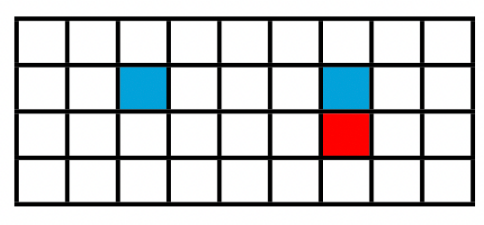
\[ K[i][j] = \left. \begin{cases} 0 & \text{if } i = 0 \text{ or } j = 0,\\ \max \left\{ \begin{array}{@{}l@{}} K[i-1][j],\\ (K[i-1][j-w[i]] + v[i]) \times [j \ge w[i]] \end{array} \right\} & \text{if } i > 0, j > 0. \end{cases} \right\} \]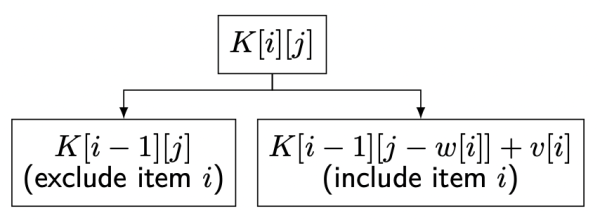
Step 3. Dependency
Step 4. Algorithm
\begin{algorithm}
\begin{algorithmic}

\FUNCTION{BottomUp}{$v[1 \ldots n], w[1 \ldots n], W$}

\STATE Create a 2-D array $K[0 \ldots n][0 \ldots W]$
\STATE $K[0 \ldots n][0] \gets [0 \ldots 0]$ \COMMENT{initialize $0$th column}
\STATE $K[0][1 \ldots W] \gets [0 \ldots 0]$ \COMMENT{initialize $0$th row}

\FOR{$i \gets 1$ \TO $n$}
\FOR{$j \gets 1$ \TO $W$}
\STATE $excludeitem \gets K[i-1][j]$
\STATE $includeitem \gets (~ j \ge w[i] ~?~ K[i-1][j-w[i]] + v[i] ~:~ 0 ~)$
\STATE $K[i][j] \gets \max(excludeitem, includeitem)$
\ENDFOR
\ENDFOR

\RETURN $K[n][W]$

\ENDFUNCTION

\end{algorithmic}
\end{algorithm}
Step 5. Table
$W = 12$
| $i$ | $v[i]$ | $w[i]$ |
|---|---|---|
| $0$ | $-$ | $-$ |
| $1$ | $10$ | $2$ |
| $2$ | $15$ | $3$ |
| $3$ | $25$ | $7$ |
| $K[i][j]$ | $j=0$ | $j=1$ | $j=2$ | $j=3$ | $j=4$ | $j=5$ | $j=6$ | $j=7$ | $j=8$ | $j=9$ | $j=10$ | $j=11$ | $j=12$ |
|---|---|---|---|---|---|---|---|---|---|---|---|---|---|
| $i=0$ | $0$ | $0$ | $0$ | $0$ | $0$ | $0$ | $0$ | $0$ | $0$ | $0$ | $0$ | $0$ | $0$ |
| $i=1$ | $0$ | $0$ | $10$ | $10$ | $10$ | $10$ | $10$ | $10$ | $10$ | $10$ | $10$ | $10$ | $10$ |
| $i=2$ | $0$ | $0$ | $10$ | $15$ | $15$ | $25$ | $25$ | $25$ | $25$ | $25$ | $25$ | $25$ | $25$ |
| $i=3$ | $0$ | $0$ | $10$ | $15$ | $15$ | $25$ | $25$ | $25$ | $25$ | $35$ | $40$ | $40$ | $50$ |
Step 6. Complexity
Time $\asymp nW$. Space $\asymp nW$.
Step 7. Extensions
\begin{algorithm}
\begin{algorithmic}

\FUNCTION{SpaceOptimized}{$v[1 \ldots n], w[1 \ldots n], W$} \COMMENT{Time $\asymp nW$, Space $\asymp W$}

\STATE Create arrays $curr[0 \ldots W]$ and $next[0 \ldots W]$
\STATE $curr[0] \gets 0$; $next[0] \gets 0$

\FOR{$i \gets 1$ \TO $n$}
\FOR{$j \gets 1$ \TO $W$}
\STATE $next[j] \gets \max(curr[j],\ (~ j \ge w[i] ~?~ curr[j-w[i]] + v[i] ~:~ 0 ~))$
\ENDFOR
\STATE $\text{swap}(curr, next)$
\ENDFOR

\RETURN $curr[W]$

\ENDFUNCTION

\end{algorithmic}
\end{algorithm}
\begin{algorithm}
\begin{algorithmic}

\FUNCTION{GetSolution}{$v[1 \ldots n], w[1 \ldots n], W$} \COMMENT{Time $\asymp nW$, Space $\asymp nW$}

\STATE // Forward Phase
\STATE Construct $K[0 \ldots n][0 \ldots W]$ using code from BottomUp
\STATE // Backward Phase
\STATE // $frequencies[i] = x[i] =$ count of item $i$

\STATE Create an array $frequencies[0 \ldots n] \gets [0 \ldots 0]$
\STATE $i \gets n$; $j \gets W$

\WHILE{$i > 0$ \AND $j > 0$}
\IF{$K[i][j] \neq K[i-1][j]$}
\STATE $frequencies[i] \gets frequencies[i] + 1$
\STATE $j \gets j - w[i]$
\ENDIF
\STATE $i \gets i-1$
\ENDWHILE

\RETURN $\langle K[n][W], frequencies[1 \ldots n] \rangle$

\ENDFUNCTION

\end{algorithmic}
\end{algorithm}
Matrix-Chain Multiplication
Problem
Step 1. Subproblem
\[ \begin{aligned} &M[i][j] = \text{Minimum \#multiplications needed to compute the}\\ &\qquad\qquad\qquad \text{matrix-chain product $a_i \times a_{i+1} \times \cdots \times a_j$, where,}\\ &\qquad\qquad\qquad \text{the size of matrix $a_i$ is $p[i-1] \times p[i]$.}\\ &\text{Compute $M[1][n]$.} \end{aligned} \]Step 2. Recurrence
For all $1 \le i \le j \le n$,
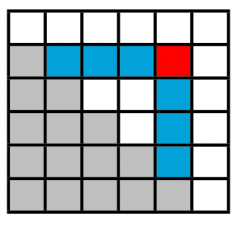
\[ M[i][j] = \left. \begin{cases} 0 & \text{if } i = j,\\ \min\limits_{k \in [i,\, j-1]} \left( \begin{array}{l} M[i][k] + M[k+1][j] + p[i-1] \times p[k] \times p[j] \end{array} \right) & \text{if } i < j. \end{cases} \right\} \]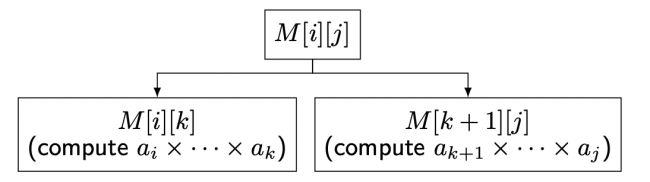
Step 3. Dependency
Step 4. Algorithm
\begin{algorithm}
\begin{algorithmic}

\FUNCTION{BottomUp}{$p[0 \ldots n]$}

\STATE Create a 2-D array $M[1 \ldots n][1 \ldots n]$

\FOR{$i \gets 1$ \TO $n$}
\STATE $M[i][i] \gets 0$
\ENDFOR

\FOR{$diagonal \gets 2$ \TO $n$}
\FOR{$i \gets 1$ \TO $(n - diagonal + 1)$}
\STATE $j \gets i + diagonal - 1$
\STATE $M[i][j] \gets \infty$
\FOR{$k \gets i$ \TO $j-1$}
\STATE $M[i][j] \gets \min(M[i][j],\ M[i][k] + M[k+1][j] + p[i-1] \times p[k] \times p[j])$
\ENDFOR
\ENDFOR
\ENDFOR

\RETURN $M[1][n]$

\ENDFUNCTION

\end{algorithmic}
\end{algorithm}
Step 5. Table
| $i$ | $0$ | $1$ | $2$ | $3$ | $4$ |
|---|---|---|---|---|---|
| $p[i]$ | $1$ | $2$ | $3$ | $4$ | $3$ |
| $M[i][j]$ | $j=1$ | $j=2$ | $j=3$ | $j=4$ |
|---|---|---|---|---|
| $i=1$ | $0$ | $6$ | $18$ | $30$ |
| $i=2$ | $-$ | $0$ | $24$ | $48$ |
| $i=3$ | $-$ | $-$ | $0$ | $36$ |
| $i=4$ | $-$ | $-$ | $-$ | $0$ |
Step 6. Complexity
Time $\asymp n^3$. Space $\asymp n^2$.
Step 7. Extensions
\begin{algorithm}
\begin{algorithmic}

\FUNCTION{GetSolution}{$p[0 \ldots n]$} \COMMENT{Time $\asymp n^3$, Space $\asymp n^2$}

\STATE // Forward phase

\STATE Create 2-D arrays $M[1 \ldots n][1 \ldots n]$ and $P[1 \ldots n][1 \ldots n]$

\FOR{$i \gets 1$ \TO $n$}
\STATE $M[i][i] \gets 0$
\ENDFOR

\FOR{$diagonal \gets 2$ \TO $n$}
\FOR{$i \gets 1$ \TO $(n - diagonal + 1)$}
\STATE $j \gets i + diagonal - 1$
\STATE $M[i][j] \gets \infty$
\FOR{$k \gets i$ \TO $(j-1)$}
\STATE $value \gets M[i][k] + M[k+1][j] + p[i-1] \times p[k] \times p[j]$
\IF{$M[i][j] > value$}
\STATE $M[i][j] \gets value$
\STATE $P[i][j] \gets k$
\ENDIF
\ENDFOR
\ENDFOR
\ENDFOR

\STATE // Backward phase

\STATE Create a dynamic array $R$
\STATE Create a stack $S$; $S.\text{Push}(\langle 1, n, 0 \rangle)$

\WHILE{stack $S$ is not empty}
\STATE $\langle i, j, state \rangle \gets S.\text{Pop}()$
\IF{$i = j$}
\STATE $R.\text{Add}(A_i)$
\ENDIF
\IF{$state = 0$}
\STATE $R.\text{Add}(\text{``("})$
\STATE $S.\text{Push}(\langle i, j, 1 \rangle)$
\STATE $S.\text{Push}(\langle i, P[i][j], 0 \rangle)$
\ELSIF{$state = 1$}
\STATE $S.\text{Push}(\langle i, j, 2 \rangle)$
\STATE $S.\text{Push}(\langle P[i][j]+1, j, 0 \rangle)$
\ELSE
\STATE $R.\text{Add}(\text{``)"})$
\ENDIF
\ENDWHILE

\RETURN $\langle M[1][n], R \rangle$

\ENDFUNCTION

\end{algorithmic}
\end{algorithm}